Executive summary
Employment law protects workers’ livelihood and employers’ right to manage. In India it is a mix of constitutional guarantees (Articles 14, 16, 19, 21, 23, 39, 41, 42, 43), central and state statutes, service rules, standing orders and judge-made law. This pillar guide covers hiring and contracts, wages, termination, industrial disputes, social security, factory and safety law and government service matters. It connects to detailed articles on labour law, Factories Act and Tamil Nadu Factory Rules and government service matters.
AskAdvocates Law Chamber appears for employees, employers, trade unions and public servants before labour courts, industrial tribunals, the Madras High Court, the Central Administrative Tribunal and the Supreme Court.
Statutory framework
| Subject |
Principal laws |
| Wages and bonus |
Code on Wages, 2019 (replacing Payment of Wages Act, Minimum Wages Act, Payment of Bonus Act, Equal Remuneration Act) |
| Industrial relations |
Industrial Relations Code, 2020 (replacing Industrial Disputes Act, 1947, Trade Unions Act, Industrial Employment (Standing Orders) Act) |
| Social security |
Code on Social Security, 2020 (EPF, ESI, gratuity, maternity benefit, employees’ compensation) |
| Safety and working conditions |
OSH Code, 2020; Factories Act, 1948 until repeal takes effect; Contract Labour Act |
| Women at work |
Maternity Benefit Act, 1961; POSH Act, 2013 |
| Equal pay and discrimination |
Constitution Articles 14-16; Equal Remuneration provisions; Rights of Persons with Disabilities Act, 2016 |
| Public service |
Service rules, Central Civil Services (CCA) Rules, Administrative Tribunals Act, 1985 |
| State laws |
Tamil Nadu Shops and Establishments Act, Tamil Nadu Factories Rules, Tamil Nadu Labour Welfare Fund Act |
The four Labour Codes consolidate twenty-nine central laws, and their implementation depends on notification and rules by central and state governments. Always confirm which statute applies on the relevant date, because older Acts continue until repealed in the relevant jurisdiction.
Employment contracts and standing orders
A written appointment letter should specify designation, duties, compensation, probation, notice, confidentiality, intellectual property, restrictive covenants and dispute resolution. Under standing orders (for industrial establishments), misconduct, discipline and termination procedures are defined. Contract and gig workers have specific protections under the Contract Labour (Regulation and Abolition) Act and, for platform and gig workers, state and central social security initiatives. Employers should avoid labelling regular employees as “contract” staff to evade obligations; courts look at the real relationship, including control and integration (Steel Authority of India v. National Union Waterfront Workers (2001) and later decisions).
Wages, working hours and leave
Minimum wages are fixed by the appropriate government by scheduled employment. Overtime, weekly rest, paid leave and festival holidays are governed by the Factories Act and shops and establishments laws. Bonus is payable to eligible employees under the Payment of Bonus Act (or Code on Wages) within the prescribed ceilings. Delayed wages may be recovered through authorities under the Wages Act and Code, with compensation. Employers must maintain registers and wage slips and issue them in accordance with law.
Termination, retrenchment and misconduct
Termination of workmen
Dismissal for misconduct requires a charge-sheet, domestic enquiry, reasonable opportunity, findings and punishment proportionate to the misconduct. Courts examine whether the enquiry was fair, whether findings were perverse, and whether punishment was shockingly disproportionate. Where the employer fails to hold an enquiry, it may justify the order in Labour Court evidence.
Retrenchment
Under the industrial relations framework, retrenchment requires notice (one month), compensation of fifteen days’ average pay per completed year of service, and notice to the government. Last-come-first-go and re-employment of retrenched workers are rules for fairness. Closures and lay-offs require specific procedures and compensation, with prior government permission for large establishments in some cases.
Reinstatement and back wages
The Labour Court may order reinstatement with full, partial or no back wages, depending on facts, including whether the employee was gainfully employed. Compensation in lieu of reinstatement may be ordered where reinstatement is inappropriate. Employers should document performance issues and follow due process.
Employees outside industrial law
Managerial and supervisory employees are governed by their contracts, and the remedy for wrongful termination is damages, not reinstatement, though public-sector and statutory bodies are subject to Articles 14 and 21 and writ review.
Industrial disputes and procedure
A dispute may be raised by an individual workman or union. The process: demand notice, conciliation, failure report, reference to the Labour Court or Industrial Tribunal, pleadings, evidence, award and publication. The award becomes enforceable after publication, and the High Court’s writ jurisdiction is limited to jurisdictional errors or perversity. Strikes and lock-outs are restricted in public utility services and require notice, and illegal strikes can lead to loss of wages and disciplinary action.
Social security and benefits
- Provident fund (EPF): employees and employers contribute, with the employer’s share partly to pension. Employers must remit contributions on time. Non-payment attracts damages and prosecution.
- ESI: medical, sickness, maternity and disablement benefits for covered employees.
- Gratuity: five years of service (waived on death or disablement) with the formula fifteen days’ wages multiplied by years of service divided by twenty-six for covered employees, subject to a ceiling.
- Maternity benefit: twenty-six weeks for the first two children, with crèche obligations for establishments with fifty or more employees.
- Employees’ compensation: compensation for accidents and occupational diseases arising out of and in the course of employment.
Factories, safety and contractors
Factories must register and obtain a licence, comply with limits on working hours, provide safety and welfare measures, and notify accidents and dangerous occurrences. The occupier has primary responsibility; managers and directors may share liability. In Tamil Nadu the Factories Rules prescribe detailed requirements for leave, ventilation, canteens and registers. Contractor workers must receive wages and benefits, with principal employers liable if contractors default. See our guide to the Factories Act and Tamil Nadu Factory Rules and the topic on industrial accidents.
Workplace harassment and discrimination
The POSH Act requires an Internal Committee in every workplace with ten or more employees, with timelines for complaint, inquiry and report, and a Local Committee for smaller workplaces. Following Vishaka v. State of Rajasthan (1997) and Medha Kotwal Lele v. Union of India (2013), employers must follow a prevention and redressal framework. Disability, caste and gender discrimination are addressed through constitutional remedies and statutes such as the Rights of Persons with Disabilities Act, 2016 and the SC/ST (Prevention of Atrocities) Act, 1989.
Government service matters
Public servants are governed by the Constitution (Articles 309 to 311), service rules and CCA rules. Key issues: appointment and seniority, promotion, transfer, pay fixation, pension, disciplinary action, suspension and compulsory retirement.
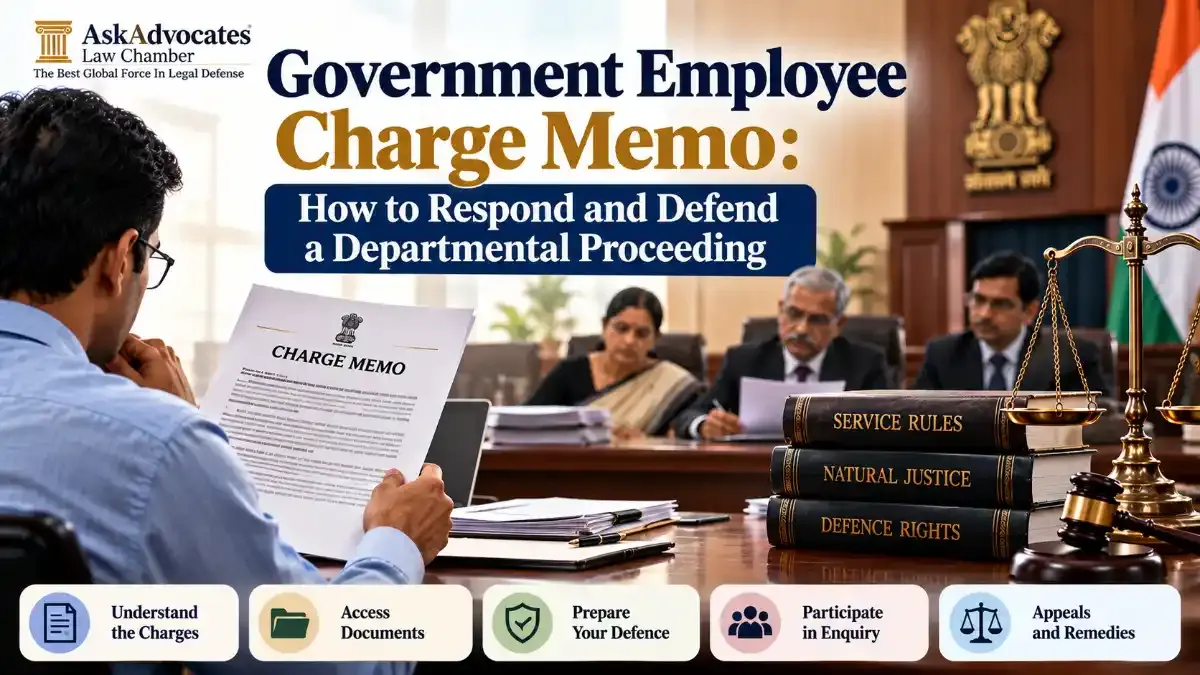
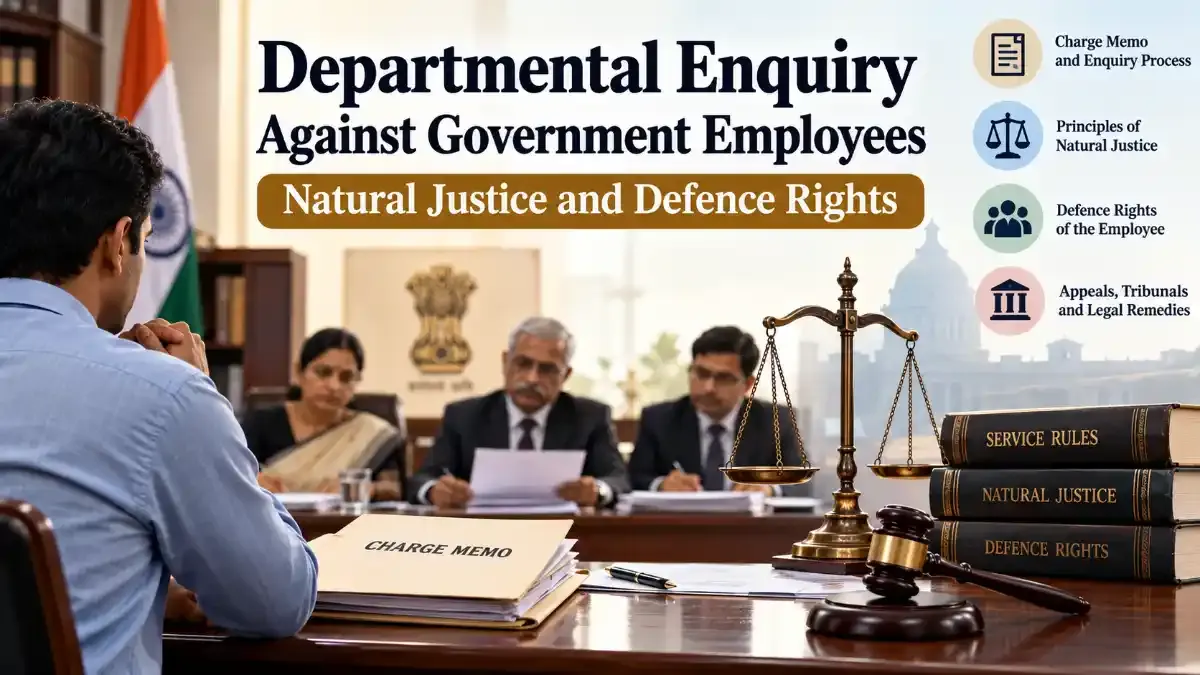
- Disciplinary proceedings: a charge memo with articles of charge and statement of imputations; the employee must receive documents, a fair inquiry and a copy of the inquiry report before punishment. Read our guide on government employee charge memo.
- Forums: Central Administrative Tribunal for central government employees, and writ petitions in the High Court for state government employees and others. See our articles on the Central Administrative Tribunal, government service matters and writ petitions in government service disputes.
- Limitation: an application to the CAT must be made within one year of the final order or six months after the representation remained undecided (Section 21, Administrative Tribunals Act, 1985).
Employer compliance calendar
| Frequency |
Examples |
| Monthly |
PF and ESI contributions, wages, TDS on salary |
| Quarterly |
Returns, professional tax, labour welfare contributions where applicable |
| Annually |
Annual returns, bonus, gratuity actuarial review, POSH annual report, factory licence renewal |
| Event-based |
Accident reports, retrenchment notices, standing orders certification |
Evidence employees should preserve
- Appointment letter, promotion letters, appraisal records
- Payslips, Form 16, PF and ESI statements
- Emails or messages showing assignments, complaints or warnings
- Charge-sheet, replies and inquiry records
- Termination order with proof of receipt date
- Proof of unemployment or attempts at re-employment, relevant to back wages
Practical tips
- Respond in writing to show-cause notices within time. Silence can be treated as admission.
- Do not sign resignation or settlement papers without understanding them.
- Raise the dispute promptly. Delay may reduce back wages.
- Employers: document performance, follow procedure and avoid mid-process shortcuts.
- Consider conciliation, which resolves many cases with negotiated compensation.
Scenario illustrations
Dismissal after a domestic enquiry. A worker accused of absenteeism is dismissed. The Labour Court examines whether the enquiry was fair, finds that the worker was not given the documents relied on, sets aside the dismissal and orders reinstatement with partial back wages.
Delayed gratuity. An employee retires after twelve years. The employer delays payment. A claim before the controlling authority yields gratuity with simple interest for the delay.
Charge memo to a government clerk. The employee requests documents, participates in the inquiry and challenges an unreasoned punishment order in the CAT, which sets it aside for non-supply of the inquiry report and remits for fresh consideration.
How we help
- Drafting employment contracts, policies, standing orders and settlement agreements
- Labour court, tribunal and High Court representation
- Defence of departmental inquiries and challenging punishment orders
- PF, ESI, gratuity and compensation claims
- Factory licensing, inspections and prosecution defence
- POSH compliance, committee training and inquiry advice
Browse our legal insights and labour and employment articles. See also the constitutional and administrative pillar.
Key takeaways
- Check which statute or code applies to your establishment and role.
- Fair procedure is the cornerstone of lawful termination and discipline.
- Time limits matter: raise disputes and approach tribunals promptly.
- Social security obligations are mandatory and enforceable.
- Public servants have additional constitutional protection and specialised forums.
This guide is general information under Indian law as at November 2026 and not legal advice.