Executive summary
Brands, content, software, inventions and data are now the most valuable assets of many businesses and individuals. Protecting them requires registration, contracts and quick enforcement. Cyber law adds a second layer: crimes online, platform responsibility and personal data. This pillar guide covers the law of trademarks, copyright, designs, patents, trade secrets, domain names, cyber crime, data protection and online speech, and how AskAdvocates Law Chamber helps.
Legal framework
| Subject |
Principal law |
Registration / duration |
| Trademarks and brands |
Trade Marks Act, 1999 |
Registered for 10 years, renewable indefinitely |
| Copyright |
Copyright Act, 1957 |
Automatic; life + 60 years for most works; registration optional |
| Designs |
Designs Act, 2000 |
10 years, extendable by 5 |
| Patents |
Patents Act, 1970 |
20 years from filing |
| Geographical indications |
GI of Goods Act, 1999 |
10 years, renewable |
| Trade secrets |
Contract law, equity, confidentiality |
No statute, protected by agreements and common law |
| Cyber offences and e-commerce |
Information Technology Act, 2000; BNS, 2023 |
Not applicable |
| Data protection |
Digital Personal Data Protection Act, 2023 |
Not applicable |
| Domain names |
Passing off; .IN Domain Name Dispute Resolution Policy (INDRP); UDRP |
Registration term |
Courts granting IP relief include District Courts, High Courts (commercial divisions) and the IP Division of the Madras High Court. Appeals from certain tribunal orders lie to the High Court following the abolition of the Intellectual Property Appellate Board by the Tribunals Reforms Act, 2021.
Trademarks
A trademark identifies the source of goods or services. Marks may be words, logos, slogans, shapes, colours and sounds. Registration gives the exclusive right to use the mark for the specified goods or services and to sue for infringement (Section 29). Unregistered marks are protected through the common-law action for passing off, which requires goodwill, misrepresentation and damage.
Steps and strategy
- Conduct a clearance search covering identical and phonetically or visually similar marks in related classes.
- File an application in the correct class(es) under the Nice Classification, including a user date if the mark is already in use.
- Respond to the examination report, defend any opposition, and obtain registration.
- Use the mark consistently; non-use for five years and three months can expose a mark to cancellation on the ground of non-use (Section 47).
- Renew every ten years, and record assignments and licences.
Likelihood of confusion is judged on similarity of marks and goods, the consumer’s imperfect recollection, and trade channels. Well-known marks receive enhanced protection (Section 11(2)). In Cadila Healthcare v. Cadila Pharmaceuticals (2001) the Supreme Court laid down factors for deceptive similarity in pharmaceutical cases, and in Toyota Jidosha v. Prius Auto Industries (2018) it clarified the territorial reach of transborder reputation. Read our article on trademark basics.
Copyright
Copyright protects original literary, dramatic, musical and artistic works, cinematograph films and sound recordings. The author is the first owner, except for works made in the course of employment or commissioned under specific conditions. Assignment and licence must be in writing and should specify the rights, territory, duration and royalty (Sections 18 and 19). Moral rights (Section 57) allow authors to claim authorship and object to distortion. Infringement includes copying, communication to the public and unauthorised adaptation, subject to fair dealing exceptions for private use, criticism, review and reporting (Section 52). In Eastern Book Company v. D.B. Modak (2008) the Supreme Court held that a minimal degree of creativity is needed for copyright in compilations. Software is protected as a literary work, and open-source licences are enforced as contracts. See our guide on copyrights and our article on entertainment law and the cinema industry.
Patents and designs
Patent protection is available for inventions that are novel, involve an inventive step and are capable of industrial application, excluding items in Sections 3 and 4 (for example, mere discoveries, methods of agriculture and, with conditions, computer programmes per se). Applicants file a provisional or complete specification, request examination within forty-eight months of priority, and respond to the First Examination Report. Compulsory licensing, Section 3(d) restrictions on pharmaceuticals (Novartis AG v. Union of India, 2013) and standard-essential patents are significant issues. Designs protect the new and original shape, configuration, pattern or ornamentation applied to an article, but not functionality, and registration is necessary.
Trade secrets and employee obligations
India has no standalone trade-secret statute, but confidential information is protected through contracts, equity and Section 27 of the Contract Act exceptions. Companies should use NDAs, access controls, clear IP assignment clauses in employment and consultancy agreements and exit protocols. Post-employment non-competes are generally unenforceable, but confidentiality and non-solicit of customers or trade secrets are enforceable to a reasonable extent.
Enforcement and remedies in IP disputes
- Cease and desist notice. Records the claim, demands compliance and may lead to settlement.
- Suit for infringement and passing off. Jurisdiction may be based on where the plaintiff resides or carries on business (Section 134 Trade Marks Act, Section 62 Copyright Act), which helps rights holders sue at home.
- Interim injunction, often decisive, requires a prima facie case, balance of convenience and irreparable harm, supported by evidence of use and reputation.
- Anton Piller orders and local commissioners to seize infringing goods and records, and John Doe orders against unknown infringers, plus dynamic injunctions against rogue websites.
- Damages, account of profits and costs. Courts have granted punitive and exemplary damages in blatant cases.
- Criminal remedies. Sections 103 and 104 of the Trade Marks Act, and Sections 63 to 65 of the Copyright Act, provide for imprisonment and fines, and police have power to seize goods.
- Customs recordal. Rights holders can record registered IP with Customs to stop imports of infringing goods.
- Domain disputes. File a complaint under the INDRP (.in) or UDRP (.com), or sue for passing off.
Cyber law: offences and remedies
The Information Technology Act, 2000 and the BNS cover offences such as:
| Offence |
Provision |
Notes |
| Hacking and unauthorised access |
IT Act s. 43, 66 |
Compensation and imprisonment |
| Identity theft and cheating by personation |
IT Act s. 66C, 66D |
Up to three years |
| Publishing obscene material |
IT Act s. 67, 67A, 67B |
Heavier punishment involving children |
| Cyber terrorism |
IT Act s. 66F |
Life imprisonment |
| Online cheating and financial fraud |
BNS s. 318, 319 |
Phishing, OTP and UPI frauds |
| Stalking, voyeurism, sexual harassment online |
BNS s. 77, 78 |
Women victims |
| Defamation |
BNS s. 356 |
Civil and criminal remedies |
Victims should immediately: preserve evidence (screenshots with URL and timestamp, bank messages, email headers); call 1930 and file at the National Cyber Crime Reporting Portal; inform the bank to freeze funds; and file an FIR at the cyber crime police station. Courts regularly order intermediaries to remove content: the Supreme Court in Shreya Singhal v. Union of India (2015) read down Section 79 intermediary liability to actual knowledge through court or government orders and struck down Section 66A. Under the Intermediary Guidelines and Digital Media Ethics Code Rules, 2021, platforms must act on grievances within prescribed timelines. Read our article on cyber crime law.
Online defamation, privacy and free speech
Speech online is protected by Article 19(1)(a), subject to reasonable restrictions including defamation. Civil suits for defamation can obtain interim injunctions against specific content, but courts are cautious about prior restraint, particularly for matters of public interest. The right to privacy is a fundamental right (Puttaswamy, 2017), supporting claims against unauthorised publication of intimate images and doxxing. Victims of non-consensual intimate images can seek urgent takedown and criminal action.
Data protection: DPDP Act, 2023
The Digital Personal Data Protection Act, 2023 regulates processing of digital personal data:
- Notice and consent: clear, itemised notice and free, specific, informed consent, with consent managers.
- Legitimate uses: specified purposes such as employment, legal compliance and emergencies.
- Data fiduciary duties: accuracy, security safeguards, breach notification to the Data Protection Board and affected persons, deletion on purpose fulfilment.
- Rights of data principals: access, correction, erasure, grievance redress and nomination.
- Children: verifiable parental consent and no tracking or targeted advertising.
- Significant data fiduciaries: extra duties including data protection officers and audits.
- Penalties: up to the schedule amounts (several hundred crore rupees) for serious failures.
Businesses should map data, update privacy notices, implement security controls, sign data processing agreements with vendors and train staff. Sector rules (RBI, IRDAI, SEBI, telecom) continue to apply.
Technology contracts and e-commerce
Software development, SaaS, cloud and licensing agreements should clearly address IP ownership, source code escrow, service levels, data protection, liability caps and indemnity. E-commerce entities must comply with the Consumer Protection (E-Commerce) Rules, 2020 and the Legal Metrology rules. Electronic signatures and records have legal validity under the IT Act, and electronic evidence needs a Section 63 certificate under the Bharatiya Sakshya Adhiniyam, 2023.
Film, music and sports rights involve complex chains of title: scripts, music, performers’ rights, distribution and broadcasting agreements, personality rights and sponsorships. Courts have granted injunctions to protect celebrity personality rights against misuse and deepfakes. Sports governance disputes are addressed under the National Sports Governance Act, 2025 and the courts. See our guides on sports law and entertainment contracts.
Evidence checklist for IP and cyber matters
- Proof of creation or first use: drafts, dated files, invoices, advertisements
- Registration certificates and renewals
- Samples, screenshots, URLs and archive captures of infringement
- Sales and reputation evidence: turnover, advertising spends, awards, press
- Communications with the infringer and notices
- For cyber crime: bank statements, IDs, email headers, device logs and the 1930 acknowledgment
Scenario illustrations
Look-alike brand. A Chennai food brand finds a competitor using a similar name and packaging. Counsel serves notice, files a passing off and infringement suit, obtains an interim injunction and a local commissioner to seize stock, and later settles with a rebranding undertaking.
Content theft. A photographer finds images used on e-commerce sites. Counsel sends takedown notices, files a copyright suit and claims damages with a licence fee computation.
UPI fraud. A victim reports fraud on 1930 within hours, enabling a bank freeze of part of the funds, and files an FIR; counsel follows up with the bank and cyber police to recover the balance.
How we help
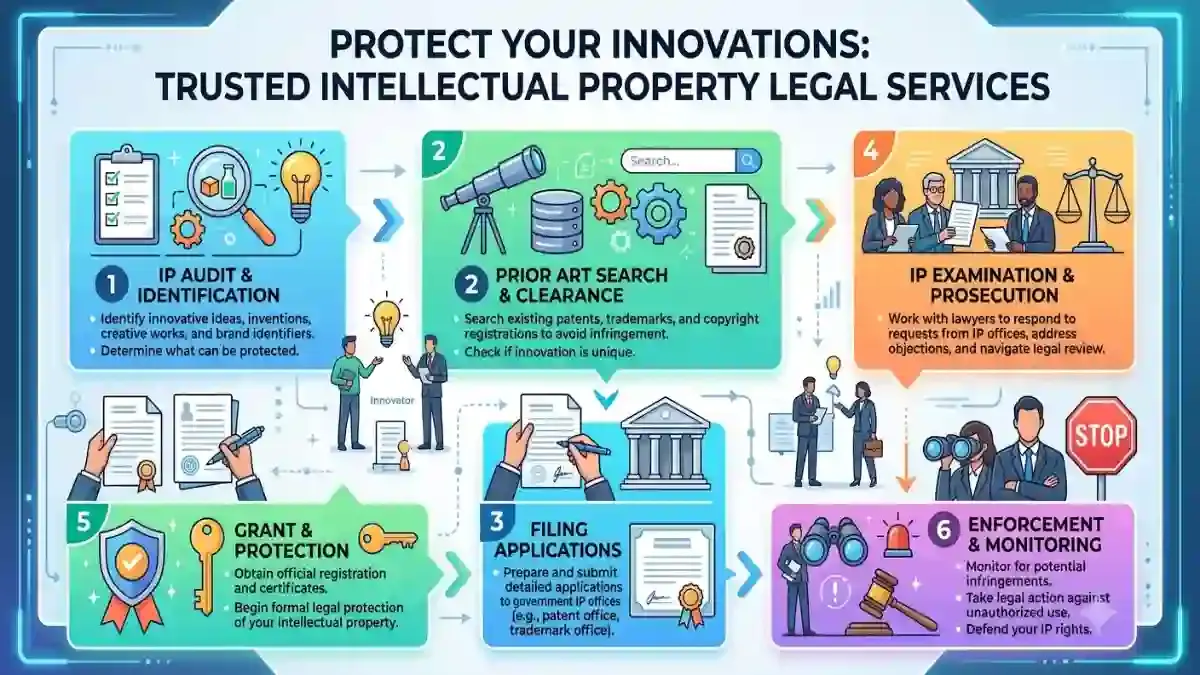
- Trademark clearance, filing, opposition and renewal
- Copyright registration, licensing and assignment agreements
- IP suits, injunctions, commissioners and customs recordal
- Domain and online brand protection
- Cyber crime complaints, FIRs, takedown and defamation actions
- DPDP compliance, privacy policies and data processing agreements
- Technology and media contracts
Browse our legal insights and the IP and cyber articles. For wider business law, see our corporate pillar.
Key takeaways
- Register marks, designs and key works early. Registration simplifies enforcement.
- Document creation and ownership in contracts with employees and vendors.
- Act fast against infringement: delay weakens injunction prospects.
- Report cyber fraud in the golden hour via 1930 and the portal.
- Data protection is a board-level compliance issue under the DPDP Act.
This guide is general information under Indian law as at November 2026 and not legal advice.