Corporate
Director Liability in India: When Can Directors Be Personally Sued or Prosecuted?
A company is a separate legal person. Its directors manage the company, but they do not ordinarily become personally liable for every debt,…
Read guide →
Company law, contracts, competition, regulatory compliance and commercial disputes.

Businesses succeed when legal structure, contracts and compliance are built into daily operations. This pillar guide explains the rules every promoter, director and manager should understand: choosing a structure, governance duties, contract drafting, competition and regulatory compliance, commercial disputes and the NCLT. It connects to detailed articles on company law, company registration and company legal advice.
AskAdvocates Law Chamber advises companies, LLPs, promoters, directors, investors and lenders, and appears before the NCLT, commercial courts, tribunals and High Courts.
| Structure | Liability | Compliance | Best for |
|---|---|---|---|
| Sole proprietorship | Unlimited | Minimal | Very small ventures |
| Partnership | Unlimited, joint | Low | Traditional family or professional firms |
| LLP (LLP Act, 2008) | Limited | Moderate: annual returns, statement of accounts | Professional services, small businesses |
| Private limited company | Limited | Higher: board, audit, ROC filings | Start-ups, investor-backed businesses |
| Public limited company | Limited | Highest, listing rules for listed entities | Large and listed companies |
| One Person Company | Limited | Moderate | Solo founders |
A private company needs at least two directors and shareholders (one for an OPC), and at least one director resident in India. Memorandum and Articles of Association govern internal affairs. Foreign investment follows FEMA rules and sectoral caps, with reporting through FC-GPR and other forms.
The Indian Contract Act, 1872 requires offer, acceptance, lawful consideration, free consent, competent parties and a lawful object. Key clauses in commercial contracts include definitions, scope, price and payment, delivery and acceptance, warranties, indemnity, limitation of liability, confidentiality, intellectual property, termination, force majeure, governing law and dispute resolution.
Liquidated damages are enforceable only to the extent of reasonable compensation (Section 74). Restraint of trade clauses are void to the extent they restrict lawful business after the contract ends (Section 27). Stamping is required, and unstamped agreements are inadmissible until stamped, as clarified by the Supreme Court’s seven-judge decision in In re: Interplay between Arbitration Agreements under the Arbitration Act and the Stamp Act (2023), which held that unstamped agreements are inadmissible but not void. For contract disputes see contractual disputes in technology partnerships.
A shareholders’ agreement allocates control and exit rights: board composition, reserved matters, pre-emption and tag-along rights, drag-along, anti-dilution, vesting of founder shares, and deadlock resolution. Clauses must be incorporated in the Articles of Association to bind the company. Share transfers involving non-residents must comply with FEMA pricing guidelines. Clear exit mechanics, such as put and call options, must also respect SEBI and RBI constraints.
The Competition Act, 2002 prohibits anti-competitive agreements (Section 3), abuse of dominant position (Section 4) and regulates mergers (Sections 5 and 6). Cartels and bid rigging attract heavy penalties. The 2023 amendment introduced a deal-value threshold, settlement and commitment mechanisms, and penalties on global turnover. Businesses should avoid price-fixing discussions with competitors, vertical restraints that foreclose markets, and unreviewed combinations. Our category on competition law and antitrust collects related articles.
| Area | Key law / regulator | Typical obligations |
|---|---|---|
| Corporate filings | Companies Act, MCA/ROC | AOC-4, MGT-7, DIR-3 KYC, changes of directors |
| Tax | Income-tax Act, GST laws | Returns, TDS, e-invoicing, assessments |
| Labour | Codes and state laws | Registers, PF, ESI, gratuity, POSH committee |
| Foreign exchange | FEMA, RBI | FDI reporting, ODI, ECB |
| Securities | SEBI Act, LODR | Disclosures, insider trading rules |
| Data and IT | IT Act, DPDP Act, 2023 | Consent, security safeguards, breach reporting |
| Consumer | Consumer Protection Act, 2019 | Product liability, e-commerce rules |
| Environment | Pollution control laws | Consents to operate, hazardous waste rules |
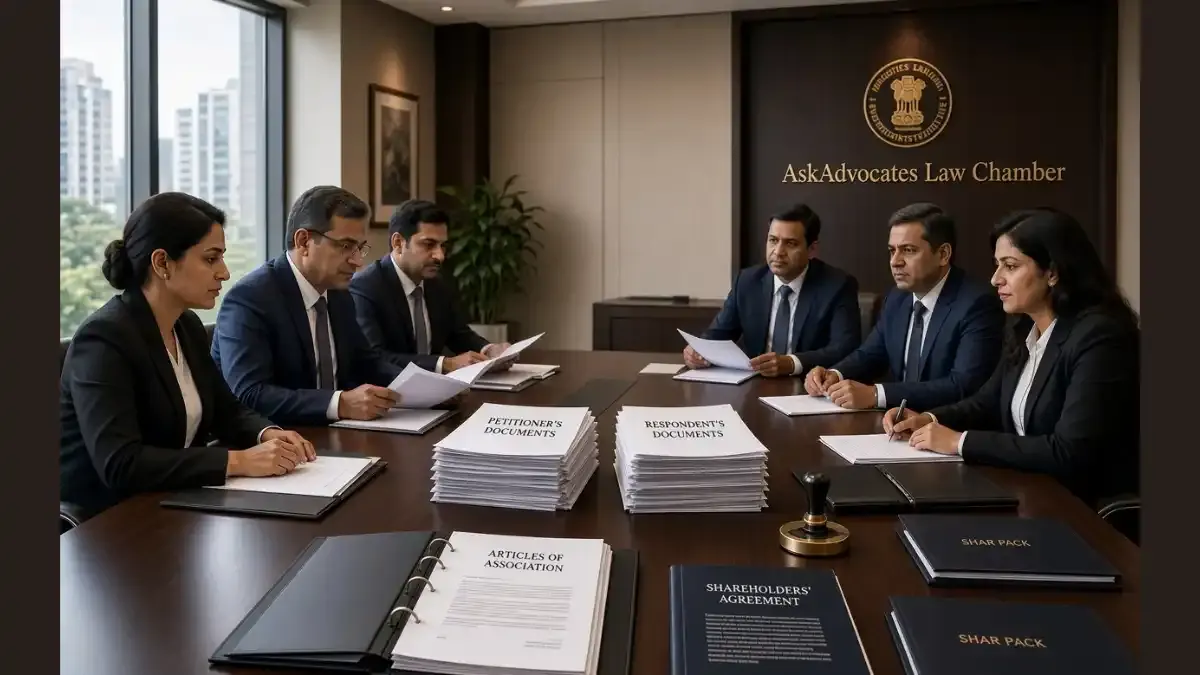
The National Company Law Tribunal handles oppression and mismanagement petitions (Sections 241 to 244), rectification of registers (Section 59), schemes of arrangement, mergers and demergers (Sections 230 to 232), revival of struck-off companies (Section 252) and insolvency under the IBC. Appeals lie to NCLAT and then the Supreme Court. Evidence is mostly documentary, and interim relief can be significant. A shareholder must have the qualifying holding (one-tenth of members or 100 members, whichever is less, in a company with share capital), unless the Tribunal waives it.
Transactions need due diligence on title, tax, litigation, contracts and employment, followed by valuation, approval of boards and shareholders, regulatory clearances (CCI, SEBI, RBI) and NCLT sanction for schemes. Fast-track mergers between small companies and holding-subsidiary companies are available under Section 233. Post-closing integration should address stamp duty, employees, contracts and licences. See also our category on corporate restructuring and mergers.
Directors may face personal liability for cheque dishonour (Section 141 NI Act for persons in charge), non-payment of statutory dues, environmental offences, fraud (Section 447 Companies Act) and failure to maintain compliance. Good practices include documented board approvals, D&O insurance, whistle-blower policies, internal audit and a compliance calendar. A director who has resigned must file Form DIR-11 and DIR-12 to avoid continuing exposure.
Founders’ deadlock. Two 50 percent shareholders disagree on strategy. The Articles lack a deadlock clause. Counsel negotiates a structured buy-out, using the NCLT oppression route as leverage and securing valuation by an independent valuer.
Supplier fails to deliver. A manufacturer sends a notice invoking the contract’s cure period, invokes arbitration, and applies for interim measures under Section 9 of the Arbitration Act to secure the advance payment.
Start-up raising seed funding. Counsel drafts a convertible instrument, ensures FEMA compliance for a foreign investor, aligns the Articles with the shareholders’ agreement, and files returns on allotment.
Every employer should maintain written appointment letters, confidentiality and invention-assignment terms, a code of conduct and a grievance process. Establishments with ten or more employees must constitute an Internal Committee under the Sexual Harassment of Women at Workplace (Prevention, Prohibition and Redressal) Act, 2013, file annual reports and train staff. Provident fund, ESI, gratuity (five years of continuous service), bonus and professional tax obligations depend on headcount and wage thresholds. Terminating employees requires a fair procedure, particularly for workmen under industrial law. See our labour and employment pillar for detailed rules.
Trademarks, copyrights, domain names, trade secrets and software licences are often a company’s most valuable assets. Register trademarks under the Trade Marks Act, 1999, assign copyright in work created by contractors in writing (Section 19 of the Copyright Act, 1957), and record IP ownership in founders’ and employee agreements. Under the Digital Personal Data Protection Act, 2023, companies that process personal data must obtain valid consent, adopt reasonable security safeguards, honour data principals’ rights and report breaches. Contracts with vendors and cloud providers should allocate data responsibilities. Read our IP and cyber law pillar.
When a company cannot pay its debts, creditors may invoke the Insolvency and Bankruptcy Code, 2016: operational creditors send a demand notice (Section 8), and creditors may file under Section 7, 9 or 10 with a default of at least Rs 1 crore. Once admitted, a moratorium begins and an interim resolution professional takes over management. The committee of creditors can approve a resolution plan, failing which liquidation follows. Directors should avoid fraudulent or wrongful trading and preferential transfers, which can be reversed. A solvent company may be wound up voluntarily or its name may be struck off under Section 248. See our banking and insolvency pillar and the article on IBC Section 8 demand notices.
A buyer or investor should review constitutional documents, statutory registers, board and shareholder resolutions, financial statements and tax assessments, material contracts and change-of-control clauses, litigation, regulatory licences, employment records, IP ownership and data protection compliance. Findings feed into price adjustments, warranties and indemnities, escrow and conditions precedent. Sellers should prepare a data room and clean up compliance defaults well before a transaction.
More guidance is in our legal insights and corporate and commercial articles.
This guide is general information under Indian law as at November 2026 and not legal advice.
A private limited company suits businesses seeking investment and limited liability, an LLP suits professional or low-capital ventures with flexible compliance, and a sole proprietorship or partnership suits small, low-risk operations. The choice depends on funding, liability, tax and compliance cost.
A company must hold a board meeting each quarter, an annual general meeting, file financial statements in Form AOC-4 and annual returns in Form MGT-7 with the Registrar of Companies, maintain statutory registers, appoint auditors and file income tax returns. Delays attract additional fees and penalties.
Sections 241 and 242 of the Companies Act, 2013 let members apply to the NCLT if the company's affairs are conducted in a manner prejudicial or oppressive to them or the public interest. The NCLT can regulate the affairs, remove directors or order buy-outs.
Post-termination non-compete restraints are generally void under Section 27 of the Indian Contract Act, 1872, though restrictions during the term of the contract and reasonable confidentiality and non-solicit obligations are enforceable.
Commercial disputes above the specified value go to commercial courts under the Commercial Courts Act, 2015, with mandatory pre-institution mediation unless urgent interim relief is sought. Many contracts instead use arbitration under the Arbitration and Conciliation Act, 1996.
The Competition Commission of India must approve combinations that cross the asset or turnover thresholds, or the deal value threshold introduced by the Competition (Amendment) Act, 2023, before the transaction closes (Section 6).
A company is a separate legal person. Its directors manage the company, but they do not ordinarily become personally liable for every debt,…
Read guide →Shareholder disputes in private companies can become significantly more complicated than ordinary commercial disagreements. A dispute may begin…
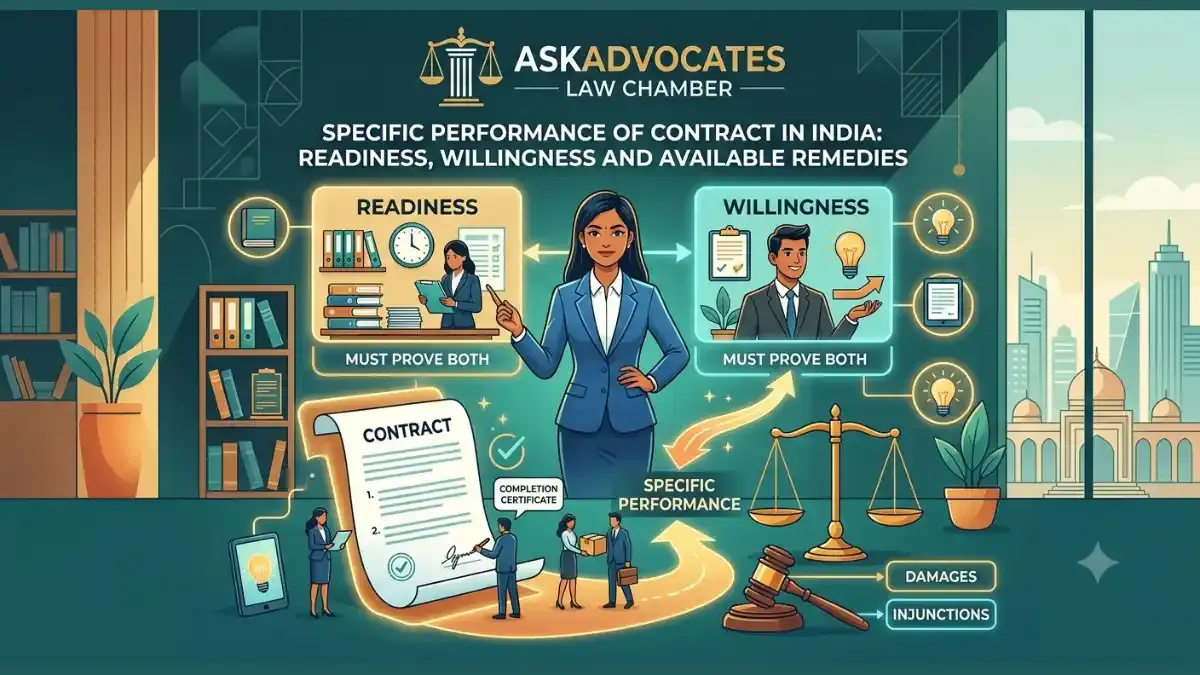
Read guide →Understand specific performance, readiness/willingness, Section 16(c), limitation, evidence, restrictions and remedies.
Read guide →Resolve Disputes Efficiently - Civil disputes affect individuals, families, businesses, startups, partnerships, companies, trusts, societies, and…
Read guide →Strategic Legal Counsel - Businesses operate within a complex legal environment. Therefore, strategic legal counsel becomes essential from…
Read guide →Comprehensive Corporate Legal Solutions - Entrepreneurs face complex legal obligations from incorporation through expansion. Businesses require…
Read guide →Navigating Corporate Law - Corporate law governs company formation, management, shareholder rights, and commercial regulatory obligations across…
Read guide →Expert Corporate Legal Services - AskAdvocates Law Chamber delivers strategic corporate legal services supporting startups, companies, NGOs, and…
Read guide →Ensuring Fair Treatment in Corporate Restructuring - Corporate restructuring reshapes businesses fundamentally. Consequently,…
Read guide →Businesses do not always move in a straight line. Sometimes, even strong companies face financial stress, operational setbacks, or unexpected…
Read guide →Rescuing Distressed Companies - Financially troubled companies face relentless legal, operational, and regulatory pressures daily. Ask Advocates…
Read guide →Rehabilitation Schemes Made Simple - Ask Advocates Law Chamber provides expert legal guidance on corporate rehabilitation and insolvency…
Read guide →In today’s complex corporate world, companies are expected to act responsibly, transparently, and in the best interests of their stakeholders.…
Read guide →In today’s fast-moving corporate world, shareholders often face serious challenges. Sometimes, company management may hide facts, misuse funds, or…
Read guide →In today’s global economy, cross-border transactions are no longer limited to large multinational companies. Individuals, startups, NRIs, and…
Read guide →Ensuring Ethical Business Practices - In today’s fast-changing business world, ethics matter more than ever. Companies are no longer judged only…
Read guide →In today’s global business environment, cross-border transactions have become a normal part of personal finance, business operations, and…
Read guide →In today’s fast-moving world, businesses face countless rules, policies, and legal standards. Whether it is taxation, environmental norms, labour…
Read guide →Regulatory Approvals and Filings - In today’s fast-changing business world, companies operate under strict regulatory frameworks. Every industry,…
Read guide →Top 5 Compliance Mistakes - Software Technology Parks of India (STPI) is a scheme designed to support IT and software export companies. It…
Read guide →Top 10 Legal Pitfalls in Commercial Transactions: Commercial transactions are the lifeblood of any thriving business. Indeed, they involve a…
Read guide →Understanding Non-STPI Registration Compliance: The Indian economy is rapidly expanding. Indeed, countless technology and IT-enabled services…
Read guide →Compliance Audits Made Simple: Corporate compliance is more than just a buzzword. It is a fundamental necessity. Businesses operate in a complex…
Read guide →Listed companies operate under intense scrutiny. They face a complex web of rules and regulations. These rules aim to ensure transparency and…
Read guide → Bar Council of India · Disclaimer
The Bar Council of India does not permit advertisement or solicitation by advocates in any form or manner (Rule 36, Bar Council of India Rules). By clicking “I Agree”, you acknowledge and confirm that:
If you do not agree, please do not use this website.
You have declined. You may close this window; no content will be shown until you agree.