
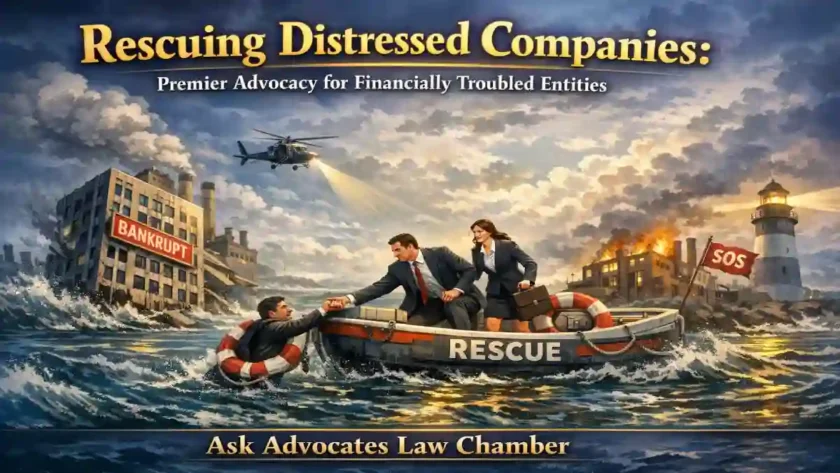
Rescuing Distressed Companies – Financially troubled companies face relentless legal, operational, and regulatory pressures daily. Ask Advocates Law Chamber provides expert advocacy for distressed entities across India. Our team combines insolvency law expertise with strategic litigation skills. Therefore, we deliver comprehensive rescue solutions for every client.
Rescuing Distressed Companies: Premier Advocacy for Financially Troubled Entities – Ask Advocates Law Chamber

Understanding Corporate Distress: Legal Framework and Strategic Rescue Options
What Is Corporate Financial Distress Under Indian Law?
Corporate financial distress occurs when a company cannot meet its financial obligations on time. The Insolvency and Bankruptcy Code, 2016 (IBC) primarily governs such situations in India. Additionally, the Companies Act, 2013 provides supplementary rescue mechanisms for troubled entities. Consequently, identifying distress early enables companies to access statutory protections proactively.
Financial distress manifests through several critical indicators that legal professionals monitor closely. Common signs include mounting unpaid debts, creditor harassment, dishonoured cheques, and winding-up threats. Furthermore, delayed wages, statutory non-compliance, and tax defaults signal deepening corporate trouble. Ask Advocates analyses these indicators to build immediate intervention strategies.
Key Legal Issues Faced by Financially Distressed Companies
Distressed companies encounter diverse legal challenges requiring specialised advocacy and timely intervention. These issues span civil, criminal, commercial, and regulatory domains simultaneously. Therefore, a multi-disciplinary legal approach becomes essential for effective corporate rescue. Ask Advocates addresses each challenge through targeted legal strategies.
The most critical legal issues distressed companies face include the following categories:
- Insolvency Proceedings: Corporate Insolvency Resolution Process (CIRP) under IBC Sections 7, 9, and 10.
- Debt Recovery: Claims filed before Debt Recovery Tribunals (DRT) under SARFAESI Act, 2002.
- Cheque Dishonour: Criminal complaints under Bharatiya Nyaya Sanhita (BNS), 2023 Section 316.
- Winding-Up Petitions: Filed before National Company Law Tribunal (NCLT) under Companies Act, 2013.
- Labour Disputes: Claims under Industrial Disputes Act, 1947 and Payment of Wages Act, 1936.
- Tax Demands: Contested before Income Tax Appellate Tribunal (ITAT) and GST Appellate Authority.
- Bank Fraud Allegations: Investigated by Enforcement Directorate (ED) and Serious Fraud Investigation Office (SFIO).
IBC 2016: The Primary Rescue Mechanism for Distressed Indian Companies
Corporate Insolvency Resolution Process: Step-by-Step Legal Pathway
The Corporate Insolvency Resolution Process offers a time-bound mechanism for rescuing financially distressed companies. Applications are filed before the National Company Law Tribunal under IBC Sections 7, 9, or 10. Subsequently, an Interim Resolution Professional (IRP) is appointed to manage the company’s affairs. Ask Advocates guides clients through every CIRP stage with precision.
The CIRP follows a structured 180-day timeline, extendable to 270 days by NCLT order. During this period, a moratorium under IBC Section 14 protects the company from all legal actions. Moreover, creditors submit claims, and the Committee of Creditors evaluates resolution plans systematically. This structured process prevents asset dissipation while enabling genuine business rescue.
Pre-Packaged Insolvency Resolution for MSMEs Under IBC
Pre-packaged insolvency, introduced through IBC Amendment 2021, specifically benefits Micro, Small, and Medium Enterprises. This mechanism allows promoters to submit a base resolution plan before initiating formal insolvency proceedings. Consequently, the process is faster, less disruptive, and more cost-effective than standard CIRP procedures. Ask Advocates specialises in structuring pre-pack applications for MSME clients in Tamil Nadu and beyond.
Pre-packaged insolvency eligibility requires satisfaction of specific conditions under IBC Section 54A. The company must be an MSME with default not exceeding ₹1 crore. Furthermore, three-fourths of financial creditors must approve the base plan before NCLT filing. This consent requirement ensures creditor confidence and accelerates resolution timelines significantly.
Voluntary Insolvency by Corporate Debtor Under Section 10
A corporate debtor may voluntarily initiate insolvency proceedings under IBC Section 10 when facing financial stress. This proactive approach demonstrates good faith and can yield more favourable resolution outcomes. Additionally, voluntary initiation allows the debtor to participate constructively in the resolution process. Ask Advocates advises clients on optimal timing for voluntary CIRP applications.
The board of directors must pass a special resolution to authorise Section 10 applications. Shareholders’ approval through a special resolution is equally mandatory before filing. Therefore, careful corporate governance compliance is essential before approaching the NCLT. Our team prepares all necessary resolutions, affidavits, and supporting documentation meticulously.
Moratorium Protection: Shielding Distressed Companies from Creditor Actions
Upon CIRP commencement, IBC Section 14 imposes an automatic moratorium protecting the corporate debtor immediately. Consequently, all suits, proceedings, and debt recovery actions against the company are legally suspended. Banks cannot enforce security interests or recover outstanding loan amounts during this period. This protection gives distressed companies critical breathing space for genuine business rescue.
The moratorium covers the following protections for distressed companies:
- Suspension of all pending civil suits and legal proceedings before courts and tribunals.
- Prohibition on transferring, encumbering, or disposing of any company assets.
- Bar on enforcing security interests by financial creditors and banks.
- Suspension of licence, permit, or registration cancellation by regulatory authorities.
- Protection from coercive recovery actions by tax and statutory authorities.
Resolution Plans: Drafting Winning Proposals for Committee of Creditors
A resolution plan must address all creditors’ claims while ensuring the company’s operational viability. The Committee of Creditors evaluates competing plans and approves the most commercially viable proposal. Accordingly, resolution applicants must demonstrate financial capacity and operational expertise convincingly. Ask Advocates crafts resolution plans that satisfy legal requirements and creditor expectations comprehensively.
Successful resolution plans must comply with IBC Section 30 requirements mandatorily. Plans must provide for operational creditors’ dues equivalent to liquidation value at minimum. Furthermore, resolution applicants must not be disqualified under IBC Section 29A provisions. Our legal team conducts rigorous eligibility checks and prepares compliant plans strategically.
Liquidation as Last Resort: Protecting Stakeholder Interests
Liquidation under IBC Chapter III occurs when CIRP fails to yield an approved resolution plan. The liquidator takes control and distributes assets according to the IBC Section 53 waterfall mechanism. Nevertheless, liquidation is viewed as a last resort under India’s insolvency framework. Ask Advocates fights vigorously to avoid liquidation through effective resolution planning.
The liquidation waterfall prioritises creditor repayment in the following order:
| Priority | Creditor Category | Legal Basis |
|---|---|---|
| 1st | Insolvency Resolution & Liquidation Costs | IBC Section 53(1)(a) |
| 2nd | Workmen Dues (24 months) & Secured Creditors | IBC Section 53(1)(b) |
| 3rd | Employee Salaries (12 months) | IBC Section 53(1)(c) |
| 4th | Unsecured Financial Creditors | IBC Section 53(1)(d) |
| 5th | Government Dues | IBC Section 53(1)(e) |
| 6th | Remaining Debts and Dues | IBC Section 53(1)(f) |
| 7th | Equity Shareholders | IBC Section 53(1)(g) |
NCLT Chennai: Primary Forum for Corporate Insolvency in Tamil Nadu
The National Company Law Tribunal, Chennai Bench, adjudicates all corporate insolvency matters in Tamil Nadu. It operates under IBC 2016 and Companies Act, 2013 with exclusive jurisdiction. Additionally, NCLT Chennai handles winding-up petitions, oppression and mismanagement cases, and scheme approvals. Ask Advocates regularly appears before NCLT Chennai for distressed company representation.
Key contact and jurisdictional details for NCLT Chennai are as follows:
- Location: NCLT Chennai Bench, Shastri Bhawan Annexe, 26, Haddows Road, Chennai – 600006.
- Jurisdiction: Tamil Nadu, Puducherry, Andaman & Nicobar Islands.
- Filing Mode: E-filing through NCLT portal for all IBC applications.
- Helpline: Available through Ministry of Corporate Affairs (MCA) portal support.
NCLAT: Appellate Forum for Challenging NCLT Orders
The National Company Law Appellate Tribunal (NCLAT) hears appeals against all NCLT orders under IBC. Appeals must be filed within 30 days of the NCLT order with prescribed fees. Moreover, NCLAT can grant stay orders against liquidation or resolution plan implementation pending appeals. Ask Advocates has successfully challenged adverse NCLT orders before NCLAT on behalf of distressed entities.
NCLAT jurisdiction extends to appeals from NCLT benches across India uniformly. The tribunal sits in New Delhi as its principal bench for all appellate matters. Furthermore, NCLAT decisions are appealable before the Supreme Court of India on questions of law. Our appellate team prepares comprehensive grounds of appeal and written submissions strategically.
Debt Recovery Tribunals: Contesting Bank Recovery Actions
Debt Recovery Tribunals (DRT) adjudicate recovery applications filed by banks and financial institutions. Banks file Original Applications (OA) under Recovery of Debts and Bankruptcy Act, 1993 before DRT. Additionally, distressed companies can file counter-claims and challenge bank actions through DRT proceedings. Ask Advocates defends companies against aggressive bank recovery at DRT Chennai.
SARFAESI Act, 2002 allows secured creditors to enforce security interests without court intervention. However, distressed companies can challenge SARFAESI actions before DRT under Section 17 applications. Therefore, timely DRT intervention prevents arbitrary asset seizure by banks and lenders. Our lawyers file urgent Section 17 applications to protect company assets effectively.
Consumer Forums and Labour Tribunals: Additional Relief Mechanisms
Distressed companies face complaints before Consumer Disputes Redressal Commissions from aggrieved customers. These complaints are filed under Consumer Protection Act, 2019 at district, state, and national levels. Consequently, companies need simultaneous representation across multiple adjudicatory forums. Ask Advocates coordinates multi-forum representation to protect distressed companies comprehensively.
Labour tribunals adjudicate employee disputes arising from retrenchment and non-payment of wages. Industrial Disputes Act, 1947 governs conciliation, arbitration, and adjudication of labour conflicts. Furthermore, distressed companies must comply with Payment of Gratuity Act, 1972 even during financial stress. Our labour law specialists negotiate favourable settlements protecting both company and employee interests.
Income Tax Appellate Tribunal: Contesting Tax Demands During Distress
Distressed companies frequently face aggressive tax demands from Income Tax and GST authorities simultaneously. The Income Tax Appellate Tribunal (ITAT) provides a specialised forum for challenging such demands. Moreover, companies can seek stay of demand pending appeal to prevent coercive recovery actions. Ask Advocates files urgent stay applications before ITAT Chennai to protect distressed companies.
GST disputes are contested before GST Appellate Authorities at the first appellate level. Further appeals lie before the GST Appellate Tribunal (GSTAT), constituted under CGST Act, 2017. Additionally, high courts exercise writ jurisdiction over arbitrary GST assessment orders and demands. Our tax litigation team handles multi-level GST disputes for distressed companies across jurisdictions.
SFIO and ED Investigations: Defending Directors of Distressed Companies
Serious Fraud Investigation Office (SFIO) investigates financial fraud in distressed and insolvent companies. Directors face criminal prosecution under Companies Act, 2013 Sections 212 and 447 upon SFIO findings. Furthermore, the Enforcement Directorate investigates money laundering allegations under PMLA, 2002 during company distress. Ask Advocates provides robust criminal defence for directors facing SFIO and ED investigations.
Bharatiya Nyaya Sanhita (BNS) 2023 replaces IPC for all criminal offences committed from December 2023. BNS Section 316 governs cheque dishonour offences previously covered under NI Act Section 138. Moreover, BNS Section 318 covers criminal breach of trust by company officers and directors. Our criminal defence team handles BNS cases before magistrate courts in Chennai and Tamil Nadu.
Police Stations and FIR Procedures for Corporate Financial Crimes
Corporate financial crimes are reported at jurisdictional police stations or specialised economic offence wings. Chennai’s Economic Offences Wing (EOW) investigates complex financial fraud cases involving distressed companies. Additionally, the Central Crime Branch (CCB) handles organised financial crime investigations in the city. Ask Advocates assists companies in filing and defending FIRs under BNSS, 2023 procedures.
Bharatiya Nagarik Suraksha Sanhita (BNSS) 2023 governs criminal procedure for all cases from December 2023. Zero FIRs can be filed at any police station regardless of territorial jurisdiction under BNSS. Furthermore, BNSS Section 173 mandates preliminary inquiry for offences punishable with seven or more years. Our criminal procedure specialists guide clients through FIR filing and bail application processes.
Bharatiya Sakshya Adhiniyam (BSA) 2023: Digital Evidence in Corporate Disputes
Bharatiya Sakshya Adhiniyam (BSA) 2023 replaces the Indian Evidence Act for all evidentiary matters. BSA recognises electronic records, digital signatures, and cloud-stored data as admissible primary evidence. Consequently, corporate disputes now heavily rely on digital evidence in all courts and tribunals. Ask Advocates leverages BSA provisions to build strong evidentiary cases for distressed companies.
Electronic records produced from company servers and cloud platforms carry high evidentiary value. BSA Section 57 governs admissibility of electronic records with appropriate certification requirements. Additionally, WhatsApp communications and email exchanges constitute admissible evidence in commercial disputes. Our evidence specialists ensure proper certification and presentation of digital evidence strategically.
Government Departments Involved in Corporate Distress Cases
Multiple government departments interact with distressed companies across regulatory and enforcement dimensions. Understanding each department’s role helps companies navigate compliance obligations effectively during financial stress. Moreover, proactive engagement with regulatory authorities often yields more favourable outcomes than adversarial approaches. Ask Advocates facilitates constructive dialogue between distressed companies and government departments.
| Department | Role in Distress Cases | Relevant Law |
|---|---|---|
| Ministry of Corporate Affairs (MCA) | Company registration, compliance, SFIO oversight | Companies Act, 2013 |
| Insolvency and Bankruptcy Board of India (IBBI) | Regulates IPs, RPAs, and oversight of CIRP | IBC, 2016 |
| Reserve Bank of India (RBI) | Bank NPA classification, stressed asset resolution | RBI Guidelines, SARFAESI |
| Enforcement Directorate (ED) | Money laundering investigation, PMLA proceedings | PMLA, 2002 |
| Income Tax Department | Tax demand, TDS default, asset attachment | Income Tax Act, 1961 |
| GST Council / CBIC | GST demand, input tax credit disputes | CGST Act, 2017 |
| EPFO / ESI Corporation | Provident fund and ESI default recovery | EPF Act, 1952; ESI Act, 1948 |
| Registrar of Companies (RoC) | Strike-off proceedings, director disqualification | Companies Act, 2013 |
Legal Remedies Available for Distressed Companies: A Comprehensive Overview
Distressed companies can access diverse legal remedies spanning statutory, equitable, and contractual dimensions. Choosing the right remedy at the right time determines the success of any corporate rescue strategy. Therefore, experienced legal counsel is indispensable for effective remedy selection and implementation. Ask Advocates maps available remedies to each client’s unique distress situation comprehensively.
The primary legal remedies available to financially distressed companies include:
- CIRP Initiation: Voluntary filing under IBC Section 10 for moratorium protection and resolution.
- Pre-Pack Insolvency: Faster rescue for eligible MSMEs under IBC Sections 54A to 54P.
- Scheme of Arrangement: Court-approved restructuring under Companies Act, 2013 Sections 230–232.
- One Time Settlement (OTS): Negotiated settlement with banks under RBI’s stressed asset guidelines.
- DRT Defence: Contesting bank recovery applications and SARFAESI actions before DRT.
- Writ Petitions: Challenging arbitrary government or regulatory orders before High Courts.
- Anticipatory Bail: Protection for directors facing criminal action under BNSS Section 484.
- Injunction Applications: Restraining coercive creditor actions under CPC Order 39 Rules 1 and 2.
- Arbitration: Commercial dispute resolution under Arbitration and Conciliation Act, 1996.
- Mediation: Cost-effective creditor-debtor settlements under Mediation Act, 2023.
Scheme of Arrangement: Court-Supervised Corporate Restructuring
A scheme of arrangement provides court-supervised restructuring without triggering formal insolvency proceedings. It is governed by Companies Act, 2013 Sections 230 to 232 and NCLT Rules, 2016. Additionally, schemes can involve mergers, demergers, debt restructuring, and capital reduction simultaneously. Ask Advocates drafts and presents scheme petitions before NCLT for financially troubled companies.
The scheme approval process involves meetings of shareholders and creditors convened by NCLT. A three-fourths majority approval from each class of creditors and shareholders is required. Furthermore, NCLT scrutinises the scheme for fairness and public interest before granting approval. Our corporate restructuring team handles the entire scheme approval process from drafting to implementation.
One Time Settlement with Banks: Negotiating Debt Relief
One Time Settlement (OTS) allows distressed companies to settle bank dues at a discounted amount. RBI’s June 2023 Prudential Framework for Resolution of Stressed Assets governs OTS negotiations. Consequently, successful OTS removes NPA classification and restores banking relationships for companies. Ask Advocates negotiates OTS agreements with banks, securing maximum debt relief for clients.
Effective OTS negotiation requires a well-prepared financial position paper and settlement offer. Banks evaluate OTS proposals based on the company’s current realisation value and future prospects. Additionally, the bank’s Board-approved OTS policy determines the minimum settlement thresholds. Our financial restructuring specialists prepare compelling OTS proposals that secure bank approval efficiently.
CPC Remedies: Civil Court Intervention for Distressed Companies
The Code of Civil Procedure, 1908 (CPC) provides essential interim remedies for distressed companies in civil courts. Temporary injunctions under CPC Order 39 prevent coercive actions pending trial effectively. Moreover, attachment before judgment under CPC Order 38 Rule 5 protects company assets proactively. Ask Advocates files urgent CPC applications in city civil courts and high courts across Tamil Nadu.
CPC provides the following remedies particularly relevant to distressed company situations:
- Order 39 Rules 1&2: Temporary injunction restraining asset disposal and coercive recovery.
- Order 38 Rule 5: Attachment before judgment protecting company assets from dissipation.
- Order 40: Court receiver appointment to manage contested company assets during disputes.
- Section 89: Referral to mediation, arbitration, or conciliation for commercial settlements.
- Order 21: Execution proceedings for enforcing favourable decrees against defaulting creditors.
Arbitration and Mediation: Alternative Dispute Resolution for Corporate Disputes
Arbitration under the Arbitration and Conciliation Act, 1996 offers confidential resolution for commercial disputes. Distressed companies benefit from arbitration’s speed, flexibility, and enforceability advantages over court litigation. Additionally, the Mediation Act, 2023 provides structured mediation for creditor-debtor disputes across India. Ask Advocates conducts arbitration and mediation for distressed companies seeking efficient commercial resolutions.
The Chennai International Arbitration Centre (CIAC) provides world-class arbitration facilities in Tamil Nadu. Institutional arbitration ensures procedural rigour and credibility in resolving high-value commercial disputes. Furthermore, mediated settlements are legally binding and enforceable as decrees under the Mediation Act, 2023. Our ADR specialists represent distressed companies in arbitration and mediation across all commercial disputes.
Director Disqualification Defence: Protecting Company Leadership
Directors of distressed companies face disqualification under Companies Act, 2013 Section 164 for various defaults. Additionally, IBC Section 29A disqualifies certain persons from submitting resolution plans in CIRP proceedings. Consequently, timely legal intervention protects directors from disqualification and its severe consequences. Ask Advocates successfully challenges disqualification orders before NCLT and High Courts across India.
Director disqualification triggers include non-filing of financial statements for three consecutive years. Non-payment of deposits, debenture redemption, and dividend defaults also attract disqualification. Furthermore, conviction for fraud-related offences automatically disqualifies individuals under Section 164(2). Our company law specialists file revival petitions and challenge disqualification orders strategically.
Intellectual Property Protection During Corporate Insolvency
Distressed companies must protect their intellectual property assets during insolvency proceedings proactively. Trademarks, patents, copyrights, and trade secrets represent significant intangible value in corporate rescue. Additionally, the moratorium under IBC Section 14 protects IP licences and assignments from cancellation. Ask Advocates ensures comprehensive IP protection for distressed companies throughout the rescue process.
Resolution plans must specifically address IP ownership, licencing, and transfer arrangements clearly. The resolution professional must identify, value, and preserve all IP assets during CIRP. Furthermore, IP infringement actions by or against the company continue despite the moratorium in certain cases. Our IP law specialists coordinate with insolvency professionals to protect valuable intangible assets effectively.
Environmental Compliance: Regulatory Issues for Distressed Manufacturing Companies
Distressed manufacturing companies face environmental compliance notices from Tamil Nadu Pollution Control Board (TNPCB). Non-compliance with Environment Protection Act, 1986 attracts criminal prosecution of company directors. Moreover, IBC moratorium does not protect companies from environmental enforcement actions. Ask Advocates provides specialised environmental compliance advice for distressed manufacturing entities.
Environmental liabilities are treated as operational creditor claims in CIRP proceedings under IBC. National Green Tribunal (NGT) adjudicates environmental disputes involving distressed industrial companies. Furthermore, consent to operate and environmental clearances must be maintained even during insolvency. Our environmental law team ensures regulatory compliance while pursuing corporate rescue simultaneously.
Why Choose Ask Advocates Law Chamber for Distressed Company Representation
Ask Advocates Law Chamber brings decades of combined expertise in corporate rescue and insolvency law. Our multidisciplinary team handles IBC, SARFAESI, DRT, NCLT, and criminal proceedings simultaneously. Consequently, clients receive integrated legal support covering every aspect of corporate distress management. We are committed to rescuing viable businesses while protecting the interests of all stakeholders.
Our firm’s key differentiators in distressed company representation include the following strengths:
- Pan-India Reach: Active representation before NCLT, NCLAT, DRT, ITAT, High Courts, and Supreme Court.
- Speed and Precision: Emergency filings and urgent injunctions secured within 24 hours when needed.
- Regulatory Navigation: Expert liaison with MCA, IBBI, RBI, ED, SFIO, and TNPCB authorities.
- Criminal Defence: Protecting directors under BNS, BNSS, PMLA, and Companies Act provisions.
- ADR Excellence: Skilled arbitrators and mediators achieving favourable settlements efficiently.
- Tamil Nadu Focus: Deep knowledge of local courts, DRT Chennai, NCLT Chennai, and EOW operations.
Frequently Asked Questions (FAQs)
FAQs on Rescuing Distressed Companies in India
1. What is the minimum default amount to file CIRP under IBC 2016?
The minimum default threshold for CIRP filing is ₹1 crore, revised by MCA in 2020. Below this, creditors must use DRT or civil courts for debt recovery effectively.
2. Can a distressed company stop a winding-up petition by filing CIRP?
Yes. Filing CIRP triggers moratorium under IBC Section 14, staying all winding-up petitions. NCLT transfers pending winding-up matters to IBC proceedings upon CIRP admission automatically.
3. What is the role of a Resolution Professional in CIRP?
The Resolution Professional manages the company’s affairs, invites resolution plans, and convenes the Committee of Creditors. IBBI-registered professionals are appointed by NCLT for this critical role.
4. Can directors be held personally liable for company debts during insolvency?
Directors can face personal liability for fraudulent or wrongful trading under IBC and Companies Act, 2013. SFIO investigations and ED proceedings may result in personal criminal liability for directors.
5. What is a Pre-Packaged Insolvency and who qualifies for it?
Pre-packaged insolvency is a faster IBC mechanism for MSMEs with defaults up to ₹1 crore. It requires prior creditor consent and allows promoters to retain management control during resolution.
6. How does the SARFAESI Act affect distressed companies with bank loans?
SARFAESI allows banks to seize secured assets without court orders upon NPA classification. Distressed companies can challenge such actions before DRT under Section 17 within 45 days.
7. What criminal laws apply to company directors of financially distressed entities under BNS 2023?
BNS 2023 Section 316 governs cheque dishonour; Section 318 covers criminal breach of trust by officers. Directors also face liability under PMLA 2002 and Companies Act 2013 Section 447.
8. Which court has jurisdiction over insolvency disputes in Tamil Nadu?
NCLT Chennai Bench has exclusive jurisdiction over IBC matters in Tamil Nadu and Puducherry. Appeals lie before NCLAT New Delhi and further to the Supreme Court on legal questions.
9. Can mediation resolve disputes between distressed companies and their creditors?
Yes. The Mediation Act, 2023 enables binding mediated settlements between distressed companies and creditors. Settlements are enforceable as court decrees, providing fast and cost-effective resolutions.
10. How can Ask Advocates Law Chamber help my distressed company immediately?
Ask Advocates provides immediate legal assessment, emergency injunctions, DRT defence, and CIRP filing. Contact us today for a confidential consultation on rescuing your financially troubled business.
Read More
- Rehabilitation Schemes Made Simple: Expert Legal Support for Corporate Recovery
- Advocating for Fair Debt Treatment: Premier Legal Counsel for Debentureholders
- Debentureholder Disputes: Trusted Legal Support for Bondholder Grievances
- Shareholder Derivative Claims: Premier Advocacy for Corporate Governance
- Class Action Support: Expert Legal Counsel for Shareholder Collective Actions
- Insolvency and Bankruptcy Board of India