
Practice Area: Cyber Law | Publication Day: Day 21 | Primary keyword: online defamation in India
Related Legal Guides
Online Defamation and Social Media Posts in India: Civil, Criminal and Constitutional Remedies addresses a defined search intent within Cyber Law. The article is deliberately narrower than the existing AskAdvocates material where overlap was identified. It explains the governing legal test, procedural sequence, evidence requirements and remedies while distinguishing general information from advice on a particular case.
Not Every Offensive Post Is Defamation
Online criticism, opinion, satire and allegations of fact must be distinguished. The legal analysis depends on the statement, context, reference to the claimant, publication and statutory exceptions. The first step is to preserve the exact content rather than react publicly. A lawyer should identify what was actually published, who published it and the objective sought before recommending civil or criminal action.
BNS Defamation Framework
The BNS contains the current criminal-law framework for defamation, subject to transitional issues. Older decisions can remain relevant for legal principles but should not be copied with outdated IPC references without checking the current statutory text. The statutory exceptions are equally important. Truth, public good, good-faith opinion and other recognised exceptions can materially affect the analysis.
Civil and Criminal Remedies
Civil proceedings may seek injunctions or damages, while criminal proceedings invoke the penal process. The remedies have different procedures and objectives. A claimant should decide whether the immediate objective is removal, restraint, correction, compensation, criminal accountability or a combination. The legal strategy should also account for the risk that litigation itself can amplify the disputed statement.
Evidence and Identity
Preserve screenshots, URLs, account information, date and time, comments and the surrounding publication. If the account is anonymous, a separate identity-disclosure strategy may be required. A username alone may not establish the publisher’s identity. Platform records and other evidence may become important. The claimant should preserve the original content before reporting it to the platform.
Free Speech and Public Interest
Article 19(1)(a) protects speech, while Article 19(2) recognises constitutionally permitted restrictions including defamation. Subramanian Swamy remains important to the constitutional discussion. Public figures and businesses may face criticism, but public interest does not automatically protect knowingly false factual allegations. Courts assess context and legal ingredients rather than simply whether the claimant disliked the statement.
Urgent Relief and Notice
A legal notice can request removal, correction, cessation or preservation of evidence. An injunction application should identify the precise statements and explain the continuing harm. Broad demands that prohibit all criticism may face constitutional and evidentiary difficulties. The strongest cases are precise about the publication, legal wrong and relief sought.
Evidence That Decides the Issue
Online defamation cases should begin with the exact words or content complained of. A claimant should preserve the original post, account identity, URL, date, comments, shares and surrounding context. The legal analysis then asks whether the statement is an imputation concerning a person, whether it was published, whether it is defamatory within the applicable law and whether an exception or defence applies. Calling a post “defamatory” without identifying the precise imputation weakens both a notice and a pleading because the defendant cannot be expected to answer an undefined complaint.
Forum and Remedy Strategy
The BNS contains the current criminal defamation framework in Section 356. The article should distinguish the substantive offence from the procedural route for prosecution and the classification of the offence. Older IPC authorities remain relevant for legal principles where appropriate, but the statutory reference must be updated for post-BNS proceedings. A criminal complaint should therefore identify the imputation, publication, accused person, relevant circumstances and statutory ingredients rather than simply attaching screenshots and asserting reputational harm.
Common Failure Points
A civil action may seek injunctions, damages or other relief depending on the facts. An urgent injunction application should identify the specific publication and explain why continued circulation creates legally cognisable harm. Courts must also balance reputational protection against legitimate speech. A prayer that effectively prohibits all future criticism is materially different from a narrowly framed request directed at a specific false factual imputation. Evidence of publication, reach, repetition and actual consequences can be relevant to interim and final relief.
When Specialist Legal Review Is Advisable
Defamation analysis cannot stop at whether a statement caused offence. The context may involve opinion, satire, criticism, fair comment, truth coupled with legally relevant public-good considerations, or one of the statutory exceptions. Article 19(1)(a) protects speech while Article 19(2) permits specified restrictions including defamation. The Supreme Court’s constitutional jurisprudence, including Subramanian Swamy, should be used carefully. The legal issue is whether the challenged publication falls within the offence or actionable wrong after considering its substance and applicable defence.
Current-Law and Statutory Accuracy
For online defamation, social-media publication and civil/criminal remedies, statutory accuracy requires the practitioner to identify the exact law, rule, notification and case-law proposition applicable on the date of the disputed event. Older terminology should be retained only when it describes a legacy proceeding or remains useful as a search term. Every material proposition should be traceable to the governing enactment, rule, judgment or official guidance.
Procedural and Forum Strategy
Forum selection in online defamation, social-media publication and civil/criminal remedies depends on the stage of the dispute, the relief required and the statutory allocation of jurisdiction. A technically available forum may still be strategically unsuitable if it cannot grant the needed relief or if an appeal is already prescribed. The reader should identify the present procedural stage before selecting a forum.
Evidence Architecture for the Case
The evidence architecture for online defamation, social-media publication and civil/criminal remedies should be built around the elements that must actually be proved. Organise primary documents first, then corroborating records and explanatory material. Each important proposition should have a document, witness or electronic record behind it. A chronology should expose contradictions and missing steps rather than merely repeat one party’s narrative.
Deadlines and Procedural Triggers
Timing is substantive in online defamation, social-media publication and civil/criminal remedies. Notice periods, limitation, response deadlines, statutory waiting periods and appeal windows can change the available remedy. Record the date of each operative document, calculate the next deadline from the governing provision and preserve proof of filing or service. Where the law changed during the relevant period, show which version governed each event.
Practical Decision Matrix
The immediate objective should determine the remedy: preserve evidence, seek correction, request removal, prevent repetition, recover damages, identify an anonymous publisher or pursue criminal process. A legal notice may be useful but does not itself determine liability. If the publisher is anonymous, identity-disclosure steps may become necessary. If the content is hosted by an intermediary, the case may involve additional statutory and procedural issues. A lawyer should therefore classify the target, content, remedy and urgency before choosing between civil, criminal and constitutional routes.
Advanced Practical Analysis
Root title and link documents
The root of title should be selected based on the nature of the property and the available historical records. Every subsequent transfer should be connected through registered instruments, succession documents, court orders or other legally valid sources. If a link document is missing, the opinion should not silently assume it existed. The lawyer should identify what can be obtained from registration records and what additional evidence is required to bridge the gap. This is particularly important in inherited or family-owned properties.
Seller capacity and authority
A perfect title chain can still be affected by a problem with the person selling the property. Verify identity, age/capacity where relevant, marital or succession issues, corporate authority, power of attorney and the authority of representatives. Where a property belongs to a company, trust, partnership or estate, the execution authority must be checked separately. The due-diligence report should therefore include a seller-capacity section rather than treating title and execution authority as the same question.
Family and succession risks
Inherited property may involve heirs, coparceners, partitions, release deeds, wills or competing succession claims. The lawyer should identify the death records, legal-heir or succession material, wills and subsequent transfers relevant to the chain. A registered sale by one heir does not automatically answer every competing claim. Where family rights are material, the title opinion should state the basis on which the seller is treated as having authority to transfer the property.
Survey and boundary identity
Property disputes frequently arise because the document description does not match the physical property. Compare survey number, subdivision, extent, four boundaries, sketch and current revenue records. Where necessary, obtain a survey or field verification. An encumbrance-free title to the wrong parcel is still a transaction risk. The final report should distinguish documentary identity from physical identity and identify any discrepancy before registration.
Litigation and attachment searches
Registration searches should be supplemented by reasonable litigation and attachment enquiries relevant to the property and owner. Search strategy should consider courts, tribunals, revenue proceedings, acquisition authorities and other public records where accessible. A pending case may not appear in an EC. The report should state the searches actually performed rather than promising an absolute absence of litigation. This qualification protects both the client and the professional opinion.
Development approvals
For land intended for construction, title is only one part of the risk. Verify layout approval, planning permissions, land-use classification, access, building permission and applicable local restrictions. For apartments or plotted developments, RERA registration and project documents may also matter. The buyer should know whether the property can legally be used for the intended purpose. The title report should therefore separate ownership risk from development and regulatory risk.
Mortgage and release documentation
A property may have been mortgaged and later released, but the release must be evidenced properly. Check mortgage deeds, deposit-of-title arrangements where relevant, release deeds, bank letters and registration records. A seller’s statement that a loan has been repaid is not a substitute for verifying the legal release. Where an existing loan will be discharged from sale proceeds, the transaction documents should clearly allocate responsibility and sequence payment with release.
Conditions precedent to registration
The final title opinion should conclude with conditions that must be satisfied before execution. These may include obtaining a missing certified copy, completing a release, resolving a survey discrepancy, obtaining succession documentation, clearing an attachment or confirming authority to execute. This approach is more useful than a binary “clear title” label because it tells the buyer what must happen before money and title are committed.
Platform evidence
Social-media evidence can change quickly through deletion, editing, account suspension or reposting. Preserve the publication early and record the URL, account identifier, timestamp and surrounding material. If a platform provides an export or archive, retain it. The evidentiary objective is to prove not only what was said but that the relevant account or person published it and that the content existed in the form alleged.
Reputation evidence
Where damages or serious commercial harm are claimed, evidence should be specific. Contracts lost, customer communications, cancellation records, professional complaints or measurable business impact can be relevant depending on the claim. General assertions that “my reputation was destroyed” are less persuasive than contemporaneous records showing a causal connection. The article should also caution that reputational harm does not eliminate the defendant’s possible legal defences.
Correction and settlement
Not every online reputation dispute requires immediate full litigation. A carefully framed correction request or settlement may achieve the practical objective faster. However, any settlement communication should be considered in light of evidence preservation and potential admissions. Where the content is repeated or the defendant refuses to correct a clearly identified false statement, formal proceedings may become more appropriate.
Preservation before takedown
Before requesting removal, preserve the content in a way that records its original context. If the post is deleted immediately, the claimant may lose evidence of publication, identity and wording. The record should include the URL, account details, date and time, screenshots, comments and any available archive or platform response. This is particularly important where an injunction or criminal complaint may follow. The practical sequence is therefore preserve first, then seek removal or correction, unless an immediate safety concern requires a different response.
Frequently Asked Questions
What is online defamation in India?
Online defamation involves publication of an allegedly reputation-harming imputation through digital or internet-based media. Civil and criminal consequences depend on the facts and applicable statutory requirements.
What section of BNS deals with defamation?
Section 356 of the Bharatiya Nyaya Sanhita, 2023 contains the current criminal defamation provision.
Can I sue someone for a defamatory social-media post?
Potentially. The appropriate civil or criminal remedy depends on the statement, publication, identity of the publisher, available defences and the relief required.
Should I screenshot the post before sending a legal notice?
Yes. Preserve the original URL, account information, date, time, comments and surrounding context in addition to screenshots.
Can a court order removal of an online defamatory post?
A court may grant appropriate injunctive relief where the legal requirements are satisfied. The order should be tailored to the specific publication and competing speech interests.
Does criticism amount to defamation?
No. Legitimate criticism, opinion and protected expression are not automatically defamatory. The exact words, context and applicable exceptions must be analysed.
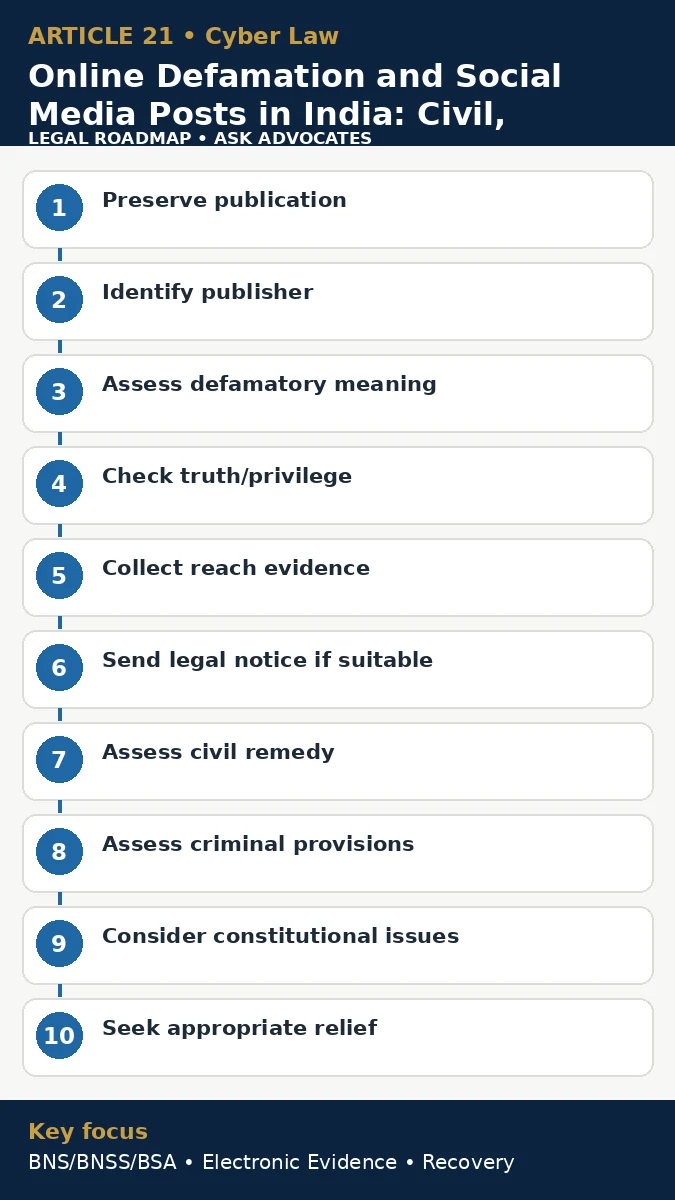
How To Proceed: 10-Step Roadmap
1. Preserve exact publication
Preserve the complete publication, URL, account identity, date, time, comments and surrounding context.
2. Identify publisher
Extract the precise factual imputation that is alleged to be defamatory rather than relying on a general description.
3. Analyse statement and context
Determine whether the statement is fact, opinion, satire, criticism or another form of expression.
4. Check statutory exceptions
Identify the publisher and assess whether the account identity requires further legal or technical steps to establish.
5. Preserve reach evidence
Analyse the applicable BNS criminal framework and any civil cause of action separately.
6. Consider notice
Check truth, public-good, fair-comment and other potentially relevant defences before issuing a demand.
7. Assess civil remedy
Assess whether urgent injunctive relief is required to prevent continued publication or repetition.
8. Assess criminal remedy
Prepare evidence of publication, reach and reputational or commercial consequences where relevant.
9. Seek urgent relief if justified
Choose civil, criminal or another lawful remedy based on the actual objective and forum.
10. Monitor further publication
Preserve all subsequent posts, deletions, responses and platform communications for the continuing record.
Key Statutes, Rules and Judicial Authorities
Current-law verification: Section 356 BNS is the current criminal defamation provision.
Statutes and Rules
BNS 2023 defamation provision and exceptions
Constitution Articles 19(1)(a) and 19(2)
CPC 1908
IT Act 2000 and intermediary framework where relevant
Judicial Authorities
Subramanian Swamy v. Union of India, (2016) 7 SCC 221
Shreya Singhal v. Union of India, (2015) 5 SCC 1
Khushwant Singh v. Maneka Gandhi, 2002 SCC OnLine Del 906