
Electronic Evidence in Cybercrime Cases: Screenshots, Chats, Emails and BSA 2023 addresses a defined search intent within Cyber Law. The article is deliberately narrower than the existing AskAdvocates material where overlap was identified. It explains the governing legal test, procedural sequence, evidence requirements and remedies while distinguishing general information from advice on a particular case.
Electronic Evidence in Cybercrime Litigation: Screenshots, Digital Chats, Emails and the Bharatiya Sakshya Adhiniyam, 2023
Electronic Evidence Is More Than a Screenshot
Digital records can include chats, emails, transaction logs, CCTV, social-media posts, device files and server data. The legal question is not merely whether a screenshot exists. The court may need to know where the record came from, whether it is authentic, how it was preserved and what fact it proves. The BSA 2023 now provides the principal evidence framework for proceedings governed by the new criminal-law regime.
Preserve the Original Source
Keep the original device and account where possible. Avoid deleting messages, resetting devices or reinstalling applications before relevant evidence is preserved. Record the date, time, account identifier and method of capture. If a platform permits an export, preserve that file as well as screenshots. The goal is to maintain a source record that can be explained later.
Chats and Emails
For chats, preserve the conversation context, participants, timestamps and source device. For emails, preserve the original message, headers where available and attachments. A printed copy can assist readability but may not establish the complete electronic source. The evidence plan should explain authorship, transmission and integrity. In corporate disputes, server logs and access records may be particularly useful.
Certification and Current Law
Older Supreme Court decisions such as Anvar P.V. and Arjun Panditrao are important for understanding electronic evidence, but section references must be updated for the BSA 2023. The applicable statutory route should be checked for the proceeding. A lawyer should not paste an old certificate formula into a new case without verifying the current law and transition provisions.
Chain of Custody
Record who collected a device or file, when, how it was stored, who examined it and what extraction method was used. Preserve the original and document every working copy. Hash values or forensic imaging may be appropriate in complex matters. Chain-of-custody records become especially important where authenticity or alteration is disputed.
Presenting and Challenging Digital Evidence
The exhibit should be tied to a specific fact. If authenticity is challenged, identify the source, supporting records and technical evidence. The opposing party should likewise test source, integrity, context and statutory compliance. A large electronic bundle without an evidence index is difficult to use. A concise exhibit table is usually more effective.
Evidence That Decides the Issue
A screenshot can be useful, but the court may need to know what system produced it, when it was captured, whether it is complete, and whether the source can be authenticated. The BSA 2023 contains the current statutory framework for electronic and digital records, including Sections 61–63. The practical objective is therefore to preserve the underlying source wherever possible and use screenshots as a readable representation rather than treating them as self-proving substitutes for the original digital context.
Forum and Remedy Strategy
For electronic records to be admitted through the statutory route, the requirements of Section 63 must be examined. The precise certificate and source particulars should be handled with care because the admissibility question can depend on how the electronic record was generated, stored and produced. A litigation team should identify the device, computer system, account, server or other source; preserve the relevant record; document extraction; and obtain the appropriate certification or technical material required by the current law.
Common Failure Points
WhatsApp conversations should be preserved with context, participants, dates and source-device information. Emails should be retained in original form where possible, including headers and attachments. CCTV requires attention to the recording system, retention period, export method and relevant time window. Social-media evidence should include the account URL, username, post, comments, timestamp and surrounding context. Treating every electronic record as if it were merely a screenshot can destroy information that later becomes important for authenticity or completeness.
When Specialist Legal Review Is Advisable
Chain of custody records who collected the device or file, when it was collected, how it was stored, who accessed it and what extraction or conversion was performed. Forensic imaging, hash values and controlled working copies may be appropriate in serious matters. The objective is to demonstrate that the record presented to court corresponds to the source and has not been materially altered. Even where formal forensic examination is unnecessary, disciplined preservation reduces challenges about manipulation, selective screenshots and missing context.
Current-Law and Statutory Accuracy
For electronic and digital evidence under the Bharatiya Sakshya Adhiniyam, 2023, statutory accuracy requires the practitioner to identify the exact law, rule, notification and case-law proposition applicable on the date of the disputed event. Older terminology should be retained only when it describes a legacy proceeding or remains useful as a search term. Every material proposition should be traceable to the governing enactment, rule, judgment or official guidance.
Procedural and Forum Strategy
Forum selection in electronic and digital evidence under the Bharatiya Sakshya Adhiniyam, 2023 depends on the stage of the dispute, the relief required and the statutory allocation of jurisdiction. A technically available forum may still be strategically unsuitable if it cannot grant the needed relief or if an appeal is already prescribed. The reader should identify the present procedural stage before selecting a forum.
Evidence Architecture for the Case
The evidence architecture for electronic and digital evidence under the Bharatiya Sakshya Adhiniyam, 2023 should be built around the elements that must actually be proved. Organise primary documents first, then corroborating records and explanatory material. Each important proposition should have a document, witness or electronic record behind it. A chronology should expose contradictions and missing steps rather than merely repeat one party’s narrative.
Deadlines and Procedural Triggers
Timing is substantive in electronic and digital evidence under the Bharatiya Sakshya Adhiniyam, 2023. Notice periods, limitation, response deadlines, statutory waiting periods and appeal windows can change the available remedy. Record the date of each operative document, calculate the next deadline from the governing provision and preserve proof of filing or service. Where the law changed during the relevant period, show which version governed each event.
Practical Decision Matrix
When relying on digital evidence, ask four questions: what fact does the record prove, where did the record originate, how was it preserved, and what statutory route establishes admissibility? When challenging the opponent’s evidence, ask the same questions from the opposite direction and test authenticity, completeness, source, metadata and certificate requirements. The answer may differ for a device image, cloud record, email, chat export or CCTV file. Evidence strategy should therefore be record-specific rather than based on a single generic electronic-evidence paragraph.
Advanced Practical Analysis
Publication and reference
The claimant should prove who published the material and how it was communicated to third parties. A private message and a public post may raise different factual issues. Preserve URLs, account names, comments, shares and timestamps. If the account is anonymous or impersonated, the strategy may require additional steps to identify the publisher. The article should distinguish the content itself from the evidence needed to connect the content to a person.
Imputation versus opinion
A statement expressing a subjective opinion is not automatically treated the same way as a factual allegation. Context matters. Words such as “I think” do not automatically immunise a statement if the publication conveys a specific false factual assertion, while harsh criticism does not automatically become defamatory merely because it is unpleasant. The legal analysis should examine the publication as a whole and identify the meaning that an ordinary reader would reasonably understand.
Business reputation
Companies and professionals can face online statements affecting customer confidence, contracts and commercial relationships. Evidence of specific commercial impact can become important in civil proceedings, particularly where damages are claimed. At the same time, businesses remain subject to legitimate criticism and public scrutiny. The article should therefore avoid presenting reputational harm as an automatic consequence of any negative review. The precise imputation, context and defence remain central.
Anonymous publishers
When a defamatory post is made anonymously, the first legal objective may be identification rather than immediate damages. The claimant should preserve the account and publication, identify the platform or intermediary involved and consider the lawful procedure required to obtain identifying information. The availability of such information depends on platform records, applicable law and the facts. A generic demand addressed only to an unknown username may not produce an effective remedy.
Notice strategy
A legal notice should identify the exact statement, date, URL or publication, legal objection and requested relief. It should avoid exaggerated claims such as demanding removal of every reference to the claimant. A focused notice can request preservation, correction, removal of a specified false statement, cessation of repetition or an appropriate response. The notice should also avoid making unnecessary admissions that could later be used in civil or criminal proceedings.
Criminal procedure
Criminal defamation is governed by the BNS substantive provision and the applicable criminal procedure. The complainant should ensure that the statutory route, jurisdiction and limitation or procedural requirements are understood before filing. The complaint should plead facts supporting the ingredients of the offence rather than relying on a general allegation that reputation was harmed. Procedural defects can delay a case even where the underlying publication is genuinely disputed.
Civil interim relief
An injunction application should be tailored to the publication. The claimant should explain the prima facie case, continuing harm and why the requested restraint is necessary and proportionate. Courts must also account for free speech. A narrow order addressing a specific false factual imputation is easier to justify than an order preventing a defendant from criticising the claimant generally. Evidence of repetition or imminent republication can materially affect urgency.
Defence planning
A defendant should preserve the original source of the challenged statement and supporting documents for truth, opinion, public interest or other applicable defences. Deleting the post after litigation begins may create evidentiary complications. The defence should distinguish what was actually stated from the claimant’s interpretation. It should also identify whether the publication was substantially accurate, opinion-based or protected by an exception under the applicable law.
Admissibility versus weight
An electronic record may be admitted yet receive limited weight if the source or context is weak. Conversely, a technically well-preserved record may still fail to prove the fact asserted if it does not identify the relevant person or event. The article should therefore teach readers to separate admissibility, authenticity, relevance and probative value. This distinction prevents overreliance on a certificate when the real problem is that the record does not establish the disputed fact.
Cloud and platform records
Records held by cloud providers, social-media platforms and service providers can be difficult to obtain after the event. Preserve account identifiers, URLs, timestamps and available export data immediately. Where formal production from the provider is required, the litigation team should identify the lawful process early. A screenshot saved months later may not preserve the same information that a provider could have supplied contemporaneously.
Forensic examination
Forensic examination is not necessary in every dispute, but it can be decisive where manipulation, deletion, malware or device attribution is contested. The examiner should receive the original or properly imaged source and document the methodology. The report should identify limitations and avoid conclusions beyond the data. The legal team should connect the technical finding to the statutory evidence requirements and the pleaded fact.
Frequently Asked Questions
Are WhatsApp screenshots admissible in court?
They may be relevant, but admissibility and evidentiary weight depend on the applicable BSA requirements, source, preservation and the statutory route for proving the electronic record.
What is Section 63 of the BSA?
Section 63 provides the statutory framework for the admissibility of electronic records through the conditions and certification mechanism specified by the current evidence law.
Should the original mobile phone be preserved?
Where the phone is a relevant source, preserving it without deleting or altering data can materially assist authenticity and later technical examination.
Is a printout of an email enough?
A printout may assist readability, but the legal proof of the electronic record must be considered under the BSA and the source, integrity and statutory requirements should be addressed.
What should a digital-evidence certificate contain?
The applicable statutory certificate should identify the electronic record and relevant system/source particulars in the manner required by Section 63. The exact requirements should be checked for the evidence and proceeding involved.
Can electronic evidence be challenged?
Yes. The opposing party can challenge source, authenticity, completeness, integrity, statutory compliance and the connection between the record and the fact alleged to be proved.
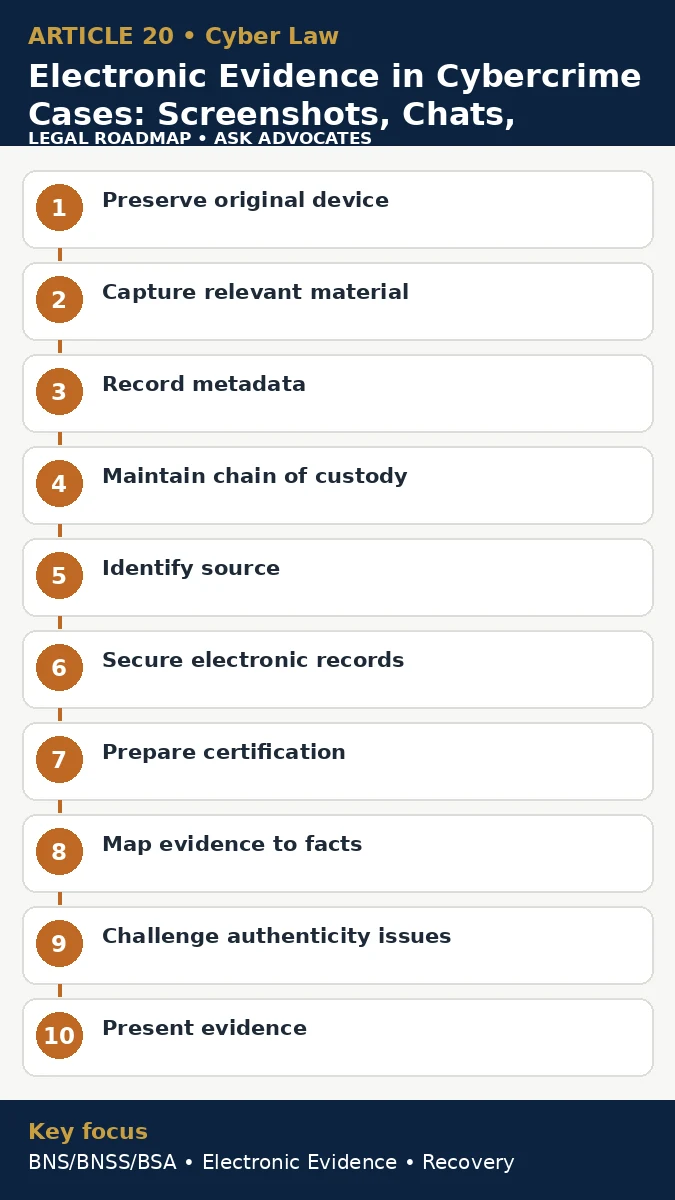
How To Proceed: 10-Step Roadmap
1. Preserve original device
Identify the precise fact the digital record is intended to prove before collecting a large volume of unrelated material.
2. Record source and context
Preserve the original device, account, storage location or source system wherever reasonably possible.
3. Export relevant records
Capture the relevant record with context, including participants, timestamps, URLs, headers or system identifiers as applicable.
4. Capture supporting screenshots
Keep the original file and create controlled working copies rather than repeatedly editing the source.
5. Maintain chain of custody
Record who collected the evidence, when it was collected and what method was used for extraction or export.
6. Preserve metadata
Assess whether forensic imaging, hash verification or technical examination is appropriate for the dispute.
7. Identify applicable BSA requirements
Identify the Section 63 requirements and arrange the necessary certificate or supporting material.
8. Prepare exhibit index
Map each exhibit to the specific fact, witness and pleading paragraph it is intended to support.
9. Address authenticity
Anticipate authenticity and completeness objections before filing the evidence in court.
10. Present or challenge evidence
Present the record with a clear chain of custody and an explanation of source, preservation and statutory compliance.
Key Statutes, Rules and Judicial Authorities
Current-law verification: BSA 2023 Sections 61–63 govern electronic/digital records; Section 63 must be addressed specifically when explaining certification and admissibility.
Statutes and Rules
Bharatiya Sakshya Adhiniyam 2023
BNSS 2023
Information Technology Act 2000 where applicable
Judicial Authorities
Anvar P.V. v. P.K. Basheer, (2014) 10 SCC 473, subject to BSA transition
Arjun Panditrao Khotkar v. Kailash Kushanrao Gorantyal, (2020) 7 SCC 1, subject to current law
Tomaso Bruno v. State of U.P., (2015) 7 SCC 178