Executive summary
Tax disputes arise from assessments, reassessments, audits, search and survey actions, GST scrutiny and credit denial, customs valuation and classification, refunds and recovery. The law is technical, timelines are short and documentation drives outcomes. This pillar guide shows how a taxpayer can respond to a notice, build a record, use appeals and choose between litigation and settlement, with links to our detailed articles on GST show cause notices, input tax credit disputes, GST appeals before the Tribunal and reassessment under the Income-tax Act.
AskAdvocates Law Chamber assists individuals, professionals, companies and traders in assessment and appellate proceedings before tax authorities, tribunals and the Madras High Court.
Statutory framework
| Tax |
Principal law |
First forum |
Appellate path |
| Income tax |
Income-tax Act, 1961 (earlier years); Income-tax Act, 2025 (from 1 April 2026) |
Assessing Officer |
CIT(Appeals), ITAT, High Court, Supreme Court |
| GST |
CGST Act, 2017 and TNGST Act, IGST Act |
Proper officer |
Appellate Authority, GSTAT, High Court |
| Customs |
Customs Act, 1962; Customs Tariff Act, 1975 |
Adjudicating authority |
Commissioner (Appeals), CESTAT, High Court |
| Central excise (legacy) |
Central Excise Act, 1944 |
Adjudicating authority |
Commissioner (Appeals), CESTAT |
| Stamp duty |
Indian Stamp Act, 1899; state laws |
Collector |
Revenue forums, High Court |
| Professional tax, property tax |
State and municipal laws |
Local authority |
Municipal tribunals, High Court |
| Black money and benami |
Black Money Act, 2015; Benami Act, 1988 |
Specified authorities |
Appellate tribunals |
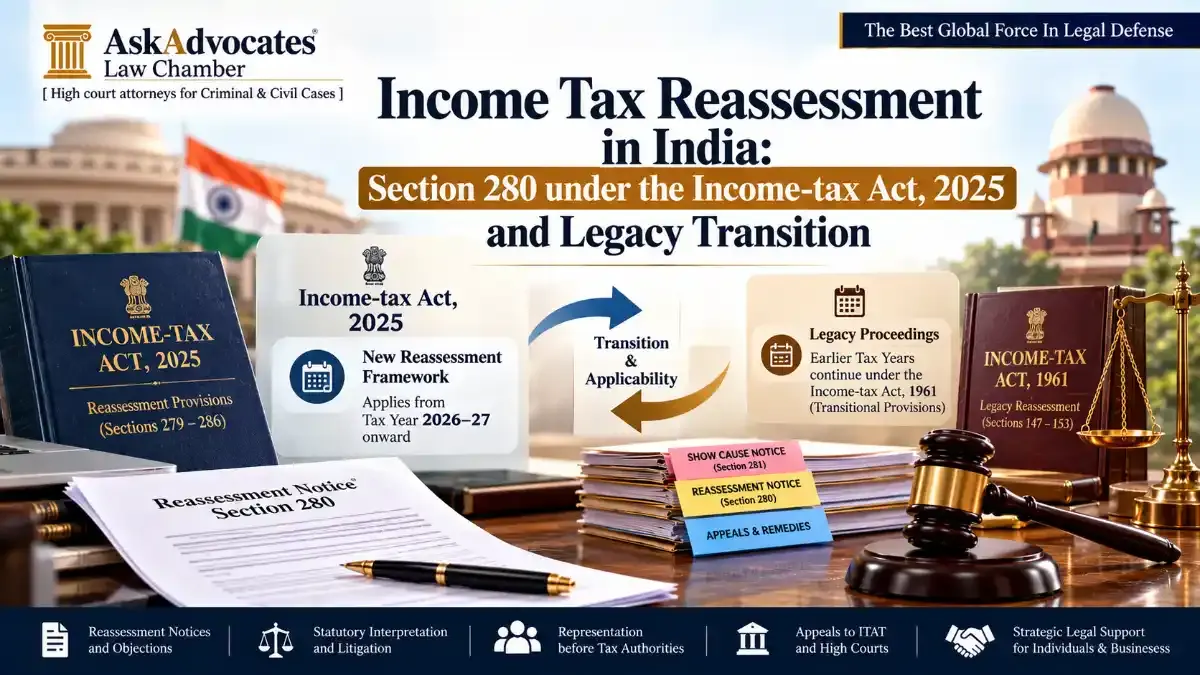
Check which law applies to the relevant assessment year, because the Income-tax Act, 2025 replaces the 1961 Act from 1 April 2026 for tax years beginning on or after that date, while earlier assessment years and pending proceedings continue under the 1961 Act.
Income tax: assessment, scrutiny and reassessment
Returns and processing. After filing a return, the Centralised Processing Centre may issue an intimation under Section 143(1), including adjustments. A mismatch with Form 26AS or AIS can trigger a notice.
Scrutiny assessment (Section 143(3)). Cases are selected for scrutiny by criteria or through the faceless assessment scheme. A notice under Section 143(2) must be issued within the statutory period (three months from the end of the financial year of filing). The assessee responds with documents; the Assessing Officer may call for explanations on cash deposits, loans, share capital, expense claims and unexplained credits (Sections 68 to 69D).
Reassessment (Sections 147 to 151). After the 2021 reforms, the Assessing Officer must conduct an enquiry under Section 148A, give the assessee a show-cause notice with material relied on, consider the reply and pass an order before issuing a notice under Section 148. In Union of India v. Ashish Agarwal (2022) the Supreme Court treated certain pre-amendment notices as show-cause notices, and in subsequent decisions the Supreme Court and High Courts have emphasised compliance with limitation and sanction requirements. Read our article on reassessment.
Penalties and prosecution. Penalty under Section 270A for under-reporting or misreporting, and prosecution under Chapter XXII for wilful evasion. Penalty proceedings are separate, and show-cause notices must state the specific charge.
Search and survey. Searches under Section 132 and surveys under Section 133A require valid warrants or authorisation and compliance with procedure; evidence collected may be challenged for illegality, though seized material can still be used subject to rules. Statements recorded must be voluntary; a retraction supported by facts can be considered.
Rectification and revision. Errors apparent from the record may be rectified under Section 154; the Principal Commissioner may revise erroneous and prejudicial orders under Section 263, and the assessee may seek revision under Section 264.
Common income tax issues
- Cash deposits and unexplained money
- Capital gains computation, exemptions under Sections 54 and 54F
- Disallowance of expenses (Section 37, 40(a)(ia), 14A)
- Charitable trusts and exemptions (registration under Sections 12A and 80G)
- Transfer pricing and international transactions
- TDS defaults and TCS
- NRI taxation, DTAA relief and Section 195 withholding
GST: notices, credit and appeals
Registration, returns and credit. GST registrants file GSTR-1 and GSTR-3B, reconcile with GSTR-2B, and claim input tax credit subject to Section 16 and Rules 36 to 38 and 42 to 43.
Scrutiny and audit. The proper officer may issue a notice for discrepancies (ASMT-10), conduct an audit (Section 65) or special audit (Section 66), and carry out inspection, search and seizure (Section 67).
Show cause notice and adjudication. Sections 73 and 74 deal with determining tax not paid or short-paid or erroneously refunded, or wrongly availed or utilised credit, for non-fraud and fraud/suppression cases respectively, with Section 74A applying from financial year 2024-25. The notice must specify the amount, period and grounds, and be served via the portal. A DRC-01 notice must be followed by a reply in DRC-06 and a personal hearing; the order is in DRC-07. Time limits for issuing notices and orders are strict, and courts quash orders passed beyond limitation or without hearing.
Common GST disputes. Denial of input tax credit due to supplier default or mismatch; classification and rate (for example, composite versus mixed supply); place of supply for IT and ITES exports (export compliance for IT and ITES); refund of unutilised credit; reverse charge; e-way bill and detention of goods (Section 129); blocking of credit ledger (Rule 86A); and provisional attachment of bank accounts (Section 83).
Appeals. An appeal against an order lies to the Appellate Authority within three months, with a pre-deposit of ten percent of the disputed tax (and an additional ten percent for further appeal to the Appellate Tribunal subject to the cap). The GST Appellate Tribunal is being operationalised, so interim High Court writ remedies remain important for jurisdictional or procedural defects. In Union of India v. Mohit Minerals (2022), the Supreme Court held that the GST Council’s recommendations are only recommendatory, and in Safari Retreats v. Chief Commissioner (2024) it addressed the availability of input tax credit on construction of commercial premises under the “functionality” test.
Customs
Customs duty is levied on imports and exports. Disputes concern classification under the Customs Tariff, valuation under Section 14 and the Customs Valuation Rules, exemption notifications, origin and free-trade agreement benefits, drawback, anti-dumping duty and confiscation and penalty. The proper officer issues a show cause notice (Section 124), after which the adjudicating authority passes an order with a personal hearing. Appeals go to the Commissioner (Appeals) within sixty days, then CESTAT. Importers should maintain commercial invoices, bills of lading, certificates of origin, test reports and correspondence. Provisional assessment and early release against bond or bank guarantee are practical tools to avoid port demurrage.
Search, seizure and arrest
Powers of search and arrest under income tax, GST and customs laws are subject to safeguards. For GST, arrest requires reasons to believe that the person committed specified offences (Section 69), with thresholds (for example, tax evasion over Rs 5 crore for certain offences) and bail provisions. Persons summoned should seek advice before giving statements. In Radhika Agarwal v. Union of India (2025) the Supreme Court discussed safeguards for arrest powers under customs and GST. Where prosecution is threatened, anticipatory bail can be sought; read our criminal law pillar.
Writ jurisdiction in tax matters
The High Court may entertain writs against tax orders where there is a violation of natural justice, absence of jurisdiction, orders passed without hearing or beyond limitation, wrongful blocking of credit or attachment of bank accounts, or where an appeal remedy is inadequate. The Madras High Court has frequently set aside GST orders for non-service of notices on the portal and for non-consideration of replies, remanding cases for fresh adjudication. See our constitutional and administrative pillar.
Settlement and relief schemes
Taxpayers may use dispute-resolution schemes announced from time to time, such as Vivad se Vishwas for direct taxes, amnesty and waiver schemes for GST interest and penalty, and the Settlement Commission or Interim Board for Settlement in specific cases. Where a transparent account of liability is possible, early compounding or settlement often saves penalty and litigation cost. Decide using a cost-benefit analysis, including interest accruals, pre-deposit and business impact.
Documents to maintain
- Returns with computations and acknowledgements
- Books of account, ledgers and audit reports
- Purchase and sales invoices, e-way bills and delivery proof
- Bank statements and reconciliation workings
- Agreements, board minutes and valuation reports for key transactions
- GSTR-2B reconciliation and supplier ledgers
- Import and export documents, shipping bills and BRC/FIRC
- Correspondence with the department and portal acknowledgements
Practical tips
- Calendar every notice and check the portal regularly, because notices are served electronically.
- Reply with law and facts, not only numbers. Annex evidence in an indexed paper-book.
- Challenge limitation and jurisdiction at the earliest stage.
- Seek stay of demand with the appellate authority or High Court when recovery is threatened.
- Reconcile books and GST returns before audit to avoid mismatch notices.
- Avoid inconsistent stands across income tax, GST and customs.
Scenario illustrations
Credit denial for supplier default. A Chennai trader’s input tax credit is denied because a supplier did not file returns. Counsel demonstrates genuine invoices, payment through banking channels, receipt of goods and the supplier’s registration status at the time, and obtains a favourable order or remand on appeal.
Reassessment of capital gains. An assessee sold land and claimed exemption under Section 54F. A reassessment notice alleges excess exemption. The assessee shows reinvestment in a residential house within the time limit with registered deed and payment trail, and challenges the reopening for non-compliance with Section 148A procedure.
Customs classification dispute. An importer’s electronic goods are classified under a heading attracting higher duty. Technical literature and expert opinion support a different heading; the matter is argued before the Commissioner (Appeals) and CESTAT.
How we help
- Replies to income tax, GST and customs notices
- Assessment, audit and search defence
- Appeals before first appellate authorities, tribunals and the High Court
- Writ petitions against jurisdictional errors and wrongful attachment
- GST advisory, registration, refunds and structuring
- Settlement, compounding and dispute resolution schemes
- Advice for NRIs, professionals, start-ups and manufacturers
Explore our legal insights and tax articles. For company-level compliance see our corporate pillar.
Key takeaways
- Never ignore a notice. Deadlines are short and ex parte orders are common.
- Evidence and reconciliation win tax cases.
- Jurisdiction, limitation and natural justice are powerful grounds.
- Know the appeal chain, time limits and pre-deposit conditions.
- Consider settlement schemes where litigation risk is high.
This guide is general information under Indian law as at November 2026 and not legal advice. Tax law changes frequently; verify current provisions.