
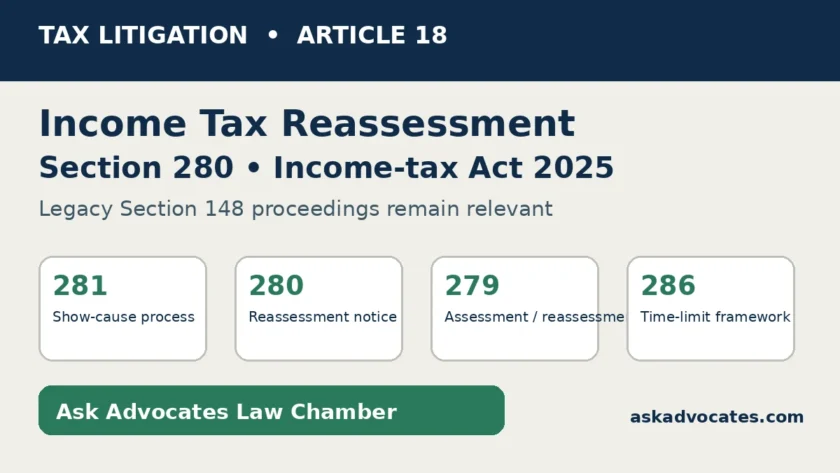
Income tax reassessment can expose taxpayers to additional tax demands, interest, penalties and prolonged litigation. However, the applicable law depends on the tax period and the transitional provisions. The Income-tax Act, 2025 introduced a new reassessment framework from 1 April 2026. Under this framework, Sections 279–286 govern reassessment and related procedures. Section 280 addresses the reassessment notice, while Section 281 generally provides the pre-notice process. Nevertheless, earlier tax periods remain subject to the Income-tax Act, 1961 under the applicable saving provisions. Therefore, taxpayers must identify the governing statute before preparing objections or choosing a remedy. Ask Advocates Law Chamber assists taxpayers with reassessment notices, statutory responses, limitation objections and tax litigation strategy. This guide explains the principal provisions, procedural safeguards, transition rules and available remedies. It offers general legal information, not an opinion on any individual notice.
Income tax reassessment in India under Section 280 of the Income-tax Act, 2025 and legacy transition rules
Understanding the Income Tax Reassessment Framework
Income tax reassessment allows the tax department to examine income that allegedly escaped assessment, subject to statutory conditions. However, the department cannot disregard the governing legislation, procedural safeguards or prescribed time limits. The first task involves identifying the relevant tax period and the law applicable to it. The Income-tax Act, 2025 applies its reassessment framework to Tax Year 2026–27 and subsequent tax years. Conversely, proceedings concerning tax years beginning before 1 April 2026 generally remain governed by the 1961 Act. This distinction matters even when authorities issue or continue proceedings after the new legislation commenced. Consequently, taxpayers should record the tax period, notice date, cited provisions and procedural history before responding. They should also distinguish a preliminary communication from a formal reassessment notice. Each document may trigger different obligations and deadlines. An early statutory review can reveal jurisdictional defects, incorrect information, procedural omissions or limitation concerns. These issues require careful examination rather than assumptions based solely on the notice heading.
Why the Governing Act Matters
The Income-tax Act, 2025 reorganises provisions that previously governed reassessment under the 1961 Act. Although the new framework serves a comparable purpose, its section numbers and statutory procedures require separate analysis. Section 280 broadly corresponds to the former Section 148 notice framework. Sections 279–286 contain the new Act’s reassessment provisions and related time limits. However, a taxpayer cannot automatically apply every new provision to an earlier assessment year. Section 536 contains transition and saving provisions that preserve the former law for specified earlier-period proceedings. Therefore, the applicable statute depends on the tax period and relevant transitional rule, not simply the notice date. For example, a notice received after April 2026 may concern an earlier assessment year under the 1961 Act. In that situation, the taxpayer must examine the old provisions and applicable judicial decisions. Meanwhile, a reassessment concerning Tax Year 2026–27 generally requires analysis under the new Act. Identifying this distinction at the outset prevents incorrect objections and helps lawyers frame a legally relevant response.
Section 279 and Alleged Escaped Income
Section 279 forms part of the Income-tax Act, 2025 framework for assessment, reassessment and recomputation. The department must follow the statutory conditions applicable to the proposed action. Accordingly, taxpayers should identify the information that allegedly indicates escaped income and examine its connection with their tax affairs. The information may concern financial transactions, third-party reports, audit objections or other recognised statutory categories. However, the existence of information does not eliminate the need for a lawful process. Taxpayers should verify whether the information concerns the correct person, tax period, transaction and amount. They should also compare the allegations with filed returns, financial statements and earlier assessment records. If the department relies on third-party information, the response should explain any factual mismatch. Moreover, taxpayers should distinguish an actual undisclosed taxable item from a transaction already disclosed or correctly treated. Relevant supporting records can include bank statements, contracts, invoices, ledgers and reconciliation statements. A precise response helps identify whether the alleged income has escaped assessment or whether the proposal rests on an incorrect factual assumption.
Section 280: The Reassessment Notice
Section 280 governs the reassessment notice under the Income-tax Act, 2025. The notice initiates the statutory process for reassessing alleged escaped income under the applicable provisions. Taxpayers should read the notice carefully and preserve the complete electronic or physical communication. They should verify the taxpayer’s identity, relevant tax year, stated legal authority and response requirements. Next, they should compare the notice with the preceding show-cause communication and order, where applicable. Any inconsistency may require a specific explanation or legal objection. Taxpayers should also examine service records because the date of service may affect statutory deadlines. Where the income-tax portal contains several documents, each relevant version should be downloaded and retained. The taxpayer should not assume that a portal alert and the operative notice are interchangeable. Instead, the complete record should establish what the department issued and when it was served. If the notice contains unclear allegations, the taxpayer should assess whether clarification or a reasoned objection is appropriate. Prompt legal review can protect procedural rights before the reassessment advances.
Section 281: The Pre-Notice Safeguard
Section 281 generally provides a show-cause process before the department issues a Section 280 notice. According to the Income Tax Department’s guidance, the Assessing Officer provides information suggesting escaped income and allows the taxpayer to respond. The officer must consider the response and pass the prescribed reasoned order with the required approval. However, the Act recognises specified situations in which the ordinary process may not apply. The taxpayer should therefore check the relevant statutory exception before alleging a procedural violation. During the ordinary process, the response should address the actual information relied upon. It should identify factual errors, explain disclosed transactions and attach relevant supporting documents. In addition, the taxpayer may raise applicable jurisdictional and limitation objections. A generic denial often fails to explain why the proposed reassessment lacks a legal or factual basis. A structured response should address each allegation separately and connect each explanation to evidence. Taxpayers should also preserve proof of submission and any acknowledgement generated by the portal. This record may become important if the department later issues a formal notice or adverse order.
Legacy Proceedings and the 2026 Transition
The transition to the Income-tax Act, 2025 does not automatically terminate earlier tax proceedings. Section 536 preserves the application of the repealed Act to specified earlier-period matters. The Income Tax Department confirms that reassessment provisions under the new Act apply to Tax Year 2026–27 and later years. For tax years beginning before 1 April 2026, reassessment generally continues under the 1961 Act. This principle applies even where a qualifying earlier-period proceeding begins or continues after commencement of the new Act. Therefore, the date on which a taxpayer receives a communication cannot alone determine the governing statute. The relevant tax period and transition provisions must also be examined. Legacy proceedings may involve Sections 147, 148, 148A, 149 and 151 of the 1961 Act. Those provisions have their own conditions, limitation rules and approval requirements. Meanwhile, the new Act uses different section numbers and its own procedural framework. Lawyers should identify the governing statute before applying a precedent or drafting a jurisdictional challenge. This approach avoids mixing provisions from separate legislative regimes and strengthens the legal analysis.
Tax Year Versus Assessment Year
The terminology change is important when taxpayers identify the correct reassessment framework. The 1961 Act uses the concepts of previous year and assessment year. The 2025 Act introduces the term Tax Year for the new framework. Tax Year 2026–27 generally concerns income earned during the period beginning 1 April 2026. By contrast, income earned during the financial year ending 31 March 2026 remains within the earlier framework. The corresponding return may therefore use the earlier Act and applicable assessment-year terminology. This distinction can affect notices, returns, statutory references and legal submissions. For example, a taxpayer receiving a notice during 2026 must not assume that the new Act governs every tax period. The notice may relate to an earlier year preserved by the transition rules. Consequently, the first page of the case chronology should identify the relevant period and statute. The lawyer should then verify the provision cited in the communication. Correct terminology improves the clarity of written objections and helps prevent avoidable disputes about the applicable law.
Pending Proceedings Under the 1961 Act
Proceedings already initiated under the 1961 Act may continue under that Act after 1 April 2026. The statutory saving provisions preserve the applicable framework for specified earlier-period proceedings. For instance, an earlier proceeding involving a Section 148A show-cause notice may require continued compliance with the old procedure. The officer may need to consider the reply, issue the prescribed order and take further steps under the 1961 Act. However, the precise result depends on the case history and applicable limitation rules. Taxpayers should not assume that commencement of the new Act invalidates every earlier notice. Equally, they should not assume that saving provisions cure a defective notice. Each step must satisfy the legal requirements governing that proceeding. The file should contain the original notice, response, order, approval information where available and subsequent communications. In addition, the taxpayer should calculate limitation under the correct old-law provision. If the department has applied the wrong statute or missed a mandatory requirement, counsel can assess the appropriate objection. A properly documented chronology supports both administrative representations and later litigation.
Comparing the New and Legacy Frameworks
| Issue | Income-tax Act, 2025 | Income-tax Act, 1961 |
|---|---|---|
| Typical period | Tax Year 2026–27 onward | Tax years beginning before 1 April 2026, subject to transition rules |
| Reassessment notice | Section 280 | Section 148 |
| Pre-notice process | Generally Section 281 | Section 148A, where applicable |
| Reassessment provisions | Sections 279–286 | Relevant provisions including Sections 147–153 |
| Time limits | New Act’s applicable limitation provisions | Old Act’s applicable limitation provisions |
| Transition rule | Read with Section 536 and related provisions | Continues for matters preserved by the saving provisions |
This comparison provides an initial orientation, not a substitute for statutory interpretation. A lawyer must confirm the precise provision applicable to the taxpayer’s facts and procedural stage. The table also does not mean that old and new provisions are identical in every respect. Their language, exceptions, limitation requirements and approval structures may differ. Therefore, taxpayers should avoid copying an objection from another case without checking its governing statute. A notice should be analysed against the law applicable to the relevant tax period. Where transition provisions preserve earlier proceedings, the old procedural framework may remain decisive. Conversely, a new-period case requires examination of the 2025 Act and relevant rules. This distinction should guide the evidence review, response drafting and choice of remedy. It also helps prevent a court submission from relying on a provision that does not govern the disputed proceeding. Accurate statutory mapping is the foundation of an effective reassessment challenge.
Limitation and Approval Requirements
Limitation is often central to an income tax reassessment dispute. However, the applicable deadline depends on the governing Act, tax period and statutory facts. The taxpayer should identify the date of the relevant event and calculate the period under the correct provision. The review may require examining the nature of the alleged escaped income and the statutory information relied upon. Approval requirements also need independent verification. A prescribed approval cannot be assumed merely because the notice contains a section number. The taxpayer should assess whether the appropriate authority approved the action when the law required approval. Where available, the relevant order and approval record should be preserved or requested through the proper procedure. Any limitation objection should include a clear chronology and the statutory calculation. It should also address applicable extensions, exclusions or special rules. A bare assertion that a notice is late may not adequately establish the defect. Legal review should therefore connect each date to the specific provision governing the case.
Reviewing the Information and Evidence
A strong reassessment response starts with the information identified by the department. Taxpayers should ask whether that information actually relates to taxable income for the relevant period. They should then compare the allegations with returns, accounts, bank records and transaction documents. Where a third party appears in the material, the taxpayer should examine the connection between that party and the alleged income. For example, a bank entry may represent a loan repayment rather than fresh taxable income. Similarly, a property transaction may require examination of ownership, consideration and supporting records. The correct treatment depends on the facts and applicable tax provisions. Therefore, explanations should rely on primary documents rather than unsupported statements. A transaction-wise reconciliation can identify missing context and inconsistencies. If the department has misunderstood a document, the response should explain the error precisely. Relevant records should be indexed and cross-referenced to each objection. This method gives the assessing authority a clear basis for evaluating the taxpayer’s explanation.
Records to Preserve
Preserve the notice, envelope or service record, portal downloads, show-cause communication and any order. Also retain the relevant income-tax return, computation, financial statements and prior assessment documents. Bank statements, ledgers, invoices, contracts and correspondence may explain disputed transactions. Where the allegation involves property, shares or loans, preserve the supporting agreements and payment evidence. Keep a copy of every response and its filing acknowledgement. In addition, save a dated chronology of telephone calls, portal events and communications with the department. Electronic files should retain readable names and dates. Avoid altering original records while preparing working copies for analysis. If the department later questions a transaction, a complete record will help establish its nature and timing. Organised evidence also allows counsel to identify missing documents before filing a formal response. Good record management cannot guarantee a favourable outcome, but it reduces avoidable factual uncertainty.
Structuring a Section 281 Response
A Section 281 response should follow the structure of the allegations rather than a generic template. Begin by identifying the notice, tax period and information under consideration. Then respond to each factual allegation with a concise explanation and supporting document. Where the information contains an incorrect amount or identity, specify the error and demonstrate the correct position. Next, address the relevant statutory conditions and any applicable jurisdictional objection. If the taxpayer needs clarification, identify the missing information and explain why it matters. The response should remain respectful, specific and evidence-led. Avoid unsupported allegations against the assessing authority. Instead, show how the record fails to establish the stated basis for reassessment. Numbered paragraphs and a document index can improve readability. Finally, confirm the requested outcome and preserve proof of filing. A properly prepared reply creates a clear record for any later statutory appeal or judicial review.
Building the Limitation Chronology
A limitation chronology should identify every legally relevant date in the reassessment process. Include the tax period, original return date, earlier assessment order and each notice date. Record the service date separately when the statute makes service relevant. Next, identify the limitation provision and the event from which it calculates the deadline. Check whether the case involves a special statutory category, extension or exclusion. Do not rely on an online summary when the statutory calculation determines jurisdiction. Instead, verify the applicable provision and amendments for the relevant proceeding. A concise date table allows counsel to explain the objection clearly. It also helps distinguish a late notice from a later communication within a valid proceeding. If the department disputes the calculation, the underlying records should support each date. Accurate chronology is particularly important where old and new legislation operate during the transition period.
Selecting the Appropriate Remedy
The appropriate remedy depends on the proceeding’s stage and the defect identified. Before a formal notice, the taxpayer may respond to the show-cause communication and challenge its factual basis. After a notice, the taxpayer should comply with applicable requirements while preserving valid objections. If an assessment produces an adverse order, a statutory appeal may address additions and legal errors. In an appropriate case, a writ petition may challenge a jurisdictional or serious procedural defect. However, High Courts often consider whether an effective alternative remedy exists. Therefore, judicial review requires careful assessment rather than an assumption that every notice can be challenged directly. The lawyer should identify the relief sought and the forum legally empowered to grant it. Relevant factors include limitation, procedural stage, available evidence and the nature of the alleged defect. A remedy should address the actual problem, not merely express disagreement with the department’s position.
Filing and Service Checklist
Before filing, confirm the correct portal, response category and submission deadline. Check that the submission identifies the notice and relevant tax period accurately. Attach readable supporting documents and ensure that each file relates to the relevant allegation. Keep the final submitted response exactly as filed. Download the acknowledgement and record its timestamp. If a portal error prevents filing, preserve screenshots and available error details. Use the prescribed alternative channel only where the applicable rules permit it. Do not assume that an unsuccessful upload constitutes a valid response. Where a deadline approaches, seek prompt professional advice on lawful options. A careful filing process protects the record and reduces avoidable disputes about compliance.
Evidence Index and Document Control
Prepare an index that identifies every document, date and allegation it supports. Use consistent file names and arrange documents in chronological or issue-based order. Separate original records from explanatory summaries and working calculations. Where a document contains several transactions, identify the relevant page or entry. Reconcile figures across the return, accounts and bank statements before filing. If a document is unavailable, record the reason and consider whether another reliable record supports the explanation. Do not create or modify evidence to fit a proposed response. Accurate document control helps counsel verify the facts and respond consistently. It also supports later appeals, where the record may require close examination.
Legal Review Before Submission
Before submission, a tax lawyer should review the governing Act, allegations and proposed response. The review should check statutory references, limitation calculations and supporting evidence. It should also identify any admission that could unintentionally weaken the taxpayer’s position. Confirm that the requested relief follows from the facts and applicable law. Where a case involves multiple years, analyse each period separately. One year’s result does not automatically determine another year’s treatment. The reviewer should also check whether the notice invokes an exception to the usual pre-notice process. Finally, preserve a copy of the approved response and filing acknowledgement. This review improves consistency without guaranteeing a particular result.
Monitoring After Submission
After filing the response, monitor the income-tax portal and official communications regularly. Record any further notice, hearing opportunity, order or request for information. Respond within the deadline stated in the operative communication, subject to the governing law. Preserve proof of every subsequent submission. If the department issues a formal reassessment notice, compare it with the earlier proceedings. If an adverse order follows, calculate the appeal deadline immediately. Do not assume that filing an objection automatically suspends the proceeding or every related deadline. Prompt monitoring helps the taxpayer protect available remedies. It also gives counsel a complete procedural history for further advice.
Legal Remedies and a Practical Roadmap
Taxpayers can challenge reassessment action through the procedure available under the governing legislation. The correct route depends on whether the dispute concerns jurisdiction, procedure, limitation or the merits of an addition. At the initial stage, a reasoned show-cause response may address incorrect information and statutory defects. After a formal notice, the taxpayer should comply with applicable requirements while preserving legal objections. Once the department passes an adverse assessment order, the statutory appeal framework may provide relief. In appropriate circumstances, judicial review may address jurisdictional errors or serious procedural illegality. However, a writ petition is not a universal substitute for a statutory appeal. Courts may consider the availability of an effective alternative remedy and the facts of the case. Therefore, taxpayers should assess the procedural stage before choosing a forum. The Income Tax Department, appellate authorities, the Income Tax Appellate Tribunal and constitutional courts may have different roles. A carefully prepared case should identify the exact relief sought, the legal basis and the evidence supporting it.
Practical roadmap: First, identify the tax period and governing Act. Second, preserve every notice, order and portal record. Third, check the information relied upon and its connection to alleged escaped income. Fourth, calculate limitation under the correct provision. Fifth, examine approval and procedural requirements. Sixth, prepare a document-supported response within the prescribed time. Seventh, review the resulting order and determine whether an appeal or other remedy is appropriate. Eighth, obtain specialist advice where the case involves multiple tax years, complex transactions or disputed jurisdiction. This sequence helps taxpayers avoid treating every reassessment communication as identical. It also supports consistent handling of both new-Act and legacy proceedings.
Judicial Authorities and Their Relevance
Judicial decisions can guide reassessment disputes, but their relevance depends on the legal issue and governing statute. In GKN Driveshafts (India) Ltd. v. ITO, (2003) 259 ITR 19 (SC), the Supreme Court addressed the handling of objections in the former reassessment framework. The decision remains relevant to understanding legacy proceedings, subject to later law and the case’s precise context. In Union of India v. Ashish Agarwal, (2022) 444 ITR 1 (SC), the Court considered reassessment notices issued during the transition from an earlier statutory regime. That judgment must be applied with attention to its factual and legal context. In Calcutta Discount Co. Ltd. v. ITO, (1961) 41 ITR 191 (SC), the Court considered principles concerning reassessment and jurisdiction. These authorities do not replace the text of the Income-tax Act, 2025. Instead, counsel should determine whether a particular principle applies to the current provision or a preserved legacy proceeding. The relevant statutory language and subsequent developments must always be checked before citing a judgment.
Professional Support for Reassessment Disputes
Professional review can help taxpayers understand a reassessment notice and identify the most relevant issues. Legal support may include statutory interpretation, review of limitation, preparation of show-cause replies and representation during proceedings. Counsel may also assess an adverse assessment order and advise on available appellate remedies. For complex cases, the review may require coordination with a chartered accountant or other tax specialist. This collaboration can help reconcile financial records with legal submissions. However, the correct strategy depends on the documents, tax period and applicable law. Taxpayers should provide complete information and disclose relevant facts during the review. Withholding an important transaction or earlier communication can undermine the advice. A structured consultation should identify the immediate deadline, potential risks and next procedural step. Ask Advocates Law Chamber provides legal assistance for tax notices and disputes, subject to review of the individual case. Early advice is especially important where a response deadline or appeal period is approaching.
Frequently Asked Questions
1. What is Section 280 of the Income-tax Act, 2025?
Section 280 provides for a reassessment notice under the new Act. It generally applies to Tax Year 2026–27 onward, subject to the statutory framework.
2. What is the purpose of Section 281?
Section 281 generally requires a pre-notice show-cause process, consideration of the taxpayer’s reply and a reasoned order with prescribed approval.
3. Does the 2025 Act govern every notice issued after 1 April 2026?
No. Proceedings concerning earlier tax years generally remain governed by the 1961 Act under the transition and saving provisions.
4. Can a taxpayer challenge a reassessment notice?
Yes, where legally justified. Possible grounds include jurisdiction, limitation and procedural defects, subject to the applicable statute and available remedies.
5. Which documents should I preserve?
Keep the notice, show-cause communication, orders, returns, financial records, supporting transaction documents, portal history and filing acknowledgements.
6. Can I approach the High Court directly?
Judicial review may be available in appropriate cases. Courts consider the nature of the defect and whether an effective alternative remedy exists.
Related Legal Guides and Official Resources
Tax reassessment disputes may intersect with other tax compliance issues. Readers can explore the following related guides from Ask Advocates Law Chamber for additional context:
- GST Show Cause Notices and Appeals
- GST Input Tax Credit Disputes
- Income Tax Department: Reassessment Proceedings FAQs
- Income Tax Department: Objective and Scope of the New Act
Legal disclaimer: This article provides general information about Indian income-tax reassessment law as understood on the publication date. It does not constitute legal, tax or accounting advice for a specific matter. Statutory amendments, rules, notifications and judicial decisions may affect the applicable position. The outcome depends on the facts, tax period, governing Act and procedural record. Obtain professional advice before taking action on a reassessment notice or appeal deadline.
Contact Ask Advocates Law Chamber for a review of an income-tax reassessment notice, Section 281 show-cause communication, legacy Section 148 proceeding, limitation objection or proposed appeal. Please keep the complete notice and relevant tax records ready for the initial assessment.