Registration of an FIR does not mean that the accused has been found guilty.
An FIR starts or records the criminal investigation process. In appropriate cases, however, an accused person can approach the High Court and seek judicial intervention before the criminal process proceeds further.
Under the Bharatiya Nagarik Suraksha Sanhita, 2023, Section 528 preserves the inherent powers of the High Court. It permits the High Court to make orders necessary to give effect to the BNSS, prevent abuse of the process of a court, or secure the ends of justice.
This provision broadly corresponds to the former Section 482 of the Code of Criminal Procedure.
Therefore, older legal articles often refer to a “Section 482 CrPC petition.” Under the present procedural framework, the corresponding provision is Section 528 BNSS.
The power is extraordinary.
It is not an ordinary appeal against an FIR. In fact, It is not a substitute for a criminal trial. Moreover, It is not ordinarily used to determine disputed questions of fact requiring detailed evidence.
The Supreme Court has repeatedly emphasised that High Courts must exercise this jurisdiction carefully. At the same time, the power exists precisely because criminal proceedings can sometimes become an abuse of the legal process.
The central question is therefore:
How to Quash an FIR in India Under BNSS Section 528
Introduction
Does the FIR and the material legally capable of being considered at that stage disclose a sustainable criminal case, or would allowing the prosecution to continue amount to an abuse of process or otherwise defeat the ends of justice?
This article explains when an FIR may be challenged, the principal grounds for quashing, the role of the famous Bhajan Lal principles, the limits on High Court interference, compromise-based quashing, the difference between quashing and bail, and how a Section 528 BNSS petition should be prepared.
What Does “Quashing an FIR” Mean?
Quashing means the High Court exercises its jurisdiction to terminate an FIR or criminal proceeding.
Depending upon the procedural stage, the relief may concern:
- the FIR itself;
- the investigation;
- the charge sheet;
- the cognizance order;
- the summoning order;
- the criminal complaint;
- the prosecution proceedings; or
- the entire criminal case.
The precise relief depends upon what has already occurred.
For example, if only an FIR exists, the petition may principally challenge the FIR and investigation.
If a charge sheet has already been filed, the petition may need to challenge the consequential proceedings as well.
If the Magistrate has taken cognizance and issued process, the petition should address those subsequent judicial steps.
This is why a quashing petition should never be drafted merely by copying a standard Section 482 format.
The procedural history must be mapped first.
What Is Section 528 BNSS?
Section 528 BNSS is titled “Saving of inherent powers of High Court.”
It provides that nothing in the BNSS shall be deemed to limit or affect the inherent powers of the High Court to make orders necessary:
- to give effect to an order under the BNSS;
- to prevent abuse of the process of any court; or
- otherwise to secure the ends of justice.
The provision is the current statutory foundation for what was commonly called a Section 482 CrPC quashing petition.
The statutory language is deliberately broad.
But broad jurisdiction does not mean unlimited jurisdiction.
The High Court must balance two competing interests:
- protecting individuals from unjustified criminal prosecution; and
- allowing legitimate criminal investigations and prosecutions to proceed without premature judicial interference.
That balance explains why quashing jurisdiction is exceptional.
Can the High Court Quash an FIR Before Investigation Is Complete?
Yes.
There is no absolute rule that an FIR must first be investigated before the High Court can exercise Section 528 jurisdiction.
However, the threshold for intervention is important.
If the allegations, taken at face value, clearly disclose a cognizable offence and the investigation is otherwise legally permissible, the High Court will ordinarily be reluctant to stop the investigation at the threshold.
The Supreme Court has repeatedly stated that the High Court should not conduct a mini-trial while considering a petition for quashing.
In Neeharika Infrastructure Pvt. Ltd. v. State of Maharashtra, the Supreme Court emphasised the importance of allowing legitimate investigations to proceed and cautioned against routine interference at the FIR stage.
The Supreme Court has subsequently reiterated that the High Court should ordinarily examine the allegations as they stand and determine whether they prima facie disclose the commission of an offence rather than conduct an evidentiary trial.
Therefore, the mere assertion that the accused is innocent is ordinarily insufficient.
The petition must identify a legally recognisable reason for intervention.
The Seven Bhajan Lal Categories
The leading authority remains State of Haryana v. Bhajan Lal, 1992 Supp (1) SCC 335.
The Supreme Court identified illustrative categories in which the extraordinary power of the High Court may be exercised.
These categories are not a rigid statutory checklist. They are guiding principles for determining whether intervention is justified.
The broad categories include the following.
Category 1: Allegations Do Not Constitute an Offence
If the allegations in the FIR are accepted at face value and in their entirety, but they still do not constitute any criminal offence, continuation of the prosecution may be unsustainable.
This is one of the strongest quashing situations.
The question is not whether the allegations are true.
The question is whether, assuming they are true, the necessary legal ingredients of the alleged offence exist.
For example, if an offence requires a particular statutory element and the FIR contains no allegation capable of satisfying that element, the High Court may consider intervention.
Category 2: No Cognizable Offence Is Disclosed
A second category concerns allegations that do not disclose a cognizable offence.
This becomes important because police investigation powers depend upon the statutory classification of the alleged offence.
Where the allegations do not legally justify the investigation being undertaken, the High Court may examine whether continuation of the process is permissible.
Category 3: Allegations and Material Do Not Make Out an Offence
A case may initially appear to disclose an offence, but the uncontroverted material collected during investigation may fail to establish the essential ingredients.
This can become particularly important after investigation and filing of the police report.
The High Court must nevertheless remain cautious.
It should not transform the quashing hearing into a detailed evidentiary assessment.
The question remains whether the prosecution case, on the legally permissible material, can sustain the alleged offence.
Category 4: Express Legal Bar
Quashing may be justified where there is a legal prohibition against instituting or continuing the prosecution.
Possible examples can include:
- absence of a mandatory statutory sanction;
- a specific statutory prohibition;
- limitation where applicable;
- jurisdictional restrictions;
- failure to satisfy a mandatory statutory precondition; or
- another express legal bar.
The exact statutory provision must be identified.
A generic assertion that “the case is barred by law” is insufficient.
Category 5: Absurd or Inherently Improbable Allegations
The High Court may intervene where allegations are so absurd or inherently improbable that no reasonable person could conclude that sufficient grounds exist for proceeding.
This is a narrow category.
It does not permit the High Court to reject an FIR simply because the accused provides a competing factual narrative.
The distinction is important.
Inherent improbability is not the same as a disputed defence.
Where two competing versions require witnesses to be examined and evidence to be tested, the issue may ordinarily belong to the trial rather than the quashing stage.
Category 6: Manifest Mala Fides
Quashing may be justified where criminal proceedings are manifestly attended by mala fide intention or are maliciously instituted for an ulterior purpose.
The word manifestly is important.
A vague allegation that the complainant has a grudge is generally insufficient.
The mala fide character should emerge from the record in a manner that justifies extraordinary intervention.
In an August 2025 decision, the Supreme Court emphasised that the expression “manifestly attended with mala fide” requires mala fide to be apparent on the face of the FIR or surrounding material that can properly be considered at that stage. A disputed factual allegation of misrepresentation could not simply be decided through the quashing jurisdiction.
Category 7: Abuse of Process or Ends of Justice
The final category is the broadest.
Where continuation of criminal proceedings would amount to an abuse of the process of the court, or where intervention is necessary to secure the ends of justice, the High Court can exercise its inherent jurisdiction.
This category must still be applied carefully.
The purpose is not to create a general appellate jurisdiction over every criminal investigation.
It exists to prevent the criminal process from being used in a manner fundamentally inconsistent with justice.
Can a Civil Dispute Be Quashed If It Has Been Given a Criminal Colour?
Sometimes.
But the existence of a civil dispute does not automatically make a criminal case invalid.
The same factual situation can sometimes generate both civil and criminal consequences.
For example:
- breach of contract may also involve cheating if the necessary criminal ingredients exist;
- a property dispute may also involve allegations of forgery or criminal trespass;
- a commercial dispute may involve allegations of criminal breach of trust;
- a matrimonial dispute may involve both family proceedings and criminal allegations.
The High Court therefore asks whether the FIR actually discloses the ingredients of the alleged criminal offences.
A petition that merely states “this is a civil dispute” may fail if the FIR independently discloses a criminal offence.
Conversely, if the FIR merely converts a contractual or property disagreement into criminal allegations without satisfying the statutory ingredients of an offence, the issue may become relevant to quashing.
The legal analysis must therefore proceed offence by offence.
Can an FIR Be Quashed Because the Accused Says It Is False?
A bare assertion that an FIR is false is generally insufficient.
The High Court does not ordinarily conduct a trial to decide whose factual version is true.
The petitioner should instead identify a threshold legal defect.
For example:
- even if the FIR is accepted as true, no offence is made out;
- the statutory ingredients are absent;
- prosecution is legally barred;
- the allegations are inherently impossible;
- the proceeding is manifestly malicious;
- the continuation is a clear abuse of process; or
- another established ground for inherent intervention exists.
This distinction is central to successful quashing litigation.
A quashing petition should be constructed around legal insufficiency, not simply around factual denial.
Can the High Court Examine Documents Produced by the Accused?
The answer depends upon the nature and status of the documents.
The High Court cannot ordinarily conduct a mini-trial by assessing disputed evidence as if it were the trial court.
However, in appropriate cases, documents of unimpeachable character or material that can be legally considered may have relevance to the exercise of inherent jurisdiction.
The precise approach depends upon:
- the stage of proceedings;
- the nature of the document;
- whether its authenticity is genuinely disputed;
- whether it is part of the prosecution record;
- whether it conclusively demonstrates a legal bar; and
- whether considering it would effectively require a trial.
This is another reason why documentary strategy must be developed carefully.
What If the Charge Sheet Has Already Been Filed?
Filing of a charge sheet does not automatically eliminate the High Court’s Section 528 jurisdiction.
The Supreme Court has expressly considered quashing petitions under Section 528 even after filing of a charge sheet.
However, the nature of the analysis may change.
The court can consider the FIR, investigation material and subsequent proceedings to determine whether continuation remains legally sustainable.
In Samadhan v. State of Maharashtra, the Supreme Court considered a Section 528 BNSS petition seeking quashing of an FIR after a charge sheet had already been filed. The Court examined whether the allegations and material disclosed the necessary ingredients of the alleged offence and ultimately allowed the appeal after finding that continuation of the prosecution amounted to abuse of process.
The case is important because it demonstrates that filing a charge sheet does not create an absolute bar against Section 528 intervention.
At the same time, the High Court must still exercise restraint.
Can a Quashing Petition Be Filed After Cognizance?
Yes, where the circumstances justify invoking the High Court’s inherent jurisdiction.
The petition may challenge:
- the FIR;
- the investigation;
- the charge sheet;
- the cognizance order;
- the summoning order;
- or consequential criminal proceedings.
The prayer must correspond to the procedural stage.
For example, if the Magistrate has already taken cognizance and issued summons, asking merely to quash the FIR may not adequately address the entire proceeding.
The petition should identify all consequential proceedings that require intervention.
FIR Quashing and Bail Are Different Remedies
This distinction is frequently misunderstood.
Bail
Bail asks:
Should the accused be released from custody while the criminal case continues?
FIR Quashing
Quashing asks:
Should the criminal process itself be terminated because continuation is legally unsustainable or amounts to abuse of process?
A person may therefore:
- seek bail while simultaneously challenging the FIR;
- obtain bail but continue the quashing proceedings;
- fail to obtain quashing but receive bail;
- obtain quashing without requiring a trial.
The remedies serve different purposes.
Article 5 in this AskAdvocates series deals with regular bail.
Article 6 addresses the separate remedy of FIR and criminal-proceeding quashing.
What Is the Difference Between Quashing and Discharge?
They operate at different procedural stages.
| Quashing | Discharge |
|---|---|
| Primarily High Court inherent jurisdiction | Generally trial-court procedural remedy |
| Section 528 BNSS | Relevant BNSS provisions depend upon case type |
| Can operate at earlier stages | Usually arises after the case reaches the appropriate judicial stage |
| Prevents abuse of process | Tests whether the accused should proceed to trial |
| Extraordinary jurisdiction | Statutory procedural remedy |
| May challenge FIR, investigation or proceedings | Usually operates after judicial scrutiny of prosecution material |
The exact discharge provision depends upon whether the case is before a Magistrate or Sessions Court and the nature of the offence.
Therefore, an accused should not automatically choose quashing simply because the FIR is disputed.
The procedural stage should determine the remedy.
Can a Compromise Result in Quashing of an FIR?
Sometimes.
The High Court can exercise inherent powers in appropriate cases where parties have genuinely settled a dispute.
But compromise does not automatically terminate every criminal prosecution.
The nature of the offence is critical.
Offences that are essentially personal or private in nature may sometimes be quashed following a genuine settlement.
Serious offences involving public interest, violence, sexual offences, corruption, economic offences affecting public institutions, or other matters with significant societal impact require greater caution.
The Supreme Court has reiterated that compromise-based quashing must be assessed in light of the nature of the offence and the public consequences of terminating the prosecution.
In a November 2025 decision, the Supreme Court considered a Section 528 petition involving a compromise and distinguished offences personal to the complainant from an offence concerning property and interests of a wider institution. The decision demonstrates why a settlement cannot automatically result in complete quashing of every offence in an FIR.
The petition should therefore explain:
- the nature of the offence;
- who is the victim;
- whether other victims exist;
- whether public interest is implicated;
- whether the settlement is voluntary;
- whether consideration has been paid;
- whether the complainant supports quashing; and
- whether any statutory restriction applies.
Can Serious Offences Be Quashed on Settlement?
Not ordinarily merely because the complainant has agreed.
The High Court must examine whether the offence has a predominantly private character or whether it concerns a broader public interest.
The fact that the complainant files an affidavit stating that the dispute is settled does not automatically require quashing.
The court retains an independent responsibility to consider the nature of the criminal allegation.
This is particularly important in cases involving:
- serious violence;
- sexual offences;
- offences against children;
- corruption;
- offences affecting public institutions;
- organised crime;
- serious economic offences; and
- offences with significant societal consequences.
A settlement should therefore be treated as one factor, not as an automatic entitlement to quashing.
What Evidence Helps in an FIR Quashing Petition?
A petition should be supported by legally relevant material.
Depending on the case, this may include:
- FIR;
- complaint;
- statements forming part of the prosecution record;
- charge sheet;
- final report;
- cognizance order;
- summons;
- relevant contracts;
- admitted correspondence;
- government records;
- court orders;
- settlement documents;
- medical records;
- public records;
- documents establishing a legal bar;
- undisputed chronology; and
- other material capable of demonstrating the threshold legal defect.
The objective is not to submit every document in existence.
The objective is to present enough material to demonstrate why the High Court’s extraordinary jurisdiction is justified.
What Should a Quashing Petition Contain?
A professionally prepared petition should normally identify the procedural history clearly.
1. Parties
Identify the petitioner, State, complainant and other necessary respondents.
2. FIR Details
Provide:
- police station;
- FIR number;
- date;
- sections;
- investigating agency.
3. Concise Facts
Set out the relevant facts chronologically.
4. Procedural History
State whether:
- investigation is continuing;
- arrest has occurred;
- bail has been granted;
- charge sheet has been filed;
- cognizance has been taken;
- summons has been issued; or
- trial has commenced.
5. Grounds
Each ground should correspond to a recognised legal principle.
6. Supporting Material
Attach relevant documents in a coherent sequence.
7. Relief
Specify exactly what should be quashed.
8. Interim Relief
Where justified, seek appropriate interim protection against coercive steps or further proceedings.
The interim prayer must be carefully drafted because the Supreme Court has cautioned against routinely staying investigations merely because a quashing petition has been filed.
Can the High Court Stay Investigation During a Quashing Petition?
It can pass appropriate interim orders in suitable cases, but such protection is not automatic.
The Supreme Court has repeatedly cautioned High Courts against routinely staying criminal investigations.
The underlying principle is that filing a quashing petition should not itself become a mechanism for indefinitely preventing lawful investigation.
The court may consider factors such as:
- whether the FIR discloses any offence;
- whether the proceedings appear legally barred;
- whether continuing investigation would cause serious injustice;
- whether immediate protection is necessary;
- whether the prosecution appears manifestly abusive; and
- whether alternative remedies are adequate.
Interim protection must therefore be specifically justified.
Can the High Court Quash an FIR Based on a Defence of Alibi?
Usually, caution is required.
An alibi is generally a factual defence.
If proving the alibi requires:
- witness examination;
- cross-examination;
- analysis of competing documents;
- forensic examination; or
- determination of disputed facts,
the issue may be inappropriate for resolution under Section 528.
However, an incontrovertible and legally admissible record may create a different situation.
For example, where an undisputed official record conclusively establishes that the accused was elsewhere in circumstances that make the prosecution allegation legally impossible, the High Court may examine whether its inherent jurisdiction is attracted.
The distinction is between conclusive material demonstrating legal impossibility and a factual defence requiring a trial.
Can Delay in Filing an FIR Be a Ground for Quashing?
Delay alone does not automatically invalidate an FIR.
The court may consider whether the delay is:
- explained;
- unexplained;
- exceptionally long;
- consistent with the prosecution version;
- supported by contemporaneous material; or
- indicative of a subsequent fabrication.
However, delay is ordinarily a factual circumstance.
If determining its significance requires evidence, it may not justify quashing at the threshold.
A petition should therefore not rely solely on delay unless the delay forms part of a broader legal defect.
Can Contradictions in Witness Statements Lead to Quashing?
Ordinarily, contradictions are matters for trial.
The High Court generally does not conduct a detailed credibility assessment while exercising Section 528 jurisdiction.
Minor inconsistencies are particularly unsuitable for quashing.
A petition should instead focus on fundamental defects such as:
- absence of an offence;
- legal impossibility;
- statutory bar;
- lack of jurisdiction;
- manifest abuse;
- or another exceptional circumstance.
The greater the factual dispute, the greater the risk that a quashing petition will be treated as an attempt to avoid trial.
Can the High Court Quash Proceedings Against Some Accused but Not Others?
Yes, depending upon the factual and legal circumstances.
Criminal liability must be assessed in relation to each accused.
For example, the FIR may contain sufficient allegations against one person but none against another.
Similarly:
- one accused may have a distinct role;
- one may be protected by a legal bar;
- one may have no specific allegation;
- one may have a separate settlement;
- or material may exist against some accused but not others.
A petition should therefore identify the petitioner’s individual role.
A vague challenge to the entire FIR may be less effective where the prosecution case differs between accused persons.
What Happens If the High Court Rejects the Quashing Petition?
Rejection does not necessarily mean conviction.
It usually means that the High Court has declined to terminate the criminal process at that stage.
Depending upon the case, the accused may still:
- seek bail;
- seek discharge;
- contest framing of charges;
- challenge subsequent orders;
- defend the case at trial;
- raise evidentiary objections;
- pursue appellate remedies; or
- approach the Supreme Court through an appropriate remedy where maintainable.
The precise consequences depend on the order.
A rejection order should therefore be read carefully.
The High Court may reject quashing because the allegations disclose a prima facie offence without making any finding of guilt.
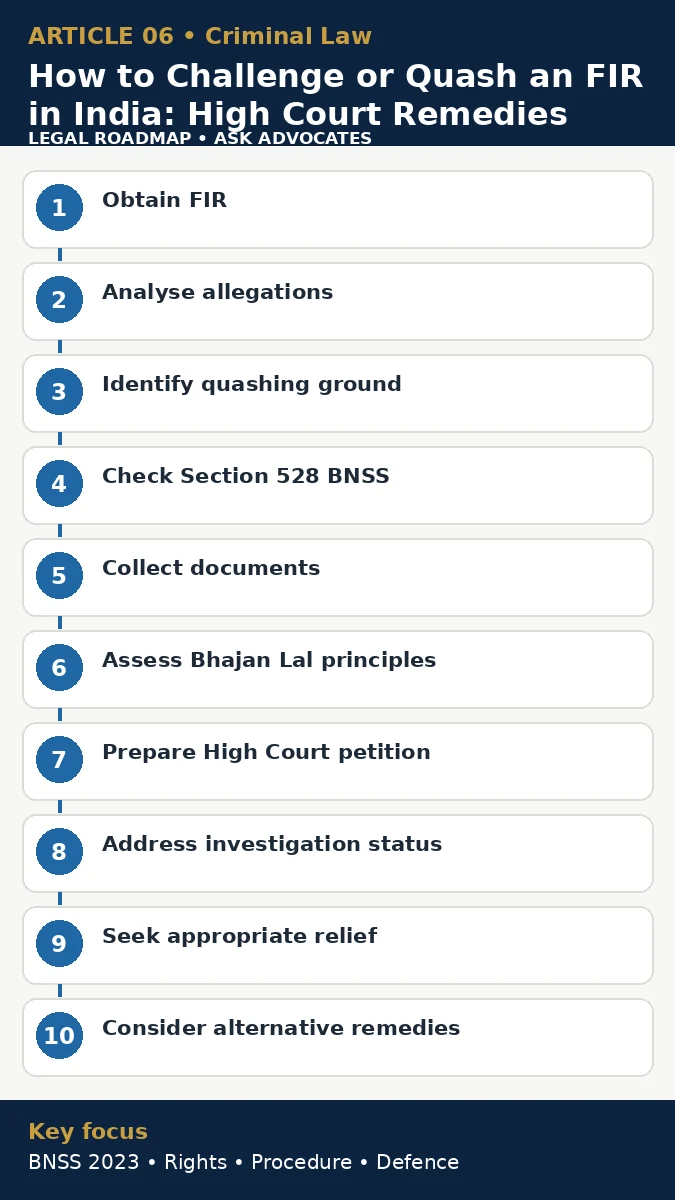
Ten-Step FIR Quashing Assessment
Step 1: Obtain the FIR
Do not rely solely on a verbal description.
Step 2: Identify Every Offence
List every BNS and special-statute provision.
Step 3: Break Down the Legal Ingredients
Identify the statutory ingredients of each alleged offence.
Step 4: Compare the Ingredients With the FIR
Ask whether the allegations, taken at face value, satisfy those ingredients.
Step 5: Check the Procedural Stage
Determine whether investigation, charge sheet, cognizance or trial has commenced.
Step 6: Check for Legal Bars
Examine sanction, limitation, jurisdiction and other statutory restrictions.
Step 7: Test for Abuse of Process
Look for manifest mala fide conduct or other exceptional circumstances.
Step 8: Assess Available Evidence
Separate conclusive material from disputed factual defences.
Step 9: Select the Correct Remedy
Consider quashing, bail, discharge, statutory remedy or trial defence.
Step 10: Draft the Relief Precisely
Identify exactly which FIR, proceedings, order or charge sheet should be quashed.
Frequently Asked Questions
Can an FIR be quashed in India?
Yes. The High Court can exercise its inherent powers under Section 528 BNSS to prevent abuse of process or secure the ends of justice. The power is extraordinary and is exercised cautiously.
What is Section 528 BNSS?
Section 528 BNSS preserves the inherent powers of the High Court to make orders necessary to give effect to the BNSS, prevent abuse of court process or secure the ends of justice. It corresponds broadly to Section 482 CrPC.
What are the Bhajan Lal grounds for quashing an FIR?
The Bhajan Lal principles identify illustrative circumstances involving absence of an offence, absence of a cognizable offence, legal bars, absurd allegations, manifest mala fides and abuse of process. They remain a leading framework for FIR-quashing analysis.
Can an FIR be quashed after a charge sheet is filed?
Yes. Filing a charge sheet does not create an absolute bar to Section 528 jurisdiction. The Supreme Court has considered and granted quashing relief after a charge sheet where continuation of the prosecution was found to constitute an abuse of process.
Can a false FIR be quashed by the High Court?
Potentially, but simply describing an FIR as false is insufficient. The petitioner should demonstrate a recognised legal ground for intervention, such as absence of the ingredients of an offence, legal prohibition or manifest abuse of process.
Can an FIR be quashed after compromise?
In appropriate cases, yes. The court considers the nature of the offence, the private or public character of the dispute, the interests of victims and wider societal considerations. A settlement does not automatically require quashing.
Important Case Law
1. State of Haryana v. Bhajan Lal
Citation: 1992 Supp (1) SCC 335
This remains the foundational authority for identifying illustrative circumstances in which the High Court may exercise inherent jurisdiction to prevent abuse of criminal process.
The principles must be understood as illustrative rather than as a mechanical seven-point formula.
2. Neeharika Infrastructure Pvt. Ltd. v. State of Maharashtra
Citation: 2021 SCC OnLine SC 315
The Supreme Court provided extensive guidance concerning High Court interference with criminal investigation.
The decision emphasised that investigation is ordinarily a statutory function of the police and that High Courts should exercise restraint while considering challenges to FIRs.
The Court also cautioned against routinely staying investigations merely because a petition seeking quashing has been filed.
3. R.P. Kapur v. State of Punjab
Citation: AIR 1960 SC 866
This is an early and important authority concerning the inherent jurisdiction of the High Court in criminal proceedings.
It remains part of the doctrinal foundation from which later Section 482 and Section 528 jurisprudence developed.
4. M. Srikanth v. State of Telangana
The Supreme Court has continued to rely upon the principles governing the limited and cautious exercise of inherent jurisdiction.
A 2025 Supreme Court judgment expressly referred to State of Haryana v. Bhajan Lal, M. Srikanth and Balaji Traders while explaining the operation of Section 528 BNSS.
5. Samadhan v. State of Maharashtra
2025 INSC 1351
This decision is particularly useful for the current BNSS framework.
The Supreme Court considered a petition under Section 528 BNSS after a charge sheet had been filed. It examined the allegations and surrounding material and concluded that the alleged offence was not made out on the facts presented at the threshold.
The Court consequently allowed the appeal and quashed the criminal proceedings.
The decision demonstrates that the High Court’s Section 528 jurisdiction does not disappear merely because investigation has concluded.
6. 2025 Supreme Court Decision on Manifest Mala Fides
In an August 2025 decision, the Supreme Court cautioned against treating disputed factual allegations as sufficient for quashing.
The Court explained that whether an allegation of misrepresentation was true was a factual issue unsuitable for determination in the inherent-jurisdiction proceeding. It also emphasised that “manifestly attended with mala fide” requires the mala fide character to be apparent rather than merely asserted.
This is an important limitation on the use of mala fide as a quashing ground.
7. Prashant v. State of NCT of Delhi
(2025) 5 SCC 764
The Supreme Court considered criminal proceedings arising from a relationship between adults and examined whether the ingredients of the alleged offence were actually disclosed.
The decision illustrates an important principle: the High Court can intervene where, even taking the prosecution allegations at face value, the essential ingredients of the offence are absent.
The case should nevertheless be applied according to its specific facts and offence involved.
Relevant Statutory Framework
The principal provisions to examine include:
- Constitution of India, particularly Articles 14 and 21;
- Bharatiya Nagarik Suraksha Sanhita, 2023;
- Bharatiya Nyaya Sanhita, 2023;
- Bharatiya Sakshya Adhiniyam, 2023;
- applicable special criminal statutes;
- applicable sanction provisions;
- limitation provisions where relevant; and
- binding Supreme Court precedent.
Important BNSS Provisions
| Provision | Relevance |
|---|---|
| Section 35 | Arrest without warrant |
| Section 173 | Information concerning cognizable offences |
| Section 187 | Custody and investigation period |
| Section 193 | Police report after investigation |
| Section 482 | Anticipatory bail |
| Section 483 | Regular bail powers of Sessions Court / High Court |
| Section 528 | Inherent powers of High Court |
Section 528 is the principal statutory provision for the quashing jurisdiction discussed in this article.
Quashing Versus Other Criminal Remedies
| Problem | Potential Remedy |
|---|---|
| Immediate fear of arrest | Anticipatory bail |
| Accused already arrested | Regular bail |
| FIR legally unsustainable | Section 528 quashing |
| No sufficient material after investigation | Discharge / appropriate statutory remedy |
| Illegal investigation | Appropriate High Court remedy |
| Serious procedural violation | Case-specific judicial remedy |
| Settlement of private dispute | Possible Section 528 intervention where legally appropriate |
| Conviction | Appeal / revision as applicable |
The same accused may have more than one possible remedy.
The correct remedy depends on the exact stage and objective.
When Should You Approach the High Court for FIR Quashing?
A High Court remedy may require urgent consideration where:
- the FIR does not disclose the ingredients of the alleged offence;
- the allegations are legally impossible;
- there is an express statutory bar;
- the proceeding is manifestly malicious;
- continuation would clearly abuse the court process;
- a legally recognised settlement exists in a predominantly private dispute;
- investigation is being used for an impermissible purpose;
- the charge sheet still fails to disclose the alleged offence; or
- another exceptional circumstance makes judicial intervention necessary.
A petition should not be filed merely because the accused believes the FIR is unfair.
The threshold for extraordinary jurisdiction is higher.
What Should You Avoid in a Quashing Petition?
Avoid treating the petition as a trial defence.
The High Court is not normally the forum for detailed witness credibility analysis.
Avoid excessive factual narration.
The court needs the facts necessary to understand the legal defect.
Avoid unsupported allegations of mala fide.
Mala fide must be demonstrated through relevant circumstances.
Avoid relying on repealed procedural provisions without explanation.
The present procedural provision is Section 528 BNSS.
Avoid ignoring subsequent proceedings.
If a charge sheet or cognizance order exists, the petition should address the complete procedural chain.
Avoid seeking blanket relief without identifying the proceedings.
The prayer should precisely identify the FIR, charge sheet, cognizance order or consequential proceeding challenged.
Practical Document Checklist
Before filing a Section 528 petition, counsel should normally examine:
- FIR;
- complaint or information;
- relevant statutory provisions;
- notice under Section 35, if any;
- arrest documents, if applicable;
- bail orders;
- remand orders;
- investigation documents legally available;
- charge sheet, if filed;
- cognizance order;
- summons or process;
- relevant contracts or public records;
- settlement documents, where applicable;
- previous court orders;
- documents demonstrating any statutory bar; and
- material supporting the specific quashing ground.
The petition should then be structured around the strongest legal ground rather than the largest volume of documents.
Read More
Conclusion
An FIR is not equivalent to a conviction.
The High Court retains inherent jurisdiction under Section 528 BNSS to prevent abuse of criminal process and secure the ends of justice. The power is extraordinary and must be exercised cautiously, but it remains an important safeguard against legally unsustainable criminal proceedings.
The leading Bhajan Lal principles continue to provide a practical framework. They include situations where the allegations do not constitute an offence, where a cognizable offence is absent, where a legal bar exists, where allegations are inherently improbable, where proceedings are manifestly malicious, or where continuation would amount to abuse of process.
At the same time, a High Court is not ordinarily expected to conduct a mini-trial.
A petitioner therefore needs more than a denial of the allegations.
The strongest petitions usually identify a threshold legal defect.
That may involve the absence of essential ingredients, an express legal bar, manifest abuse, a legally unsustainable prosecution theory, or another exceptional circumstance warranting intervention.
The filing of a charge sheet does not automatically extinguish Section 528 jurisdiction. The Supreme Court’s 2025 decision in Samadhan demonstrates that intervention can remain available even after investigation has concluded where continuation of the prosecution is legally unsustainable.
Settlement can also be relevant in appropriate private disputes, but it does not automatically terminate serious offences involving broader public interest.
The practical principle is therefore:
Do not approach FIR quashing as a substitute for trial. Approach it as an extraordinary remedy against a criminal process that is legally unsustainable, abusive or contrary to the ends of justice.
Legal Disclaimer
This article provides general information about FIR quashing and High Court criminal jurisdiction in India. It does not constitute legal advice and does not create an advocate-client relationship. The availability of a quashing remedy depends on the exact FIR, statutory provisions, evidence, procedural stage, jurisdiction and applicable precedent. Special criminal statutes may impose additional requirements.