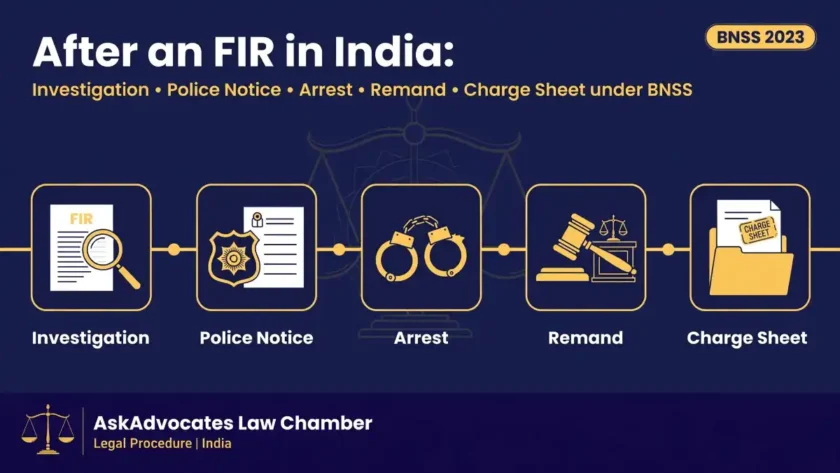
Introduction: An FIR is not the end of a criminal case. It is generally the beginning of the formal criminal investigation process. First, after recording information regarding a cognizable offence, the investigating officer immediately collects relevant physical evidence and examines key witnesses. Subsequently, the police conduct necessary searches, seize critical documents, and issue statutory notices to all concerned parties. Furthermore, officers execute arrests whenever the law explicitly justifies taking the accused into custody. Finally, the police present the completed investigation report before the competent Magistrate for judicial scrutiny.
The procedural framework has changed significantly since the Bharatiya Nagarik Suraksha Sanhita, 2023 came into force on 1 July 2024. The BNSS replaced the Code of Criminal Procedure, 1973 for proceedings governed by the new framework. India Code records the BNSS as Act No. 46 of 2023 and identifies its enforcement date as 1 July 2024.
Therefore, a person involved in an FIR should not rely mechanically on old CrPC terminology. The relevant provisions now include Sections 173, 175, 176, 180, 187 and 193 of the BNSS, together with the arrest and notice safeguards under Section 35.
The Supreme Court has also clarified important safeguards concerning arrest after an FIR. In Satender Kumar Antil v. Central Bureau of Investigation, decided on 15 January 2026, the Court held that for offences punishable with imprisonment up to seven years, a notice under Section 35(3) BNSS is the rule, while arrest is an exception requiring statutory justification.
This article explains what normally happens after an FIR, what the police can do, when arrest may occur, what remand means, how investigation concludes, and what a charge sheet or final report means.
What Happens Immediately After an FIR?
First, legal practitioners must recognize that the registration of a First Information Report (FIR) does not establish criminal guilt. Instead, an FIR merely records initial information concerning an alleged cognizable offence. Subsequently, the investigating authority must conduct a thorough inquiry to determine whether the suspect actually committed the alleged crime. During this process, officers examine what evidence exists to evaluate whether the state should initiate formal prosecution. Under the modernized criminal procedure framework, Section 173 of the Bharatiya Nagarik Suraksha Sanhita (BNSS) explicitly governs information regarding cognizable offences. Furthermore, this provision allows citizens to submit information either orally or through electronic communication channels.
FIR Registration and Preliminary Inquiry Procedure Under Section 173 BNSS
The station house officer must then supply a copy of the recorded information to the informant or victim free of cost. In addition, Section 173 authorizes a limited preliminary inquiry for specified offences punishable with three to seven years of imprisonment. However, the investigating officer must satisfy strict statutory conditions and secure prior permission from a Deputy Superintendent of Police before conducting this inquiry. Once the formal investigation commences, the investigating officer actively gathers all physical and documentary material relevant to the allegations. Ultimately, this structured procedure ensures that law enforcement establishes concrete evidentiary proof before taking further coercive action. Therefore, defense counsel must scrutinize every step of the investigation under Section 173 BNSS to safeguard the constitutional rights of the accused.
The investigation can involve:
- visiting the scene;
- identifying witnesses;
- recording witness statements;
- collecting documentary evidence;
- collecting electronic evidence;
- conducting searches;
- making seizures;
- obtaining forensic material;
- examining medical evidence;
- questioning relevant persons;
- identifying suspects;
- considering whether arrest is legally necessary;
- maintaining the investigation record; and
- eventually forming an opinion regarding the evidence.
First, the Supreme Court defines criminal investigation as a multi-stage process where the officer proceeds to the crime scene and ascertains the underlying facts. Subsequently, the investigating authority collects vital evidence, conducts necessary searches, and executes arrests whenever legal circumstances warrant. Finally, the officer evaluates the gathered material to form an independent legal opinion on whether the evidence discloses a committed offence.
Does Filing an FIR Mean the Accused Will Be Arrested?
No.
Registration of an FIR and arrest are legally distinct events.
An FIR can exist while the person named or suspected remains outside custody. The investigating officer must apply the statutory requirements governing arrest. Arrest cannot be treated as an automatic consequence of every FIR.
This distinction is particularly important for offences punishable with imprisonment up to seven years.
Section 35 BNSS governs arrest without warrant in the relevant circumstances. The Supreme Court’s 2026 decision in Satender Kumar Antil v. CBI provides important guidance on how Section 35 must operate.
The Court held that, for offences punishable with imprisonment up to seven years, a notice under Section 35(3) is ordinarily the rule. If the person complies with the notice and continues to comply, arrest is not to be made merely because an FIR exists. Arrest requires the statutory conditions and reasons contemplated by Section 35.
The Court further clarified that failure to comply with a notice does not automatically require arrest. The investigating agency must still consider whether arrest is necessary.
This reinforces the constitutional importance of personal liberty under Article 21.
Police Notice Under Section 35 BNSS
A person receiving a police notice after an FIR should not ignore it.
First, Section 35(3) of the Bharatiya Nagarik Suraksha Sanhita (BNSS) establishes the formal procedure for issuing a notice of appearance to a suspect. Consequently, the police officer directs the individual to present themselves for questioning whenever the law does not explicitly require an immediate arrest.
The Supreme Court’s January 2026 ruling makes the position particularly important. For offences punishable with imprisonment up to seven years, the Court held that a Section 35(3) notice is the rule and arrest is the exception.
The recipient should therefore:
- read the notice carefully;
- identify the FIR number;
- identify the police station;
- note the date and time of appearance;
- identify the investigating officer;
- preserve the original notice;
- obtain legal advice where appropriate;
- comply with lawful requirements;
- maintain proof of appearance; and
- avoid assuming that appearance itself means admission of guilt.
First, recipients must never treat a police notice as an informal WhatsApp message. Subsequently, the Supreme Court of India clarified the exact legal parameters regarding the service of notices under Section 35. Specifically, in July 2025, the apex court ruled that electronic messaging platforms cannot simply substitute for the formal modes of service prescribed under the BNSS. Consequently, defense attorneys must carefully examine both the precise form and the actual delivery method of any police communication. Furthermore, legal counsel should challenge improper service rather than assuming that every digital message constitutes valid statutory notice. Ultimately, this judicial standard ensures that law enforcement strictly adheres to due process before demanding an individual’s appearance.
Can Police Arrest After Issuing a Section 35 Notice?
Yes, but the answer depends on the statutory circumstances.
Compliance with a notice is legally significant. The Supreme Court has held that where a person complies with a Section 35(3) notice and continues to comply, the police cannot simply arrest that person as a routine step. Reasons supporting the necessity of arrest must exist and be recorded as required by law.
The Court described notice as the rule and arrest as an exception for offences punishable with imprisonment up to seven years.
This principle does not mean that every person receiving a notice is permanently protected from arrest.
If circumstances subsequently arise that satisfy the statutory requirements, the police may exercise the power of arrest in accordance with Section 35. The legality of that arrest can depend upon:
- the punishment prescribed for the offence;
- the material collected;
- the necessity of arrest;
- the possibility of further offending;
- the possibility of evidence tampering;
- the possibility of influencing witnesses;
- the possibility of evasion;
- compliance with the notice; and
- other statutory circumstances.
The investigation must therefore be assessed on facts rather than on the mere existence of an FIR.
What Happens During Police Investigation?
First, the investigating officer systematically builds the evidentiary record immediately after registering the First Information Report. Subsequently, the officer coordinates several parallel investigatory activities to gather comprehensive proof. For instance, law enforcement examines key witnesses and obtains crucial documents from individuals, corporations, banks, and government departments. Furthermore, the officer preserves critical electronic records and collects relevant CCTV footage from the scene. Additionally, forensic experts examine electronic devices in strict accordance with applicable legal safeguards. Finally, the investigating team secures medical reports and forensic material wherever the circumstances of the crime demand specialized analysis.
The investigator may also conduct searches and seizures where authorised.
The BNSS contains provisions governing police investigation and related procedures. Section 175 permits police investigation of cognizable cases without a Magistrate’s order, subject to the statutory framework. Section 176 provides the procedure for investigation after the police officer has reason to suspect commission of an offence.
The quality of investigation can therefore become important for both sides.
For the complainant, inadequate investigation can result in relevant evidence being missed.
For the accused, an investigation may incorrectly rely upon inconsistent statements, unreliable documents, manipulated digital material, or evidence that does not establish the necessary ingredients of the alleged offence.
Can the Accused Defend Himself During Investigation?
The accused does not conduct the police investigation. However, the accused is not without legal remedies.
Depending upon the circumstances, an accused person may:
- comply with lawful notices;
- consult counsel;
- seek anticipatory bail where legally maintainable;
- challenge unlawful arrest;
- seek regular bail after arrest;
- preserve exculpatory evidence;
- produce relevant documents through appropriate legal channels;
- challenge unlawful investigation in suitable proceedings;
- seek quashing where the legal requirements are satisfied;
- raise objections before the competent court; and
- contest the prosecution case during subsequent proceedings.
The appropriate remedy depends heavily on the procedural stage.
For example, the question of whether an FIR should be quashed is different from the question of whether a person should receive bail.
Similarly, an allegation of defective investigation is different from an allegation that the FIR itself does not disclose an offence.
This distinction is important because different remedies operate at different stages.
AskAdvocates already has a separate article dealing with arrest rights under the BNSS. Article 4 should therefore link to that resource rather than duplicate its detailed treatment of grounds of arrest, family notification, lawyer consultation and other arrest safeguards.
What Is Remand Under BNSS?
Remand becomes relevant when an arrested person cannot simply be released and the investigation cannot be completed within the initial period permitted by law.
Section 187 BNSS governs the procedure when investigation cannot be completed within twenty-four hours.
Where a person has been arrested and the investigation cannot be completed within the applicable twenty-four-hour period, the police must forward the accused and relevant diary material to the Magistrate in accordance with Section 187.
The Magistrate then considers whether further detention is legally justified.
Remand is therefore a judicially supervised custody process. It is not merely an administrative extension of police custody.
Depending on the statutory conditions, custody can involve police custody or judicial custody. Section 187 also contains provisions concerning the overall period of detention relevant to what is commonly called statutory or default bail.
For certain serious offences, the statutory investigation period can extend to ninety days. For other offences, the relevant period is sixty days. The precise application depends upon the offence and statutory conditions.
This is one reason why the date of arrest and the precise offences invoked in the FIR can become legally significant.
Police Custody and Judicial Custody Are Different
These terms should not be confused.
Police Custody
Police custody means the accused remains in the custody of the investigating police authorities pursuant to judicial authorisation.
It may be sought where investigators claim that custody is necessary for purposes such as investigation, recovery, confrontation with material or other legally permissible investigative purposes.
The Magistrate must consider the statutory requirements before authorising custody.
Judicial Custody
Judicial custody generally means that the accused is placed in custody under the authority of the court rather than being held in the investigating officer’s physical custody.
The investigation can continue while the accused remains in judicial custody.
Therefore, judicial custody does not mean that the criminal case has ended. It only describes the custody status during the proceeding.
What Is Default Bail?
Default bail is a statutory safeguard associated with failure to complete the investigation and submit the required police report within the applicable statutory period.
Section 187 BNSS contains the relevant framework.
The applicable period depends upon the offence. The commonly relevant periods are sixty days or ninety days, subject to the statutory conditions and the nature of the offence.
Default bail should not be confused with ordinary bail on merits.
Regular bail asks whether the accused should be released based on the circumstances of the case.
Default bail arises from the statutory consequence associated with expiry of the prescribed investigation period, subject to the legal requirements for claiming and furnishing bail.
The calculation of the period can be legally complex. The arrest date, custody periods, offence provisions, filing of the police report, and the accused’s readiness to furnish bail can all become relevant.
Accordingly, anyone approaching the statutory deadline should obtain immediate case-specific legal advice rather than relying on a generic online calculation.
How Long Does Police Investigation Take After an FIR?
There is no single universal period applicable to every FIR.
The duration can depend on:
- the nature of the offence;
- number of accused persons;
- number of witnesses;
- volume of documentary evidence;
- electronic evidence;
- forensic examination;
- medical evidence;
- interstate investigation;
- international evidence;
- financial transactions;
- corporate records;
- expert opinions;
- search and seizure requirements; and
- other statutory requirements.
Section 193 BNSS states that investigation should be completed without unnecessary delay. It also prescribes a specific two-month investigation period for certain specified sexual offences involving children and women covered by the provision.
Therefore, a complainant should not assume that every FIR must result in a charge sheet within a fixed number of days.
At the same time, unnecessary investigative delay can raise legal issues. In an appropriate case, the affected party may seek judicial intervention where the investigation is demonstrably stalled, biased, unlawful or otherwise defective.
What Is a Charge Sheet Under BNSS?
A charge sheet is commonly used to describe the police report submitted after the investigating officer completes the investigation and forms an opinion that prosecution should proceed.
The BNSS uses the expression report of the police officer on completion of investigation in Section 193.
The police report contains prescribed particulars concerning the case, including relevant information about the parties, the nature of the information, persons acquainted with the circumstances, whether an offence appears to have been committed and other statutory details.
The report may be accompanied by relevant statements and documents.
Section 193 also permits submission of the police report and documents through electronic communication in accordance with the statutory framework.
The filing of a charge sheet does not mean that the accused has been convicted.
It means that the investigating agency has completed the investigation to the stage of submitting its report and has taken a position concerning prosecution.
The court must then apply its judicial mind to the material placed before it.
What Is a Final Report or Closure Report?
Not every investigation ends with a charge sheet against an accused.
The investigating agency may conclude that:
- the alleged offence was not established;
- sufficient evidence is unavailable;
- the accused cannot be connected with the offence;
- the allegations are otherwise unsupported; or
- another legally recognised conclusion should be recorded.
The police may consequently submit a final report or closure report rather than a prosecution charge sheet.
The Magistrate is not necessarily required to accept the police conclusion mechanically.
The court has its own judicial role in considering the report and the material placed before it.
The Supreme Court has explained that the investigation culminates in the formation of an opinion regarding whether an offence appears to have been committed and whether a charge sheet or final report should be submitted.
This distinction is particularly important for complainants who disagree with a closure report.
Depending on the circumstances, the complainant may have legal avenues to challenge the conclusion through the appropriate procedural mechanism.
Can Further Investigation Take Place After a Charge Sheet?
Yes, further investigation remains legally possible in appropriate circumstances.
Section 193(9) BNSS expressly recognises further investigation after submission of the police report, subject to the statutory framework.
The issue has received important judicial clarification in 2026.
In Pramod Kumar v. State of Uttar Pradesh, decided on 4 February 2026, the Supreme Court considered the relationship between Section 173(8) CrPC and Section 193(9) BNSS. The Court held that once a final report has been submitted, the investigating agency cannot independently proceed with further investigation without obtaining the required leave of the competent Magistrate or court.
The decision is important because it confirms that further investigation is not an uncontrolled executive power after the judicial process has been engaged.
The BNSS also provides a specific framework for further investigation during trial, including judicial permission and a statutory completion period subject to extension by the court.
What Happens After the Charge Sheet Is Filed?
The next stage is no longer simply a police investigation.
The matter moves further into the judicial process.
Depending on the case, the court may consider:
- whether it has jurisdiction;
- whether the police report discloses an offence;
- whether cognizance should be taken;
- whether process should issue;
- whether documents must be supplied;
- whether the case is triable by a Magistrate or Sessions Court;
- whether discharge is legally available;
- whether charges should be framed; and
- whether the matter should proceed to trial.
The filing of the charge sheet therefore does not automatically establish that charges will ultimately be framed against every person named in the police report.
Judicial scrutiny continues.
The Supreme Court has recognised that after receiving the police report, the competent court must apply its mind to the material before proceeding according to law.
What Should an Accused Person Do After an FIR?
A person who learns that an FIR has been registered should avoid panic and avoid destroying or altering evidence.
A sensible first response is to establish the exact procedural position.
Obtain the Basic Case Information
Record:
- FIR number;
- police station;
- date of FIR;
- sections invoked;
- complainant’s identity;
- accused persons named;
- investigating officer;
- notice received, if any;
- arrest status;
- court proceedings;
- next date, if applicable.
Preserve Evidence
Preserve original:
- emails;
- messages;
- contracts;
- invoices;
- bank records;
- photographs;
- videos;
- location information;
- CCTV material;
- call records;
- medical documents; and
- other potentially relevant material.
Do not delete or manipulate potentially relevant electronic material.
Obtain the FIR and Notices
The precise allegations and statutory sections should be reviewed.
The defence strategy can change significantly depending on whether the FIR alleges a bailable offence, a serious non-bailable offence, an offence punishable up to seven years, or an offence carrying a substantially higher punishment.
Seek Appropriate Legal Advice
Legal advice should identify the immediate procedural remedy.
That may involve:
- responding to a notice;
- anticipatory bail;
- regular bail;
- representation to investigating authorities;
- petition for quashing;
- challenge to unlawful investigation;
- discharge;
- defence preparation; or
- another statutory remedy.
There is no single remedy that applies to every FIR.
What Should a Complainant Do After an FIR?
A complainant should also actively preserve evidence.
Registration of an FIR does not guarantee a particular investigative result.
The complainant should maintain:
- original documents;
- transaction records;
- photographs;
- videos;
- electronic communications;
- witness information;
- medical records;
- financial records;
- chronology of events;
- property records; and
- previous complaints or representations.
If important evidence is omitted from the investigation, legal advice may be necessary concerning appropriate representations or judicial remedies.
The complainant should also distinguish between criminal prosecution and parallel civil remedies.
For example, a property dispute may involve both criminal allegations and civil rights. A contractual dispute may involve arbitration or civil proceedings alongside criminal allegations where the statutory ingredients of an offence are independently established.
A criminal FIR should not automatically be treated as a substitute for every civil or commercial remedy.
FIR to Charge Sheet: A Practical Flow
The post-FIR process can be understood broadly as follows:
| Stage | What Happens | Key BNSS Framework |
|---|---|---|
| FIR | Information concerning cognizable offence is recorded | Section 173 |
| Investigation | Police collect facts and evidence | Sections 175–176 |
| Notice | Person may be required to appear instead of immediate arrest where applicable | Section 35 |
| Arrest | Arrest may occur when statutory requirements are satisfied | Section 35 |
| Remand | Magistrate considers custody beyond the initial period | Section 187 |
| Evidence Collection | Statements, documents, searches, seizures and forensic material | Investigation provisions |
| Police Report | Investigation culminates in police report | Section 193 |
| Charge Sheet | Prosecution report is submitted where offence appears established | Section 193 |
| Closure/Final Report | Police may report that prosecution is not warranted | Section 193 |
| Further Investigation | Additional investigation may occur subject to statutory and judicial safeguards | Section 193(9) |
| Judicial Stage | Court considers cognizance and subsequent proceedings | Applicable BNSS provisions |
This table is a practical overview. Special statutes can modify ordinary criminal procedure.
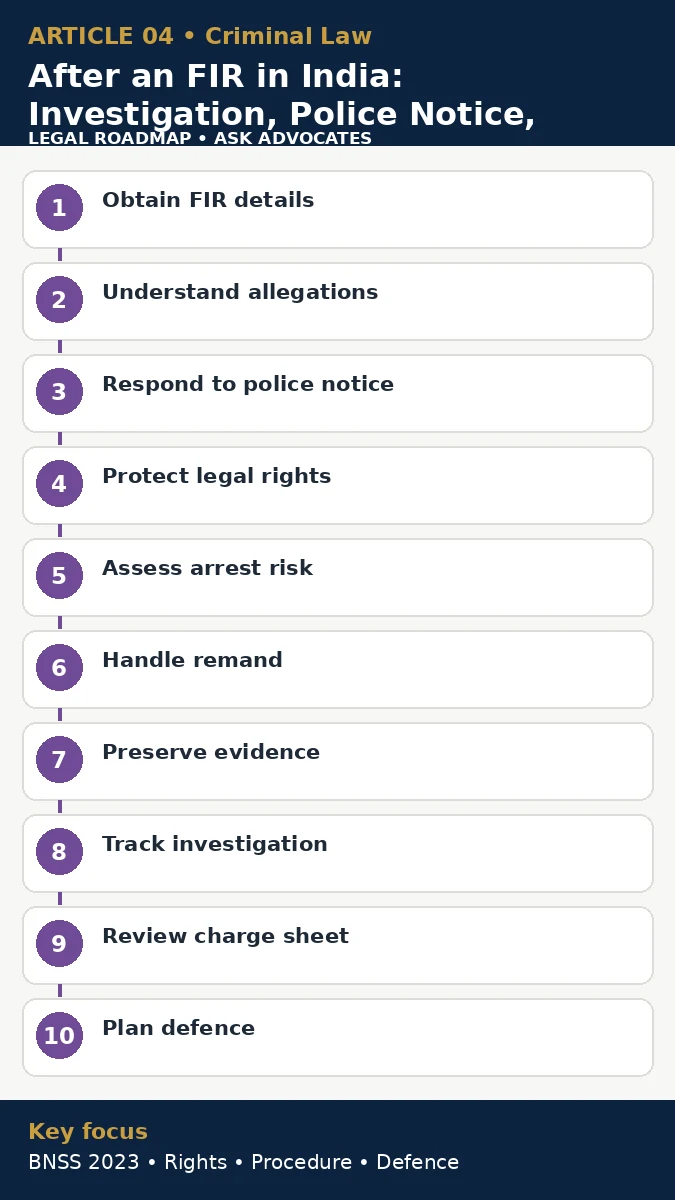
Ten-Step Action Plan After an FIR
Step 1: Obtain the FIR Details
Record the FIR number, date, police station and statutory provisions invoked.
Step 2: Identify the Procedural Stage
Determine whether the matter is at investigation, notice, arrest, remand, bail, charge sheet or trial stage.
Step 3: Preserve Evidence
Secure original documents and electronic material without alteration or deletion.
Step 4: Examine the Allegations
Compare each allegation with the ingredients of the offences invoked.
Step 5: Check Notice Requirements
If a Section 35 notice is issued, examine its contents, service and compliance requirements.
Step 6: Assess Arrest Risk
Determine whether arrest is legally contemplated and whether anticipatory bail or another protective remedy is appropriate.
Step 7: Track Custody Dates
If arrest occurs, record the exact arrest time and all remand orders.
Step 8: Monitor Investigation
Track material developments, notices, searches, seizures and court proceedings through lawful means.
Step 9: Examine the Police Report
When the investigation concludes, examine whether a charge sheet, final report or other police report has been filed.
Step 10: Select the Judicial Remedy
Depending upon the report and circumstances, consider bail, discharge, quashing, protest proceedings, further-investigation remedies, defence strategy or trial preparation.
Frequently Asked Questions
What happens after an FIR is filed in India?
The police may begin investigation, collect evidence, examine witnesses, conduct searches and seizures, issue statutory notices, and consider arrest where legally justified. The investigation ultimately leads to a police report under Section 193 BNSS.
Can police arrest immediately after an FIR?
An FIR does not automatically require arrest. Section 35 BNSS governs arrest without warrant. For offences punishable with imprisonment up to seven years, the Supreme Court has held that a Section 35(3) notice is ordinarily the rule and arrest is an exception requiring statutory justification.
What is a Section 35 notice under BNSS?
It is a statutory notice requiring a person to appear before the police when arrest is not otherwise required under the applicable legal framework. The Supreme Court has clarified that compliance with the notice is legally significant.
What happens if the accused is arrested after an FIR?
The arrested person must be dealt with according to the statutory arrest and custody safeguards. If investigation cannot be completed within the initial twenty-four-hour period, Section 187 BNSS provides the procedure for production before a Magistrate and further detention.
How long can police investigate before filing a charge sheet?
There is no single universal deadline for every FIR. Section 193 requires investigation to be completed without unnecessary delay and provides specific periods for certain offences. Custody-related statutory periods under Section 187 can also become relevant to default bail.
Can police conduct further investigation after filing a charge sheet?
Yes, further investigation is recognised under Section 193(9) BNSS. However, the Supreme Court’s 2026 decision in Pramod Kumar v. State of Uttar Pradesh clarified the requirement of obtaining the appropriate judicial leave before further investigation after submission of the final report.
Important Case Law
1. Satender Kumar Antil v. Central Bureau of Investigation
The Supreme Court’s 15 January 2026 decision is particularly important for Section 35 BNSS.
The Court held that, for offences punishable with imprisonment up to seven years, notice under Section 35(3) is the rule. Arrest is an exception requiring satisfaction of the statutory conditions. The Court also clarified that non-compliance with notice does not automatically mandate arrest.
2. Arnesh Kumar v. State of Bihar, (2014) 8 SCC 273
The Supreme Court emphasised that arrest for offences carrying punishment up to seven years cannot be made mechanically. The police must consider whether arrest is necessary and record the relevant reasons. The principles remain highly relevant to understanding the arrest safeguards now reflected in Section 35 BNSS.
3. Lalita Kumari v. Government of Uttar Pradesh, (2014) 2 SCC 1
The Constitution Bench established the general principle that where information discloses a cognizable offence, FIR registration is mandatory, subject to limited categories permitting preliminary inquiry. The principle remains important when understanding the relationship between information, FIR registration and investigation.
4. H.N. Rishbud and Inder Singh v. State of Delhi, (1955) 1 SCR 115
The Supreme Court explained the general stages of criminal investigation, including collection of facts and evidence and formation of the investigating officer’s opinion leading to the police report. The decision continues to provide useful conceptual guidance when analysing the investigation process.
5. Pramod Kumar v. State of Uttar Pradesh, 2026 INSC 120
The Supreme Court’s 4 February 2026 judgment is significant under the current BNSS framework. It held that after submission of the final report, further investigation cannot be undertaken by the investigating agency without obtaining the required leave of the competent court.
Relevant Statutes
The principal legal framework for this article includes:
- Constitution of India, particularly Articles 21 and 22;
- Bharatiya Nagarik Suraksha Sanhita, 2023;
- Bharatiya Nyaya Sanhita, 2023;
- Bharatiya Sakshya Adhiniyam, 2023;
- applicable special criminal statutes;
- applicable State police rules and procedural directions; and
- judicial precedents interpreting criminal procedure.
The BNS concerns substantive criminal offences. The BNSS principally governs criminal procedure. The BSA governs general principles concerning evidence. India Code identifies the three 2023 enactments as the principal new central criminal-law statutes, with the BNSS and BSA coming into force on 1 July 2024.
When Should You Consult a Criminal Lawyer?
Legal assistance becomes particularly important when:
- an FIR names you as an accused;
- police have issued a Section 35 notice;
- arrest is apprehended;
- a search or seizure has occurred;
- police seek remand;
- the accused has been arrested;
- statutory bail deadlines are approaching;
- important electronic evidence exists;
- the investigation appears one-sided;
- a closure report has been submitted;
- a charge sheet has been filed;
- the FIR appears legally unsustainable;
- parallel civil and criminal proceedings exist; or
- a High Court remedy may be required.
The earlier the procedural stage is identified, the more accurately the available remedies can be assessed.
A criminal case should be approached through its actual procedural status rather than through general assumptions about FIRs, arrest or charge sheets.
Conclusion
An FIR is the starting point of a criminal investigation, not a declaration of guilt. After an FIR, the police may investigate the allegations, collect evidence, examine witnesses, conduct searches, issue statutory notices and consider arrest where the BNSS permits it. The Supreme Court’s recent interpretation of Section 35 places particular importance on notice and limits routine arrest for offences punishable with imprisonment up to seven years.
If arrest occurs, Section 187 BNSS introduces judicial supervision over continued custody. The investigation eventually leads to a police report under Section 193. That report may result in prosecution, closure or another legally recognised outcome. The filing of a charge sheet does not amount to conviction. The court must independently proceed according to law.
Similarly, a closure report does not necessarily end every possible legal avenue available to a complainant. Further investigation can remain possible, but the 2026 Supreme Court decision in Pramod Kumar confirms the importance of judicial control after submission of the final report.
The most important practical principle is therefore simple:
After an FIR, identify the exact procedural stage, preserve evidence, comply with lawful requirements, and select the remedy that matches that stage.
Read More
Legal Disclaimer
This article provides general legal information concerning Indian criminal procedure. It does not constitute legal advice or create an advocate-client relationship. Criminal procedure can be modified by special statutes, State rules, judicial orders and case-specific circumstances. The applicable law should be independently verified before taking action in an individual matter.