
Practice Area: Property Law | Publication Day: Day 23 | Primary keyword: builder delay homebuyer remedies India
Related Legal Guides
Builder Delay and Homebuyer Remedies: RERA, Consumer Forum or Civil Court? addresses a defined search intent within Property Law. The article is deliberately narrower than the existing AskAdvocates material where overlap was identified. It explains the governing legal test, procedural sequence, evidence requirements and remedies while distinguishing general information from advice on a particular case.
Delayed Possession Requires a Strategy
When a builder misses possession, the buyer should decide the objective before choosing the forum. The buyer may want possession, refund, interest, compensation or a negotiated exit. The agreement, RERA record, payment history and project status must be examined together. Filing a complaint without deciding the objective can create inconsistent litigation.
RERA
RERA provides a specialised framework for real-estate regulation and allottee remedies. The applicable State RERA authority and rules should be checked. The buyer should verify project registration, promoter disclosures, promised possession date and current project status. RERA can provide a focused route, but the relief sought and jurisdiction must still be established.
Consumer Remedy
In Imperia Structures, the Supreme Court held that RERA does not automatically bar an eligible homebuyer from approaching the consumer forum. This means the buyer should compare remedies rather than assume that only RERA is available. Consumer jurisdiction, limitation and the exact relief should be verified before filing. The buyer should also avoid duplicative proceedings for the same relief without legal advice.
Refund or Possession
Long delay can create a decision between waiting for the property and seeking exit. Pioneer Urban and subsequent jurisprudence are important in assessing prolonged delay and refund-related relief. The buyer should calculate payments, contractual date, actual progress and financial consequences. The builder’s force-majeure defence must be tested against the evidence.
Evidence
Preserve agreement, allotment letter, receipts, bank statements, construction updates, correspondence, advertisements and RERA records. Prepare a chronology. If the builder has promised repeated possession dates, preserve each promise. The evidence should establish delay and the relief sought.
Execution
An order is only useful if it can be enforced. Settlement terms should state amount, interest, possession date, default consequences and release conditions. If the builder does not comply, use the forum’s execution mechanism. Do not rely on oral assurances.
Evidence That Decides the Issue
A delayed-possession case begins with dates, not frustration. Compare the agreement for sale, allotment letter, payment schedule and promised possession date with the RERA registration details and extensions, if any. Identify the contractual basis for delay, the actual construction status and communications from the promoter. The buyer should also check whether the project is registered, whether the relevant phase is covered, and whether the relief sought is possession, refund, interest, compensation or a combination that the chosen forum can grant.
Forum and Remedy Strategy
The Supreme Court has recognised that remedies under RERA and consumer law can coexist in appropriate circumstances, but the buyer must still select the forum strategically. *Imperia Structures Ltd. v Anil Patni* is important on consumer remedies; *Pioneer Urban* addresses the treatment of homebuyers and insolvency; and *Ireo Grace Realtech* is relevant to delayed possession and refund principles. The article should not tell readers simply to “file anywhere.” Forum, relief, limitation, project status, contractual terms and existing proceedings must be evaluated together.
Common Failure Points
A buyer seeking possession must establish the contractual and statutory entitlement to delivery and applicable interest or compensation. A buyer seeking exit and refund must establish why continued retention is legally and commercially unreasonable and identify the relief available under the selected statute. Payment schedules, bank statements, demand letters, construction updates, possession notices, RERA orders and correspondence should be organised chronologically. Delay calculations should be independently checked because a wrong starting date can distort both the remedy and the amount claimed.
When Specialist Legal Review Is Advisable
Promoters may rely on force majeure, approvals, changes in law, buyer default, contractual extension clauses or project circumstances. The response should examine the actual clause and evidence. A general assertion that “force majeure caused delay” is not the end of the inquiry. The buyer should identify the period of delay, whether the event legally qualifies, whether the promoter acted diligently, and whether the claimed event explains the entire delay. The same discipline should be applied to allegations that the buyer defaulted or failed to cooperate.
Current-Law and Statutory Accuracy
For builder delay, delayed possession and homebuyer forum selection, statutory accuracy requires the practitioner to identify the exact law, rule, notification and case-law proposition applicable on the date of the disputed event. Older terminology should be retained only when it describes a legacy proceeding or remains useful as a search term. Every material proposition should be traceable to the governing enactment, rule, judgment or official guidance.
Procedural and Forum Strategy
Forum selection in builder delay, delayed possession and homebuyer forum selection depends on the stage of the dispute, the relief required and the statutory allocation of jurisdiction. A technically available forum may still be strategically unsuitable if it cannot grant the needed relief or if an appeal is already prescribed. The reader should identify the present procedural stage before selecting a forum.
Evidence Architecture for the Case
The evidence architecture for builder delay, delayed possession and homebuyer forum selection should be built around the elements that must actually be proved. Organise primary documents first, then corroborating records and explanatory material. Each important proposition should have a document, witness or electronic record behind it. A chronology should expose contradictions and missing steps rather than merely repeat one party’s narrative.
Deadlines and Procedural Triggers
Timing is substantive in builder delay, delayed possession and homebuyer forum selection. Notice periods, limitation, response deadlines, statutory waiting periods and appeal windows can change the available remedy. Record the date of each operative document, calculate the next deadline from the governing provision and preserve proof of filing or service. Where the law changed during the relevant period, show which version governed each event.
Practical Decision Matrix
Choose the remedy after defining the commercial objective. If the buyer wants the apartment, the case should focus on enforceable possession and delay compensation. If the buyer wants an exit, the pleadings should focus on the statutory and contractual basis for refund and interest. Compare RERA and consumer jurisdiction, existing proceedings, limitation and execution mechanisms. A civil suit should not be chosen merely because it is familiar. The selected forum should have a clear legal route to the remedy the buyer actually needs.
Advanced Practical Analysis
Look-back periods
Avoidance analysis depends heavily on the relationship between the transaction date and insolvency commencement date. The statutory look-back differs by category and can also depend on whether a party is a related party. The applicant should therefore prepare a transaction schedule before forming the legal conclusion. A transaction outside the relevant period may require a different legal theory, while an apparently ordinary transaction within the period may still fall within a statutory exception.
Related-party analysis
Whether a counterparty is a related party can affect both the statutory analysis and the period within which a transaction may be challenged. The relationship should be tested under the Code and relevant corporate records, not merely based on informal association. Shareholding, control, management relationships and other statutory indicators may matter. The application should state the factual basis for related-party status so that the NCLT can see why the relevant provision applies.
Valuation evidence
An undervalued transaction requires reliable valuation evidence. The relevant comparison should reflect the asset, date, condition, rights transferred and market circumstances at the time. A later market price may be evidence but should not automatically become the transaction value benchmark. Independent valuation, financial statements, comparable transactions and expert evidence can help. The article should teach readers why hindsight can distort avoidance analysis.
Ordinary-course exceptions
Not every transaction with a creditor or related party is avoidable. Statutory exceptions and ordinary-course principles must be tested against the actual transaction and business practice. The company’s historical dealings, payment terms, board approvals and industry practice can be relevant. A transaction should not be labelled preferential merely because one creditor received payment during financial distress. The legal ingredients must be established in sequence.
Extortionate credit
Section 50 concerns credit transactions on terms that meet the statutory standard. The analysis should consider interest, fees, security, repayment terms, default consequences and the commercial context. A high rate alone may be insufficient. Conversely, a complex financing structure can still be challenged if its overall terms satisfy the Code. The application should therefore present the complete economics of the transaction.
Section 66 contribution
For fraudulent or wrongful trading, the applicant must identify the conduct, the persons responsible and the statutory basis for contribution. The section is not a general penalty provision for poor management. Evidence may include board records, financial statements, related-party transactions, diversion of assets and decisions taken when insolvency was unavoidable. The article should clearly distinguish ordinary business failure from conduct meeting the statutory standard.
Role of the resolution professional
The resolution professional or other authorised applicant must investigate transactions with appropriate diligence and preserve records. Bank statements, ledgers, emails, contracts, valuation reports and corporate minutes may need to be reconstructed from incomplete records. The application should explain the investigative methodology and identify the evidence supporting each statutory ingredient. A conclusory report without transaction-specific proof is vulnerable to challenge.
Relief and valuation of recovery
The NCLT remedy should correspond to the transaction category and statutory provision. Where avoidance assets have economic value, the applicant should quantify the benefit sought rather than merely request a declaration. Recent Supreme Court jurisprudence underscores why value assigned to avoidance claims can have significant insolvency consequences. The article should therefore connect legal classification with actual recovery value and the treatment of such value in the insolvency process.
Advanced Practical Analysis
Operational debt classification
Before issuing Section 8 notice, confirm that the debt arises from goods, services, employment or another category within the statutory definition of operational debt. A claim arising from financing may belong to the financial-debt route. Mixed claims should be separated where possible. The notice should not use “operational creditor” merely because the parties have a commercial relationship. The underlying source of the debt must be established.
Default date and limitation
The creditor should identify the exact date on which default occurred and ensure that the Section 8 notice and Section 9 application use consistent dates. Acknowledgements, part-payments and other events can affect limitation under the applicable law. The insolvency record should therefore contain a date schedule supported by invoices, ledger entries and payment evidence. A correct default date is central to both jurisdiction and limitation.
Notice content
The demand notice should state the amount, basis of the operational debt and relevant supporting material with sufficient clarity for the corporate debtor to understand the claim. The creditor should avoid inflating the demand with unsupported interest or unrelated claims. If several invoices are involved, attach a schedule. A well-structured notice reduces later disputes about what the debtor was actually required to answer.
Service proof
Service should be documented through the prescribed route. Preserve courier receipts, delivery reports, email evidence, acknowledgements and returned communications. If the debtor refuses delivery or changes address, the creditor should retain evidence showing the statutory method used. The Supreme Court’s recent Section 8 jurisprudence makes service a critical part of the Section 9 record rather than a minor administrative detail.
Pre-existing dispute evidence
Before filing Section 9, search all correspondence for an earlier dispute. Quality complaints, delay allegations, defective goods claims, contractual set-off, arbitration notices or emails disputing invoices can become important. The creditor should not conceal an earlier dispute merely because it believes the debtor’s objection is weak. Under *Mobilox*, the existence of a genuine pre-existing dispute can prevent admission of a Section 9 application.
Ten-day period
The ten-day period after receipt of the demand notice is a statutory stage that should be recorded precisely. The creditor should not file prematurely. If payment is made, record it. If a dispute is raised, preserve the communication and analyse whether it was pre-existing and genuine. If there is no response, preserve proof of expiry and then prepare the Section 9 filing.
Section 9 evidence bundle
The application should contain a coherent sequence: contract or source of debt, invoices, ledger, default evidence, Section 8 notice, proof of service, response if any, bank records where relevant, affidavit and required information. Every amount in the application should reconcile to the underlying documents. Inconsistency between the demand notice and Section 9 application can create avoidable objections.
Insolvency versus recovery
The IBC is not simply a faster debt-recovery forum. The applicant must satisfy the statutory requirements for insolvency commencement. If the claim is genuinely disputed or the insolvency threshold is not met, contractual arbitration, civil recovery, commercial litigation or another remedy may be more appropriate. The article should teach creditors to choose Section 9 because the statutory conditions are satisfied, not merely because the debtor is slow to pay.
Frequently Asked Questions
What can a homebuyer do if a builder delays possession?
Depending on the project and facts, the buyer may consider RERA, consumer remedies and other legally available proceedings. The correct forum depends on the relief sought, statutory coverage and existing proceedings.
Can a homebuyer seek refund for delayed possession?
Refund may be available where the applicable law and facts justify exit from the project. The agreement, delay, statutory rights and Supreme Court jurisprudence should be examined.
Is RERA the only remedy for builder delay?
No. Consumer remedies may remain available in appropriate cases, and other legal mechanisms can apply depending on the dispute. Forum selection should be deliberate.
What documents are needed for a delayed-possession case?
The agreement, allotment documents, payment records, demand letters, promised possession date, project/RERA records, correspondence and evidence of delay are central.
Can a builder rely on force majeure for every delay?
No. The promoter must establish the contractual and legal basis for the defence and connect the claimed event to the actual period and extent of delay.
How is interest or compensation decided?
It depends on the governing statute, contractual terms, applicable precedent, period of delay, relief selected and evidence placed before the forum.
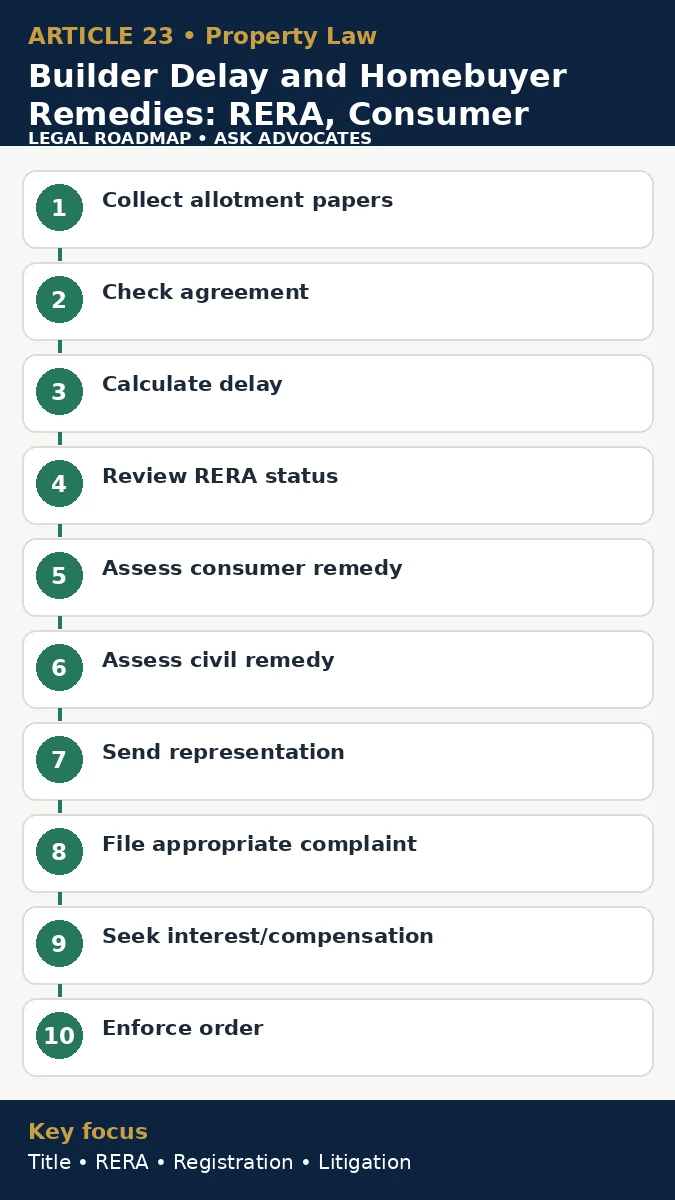
How To Proceed: 10-Step Roadmap
1. Review agreement
Collect the agreement for sale, allotment documents, payment schedule and promised possession date.
2. Verify RERA status
Check the project’s RERA registration, phase, declared completion date and any approved extension or order.
3. Calculate delay
Calculate the delay from the legally relevant possession date and verify every date against the documents.
4. Define desired remedy
Decide whether the primary objective is possession, refund, interest, compensation or another remedy.
5. Compare RERA/consumer/civil routes
Compare RERA and consumer jurisdiction based on the relief, limitation, project status and existing proceedings.
6. Preserve evidence
Preserve payment records, builder communications, construction updates and evidence of promised representations.
7. Issue representation
Analyse every builder defence, including force majeure, buyer default, approvals and contractual extensions.
8. File appropriate complaint
Prepare the complaint or petition with a precise chronology and quantified relief.
9. Address builder defences
Check limitation and procedural filing requirements before institution.
10. Enforce order
Plan execution at the outset by confirming how the selected forum’s order can practically be enforced.
Key Statutes, Rules and Judicial Authorities
Statutes and Rules
RERA 2016
Consumer Protection Act 2019
Applicable State RERA Rules
Specific Relief Act and contract law
Judicial Authorities
Imperia Structures Ltd. v. Anil Patni, (2020) 10 SCC 783
Pioneer Urban Land & Infrastructure Ltd. v. Govindan Raghavan, (2019) 5 SCC 725
Ireo Grace Realtech Pvt. Ltd. v. Abhishek Khanna, (2021) 3 SCC 241