
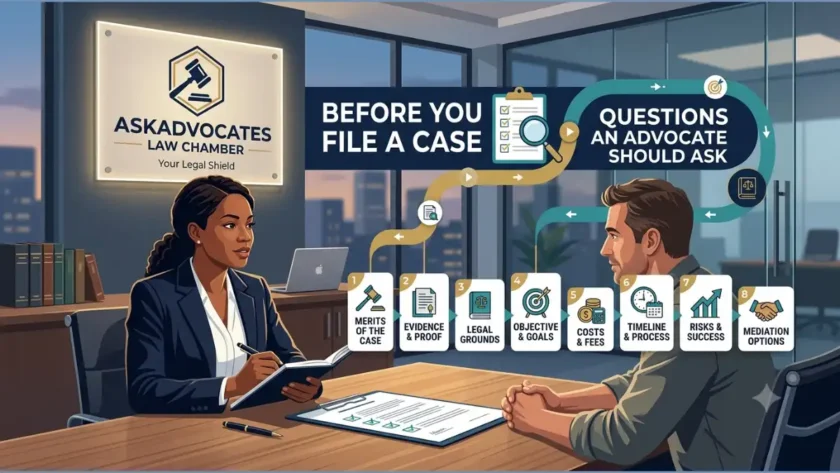
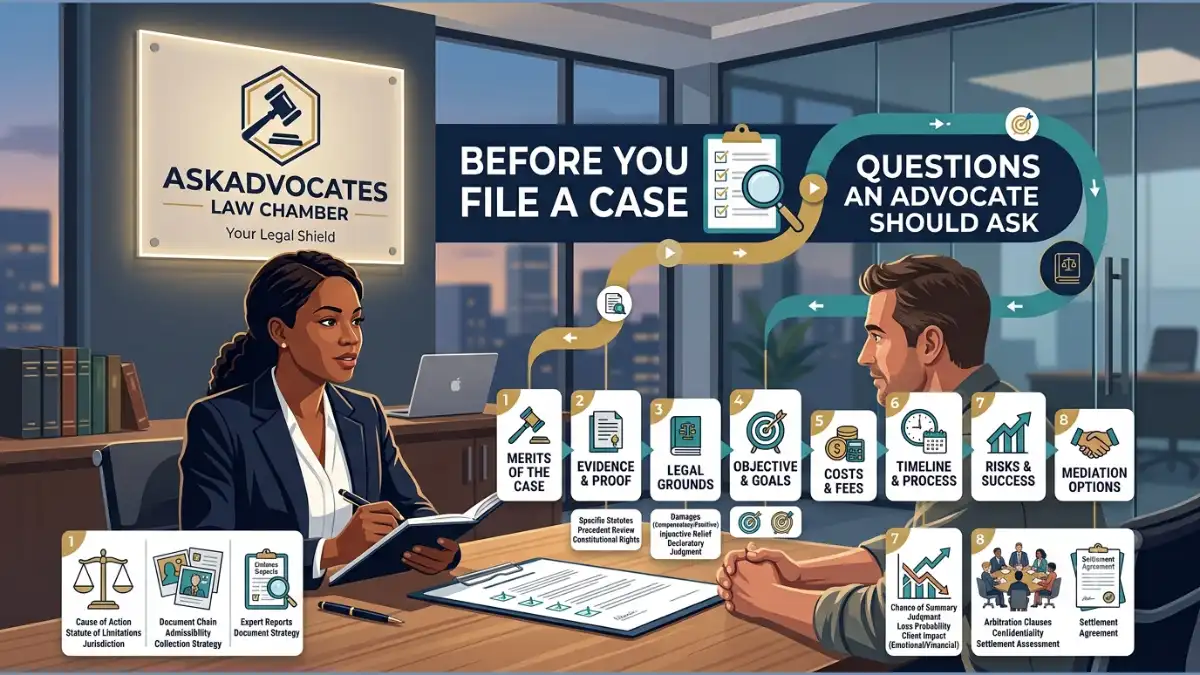
First, a high-quality initial legal consultation directly shapes how lawyers investigate and document a matter. Second, early legal guidance ensures that counsel presents the strongest possible case before filing. A client may arrive with a clear conclusion about who is right, but an advocate must first identify the facts, legal issues, evidence, parties, forum, limitation questions, available remedies and practical risks.
This guide explains the questions an advocate should ask before filing a case in India. First, this guide helps clients prepare for an effective legal consultation. Second, a careful case assessment often leads lawyers to recommend negotiation, mediation, administrative action, or a legal notice instead of immediate litigation.
Quick Answer: What Should an Advocate Ask Before Filing?
- What exactly happened, and when?
- Which legal right or interest did the other party allegedly affect?
- Who are all the relevant parties and decision-makers?
- What documents, messages, records or witnesses support the account?
- Which court, tribunal, authority or other forum has jurisdiction?
- Is the proposed claim within the applicable limitation period?
- What remedy is actually required?
- Are there pre-litigation notices, statutory procedures or other prerequisites?
- What are the foreseeable costs, risks and evidentiary weaknesses?
- Could negotiation, mediation, settlement or an administrative remedy resolve the problem more efficiently?
1. What Happened? Build the Factual Timeline First
The first task is to separate facts from assumptions. An advocate should ask the client to describe the events chronologically: what happened first, what happened next, when communications were exchanged, when money was paid or received, when possession changed, when a notice was issued, and when the client first discovered the alleged wrong.
A written chronology is often more useful than a long narrative because it helps identify missing periods, contradictory statements and documents that should be obtained. Dates can also become important when limitation or procedural deadlines are involved.
2. Which legal right or interest did the action affect?
The client’s desired outcome is not necessarily the same as the legal remedy available. The advocate should identify the underlying right or interest: ownership, possession, contractual entitlement, money claim, employment right, family or succession interest, reputation, intellectual property, corporate right or another legally protected interest.
This distinction prevents a case from being framed solely around an allegation. The legal theory must connect the material facts to a recognised right, duty, cause of action or statutory remedy.
3. Who Are All the Relevant Parties?
Identify the claimant, proposed defendants, affected third parties, companies, partnerships, legal representatives, government authorities and other persons whose rights may be involved. The advocate should also establish correct names, addresses, status and capacity.
For example, a property dispute may involve multiple co-owners or legal heirs; a commercial dispute may involve a company and authorised signatories; and a challenge to an administrative action may require identifying the statutory authority responsible for the decision.
4. What Evidence Exists?
Evidence assessment should begin before pleadings are drafted. Ask for agreements, deeds, invoices, bank records, photographs, emails, WhatsApp messages, notices, government records, medical records where relevant, electronic records, prior pleadings, orders and names of potential witnesses.
The advocate should distinguish between evidence that merely supports the client’s account and evidence that is legally admissible and capable of proving a material fact. Digital material should be preserved in its original form and handled carefully because questions of authenticity and admissibility may arise.
5. Is There a Jurisdiction Issue?
Before filing, determine which court, tribunal or authority can legally hear the matter. Depending on the dispute, jurisdiction may involve subject matter, territorial and pecuniary considerations, statutory allocation of power or special forums.
The Code of Civil Procedure, 1908 contains provisions governing civil-court procedure and jurisdiction, while special statutes may create separate remedies or forums. The exact forum must therefore be determined from the facts and governing law rather than from convenience alone. India Code’s CPC resource provides the statutory text.
6. Is the Claim Within Limitation?
Limitation should be examined at the beginning, not after the pleadings are prepared. The relevant period can depend on the nature of the claim, the statutory provision and the facts affecting when the period begins or whether an exclusion or extension applies.
The Limitation Act, 1963 consolidates and amends the law relating to limitation of suits and other proceedings. The applicable article must be identified from the actual relief and factual circumstances. India Code’s Limitation Act resource should be checked against the current law before action is taken.
7. What Remedy Does the Client Actually Need?
Ask the client to describe the practical result they need. Is it recovery of money, possession, an injunction, declaration of rights, specific performance, cancellation, damages, protection from an unlawful action, enforcement of a contractual right, or another remedy?
Different remedies have different legal requirements. A case should therefore be designed around the relief that the law permits and the evidence that can support it.
8. Is There an Urgent Interim Issue?
Ask whether there is an immediate risk of sale, demolition, dispossession, dissipation of assets, destruction of evidence, termination of employment, enforcement action or another event that could materially change the client’s position.
Urgency does not automatically justify an emergency application. The advocate should identify the legal basis for interim relief and the evidence necessary to demonstrate the relevant risk.
9. Have any parties filed a notice, complaint, suit, or proceeding?
Before starting a new proceeding, check whether there is already a legal notice, police complaint, FIR, suit, appeal, arbitration, consumer complaint, revenue proceeding, tax proceeding, regulatory action or other case concerning the same events.
Existing proceedings can affect strategy, forum, evidence and available remedies. The advocate should obtain copies of relevant notices, pleadings and orders rather than relying on the client’s description alone.
10. What Have You Already Admitted or Signed?
Clients should disclose agreements, undertakings, settlement proposals, emails, messages, affidavits and statements already made. An uncomfortable document is still important evidence. Withholding it can prevent the advocate from properly assessing the case.
11. What Is the Opposing Side Likely to Say?
A sound case assessment tests the client’s account against foreseeable counterarguments. Ask what the other party may allege, which documents they may rely on, whether they have a competing title or contract, and whether they may raise limitation, jurisdiction, maintainability, payment, waiver, settlement or other defences.
This is not about weakening a client’s case. It is about identifying vulnerabilities early enough to address them through evidence, pleadings or strategy.
12. Are There Settlement or ADR Options?
Before filing, ask whether negotiation, mediation, arbitration where applicable, Lok Adalat or another consensual mechanism could realistically resolve the dispute. Litigation may still be necessary, but an early assessment can help the client compare the legal and commercial consequences of different routes.
13. What Are the Costs and Practical Risks?
The consultation should address court fees where applicable, professional fees, documentation expenses, travel, expert evidence, delays, enforcement and the possibility that litigation may not produce the desired result. A client should understand that filing a case is the beginning of a legal process, not a guarantee of a particular outcome.
14. What Instructions Does the Client Want to Give?
The Supreme Court has discussed the advocate-client relationship and the importance of acting on the client’s or authorised agent’s instructions. In a 2024 judgment, the Court referred to the professional duties of advocates and the requirement that advocates act on instructions of the client or authorised agent. Read the Supreme Court judgment.
The client should therefore understand the proposed strategy, material risks and major decisions requiring instructions. The advocate provides professional legal advice; the client remains an important decision-maker on matters affecting the client’s rights and objectives.
15. What Should Happen Immediately After the Consultation?
The consultation should finish with a practical action list. Depending on the matter, this may include preserving evidence, obtaining certified records, sending a notice, collecting missing documents, checking court records, responding to an existing notice, negotiating, preparing pleadings or obtaining specialist advice.
Client Preparation Checklist Before Meeting an Advocate
- Prepare a one-page chronology of important events.
- Bring the principal agreements, deeds, notices and orders.
- Prepare a list of all parties and their contact details.
- Bring relevant bank, payment or transaction records.
- Preserve emails, messages, photographs and other digital evidence.
- Disclose previous cases, notices, complaints and settlements.
- Write down the outcome you actually want.
- Identify urgent dates, deadlines or threatened actions.
- Tell the advocate about facts that may be unfavourable as well as favourable.
- Ask what you should do next, what you must avoid, and what documents the team still requires.
When a Consultation Should Come Before Litigation
Early advice can be useful in civil, criminal, family, property, corporate, tax, employment, immigration, cyber and commercial matters. Ask Advocates Law Chamber’s existing practice information describes services across civil and criminal matters, corporate law, family disputes, property, IPR, cyber crime, arbitration and other legal areas. See the firm’s advocates and practice information.
Firstly, For civil disputes, the firm’s civil law guidance discusses early legal analysis, evidence, negotiation and litigation. Secondly, For corporate matters, see the firm’s corporate legal services. For specialist matters, the site also provides information on trademark litigation, GST appeals and DRT litigation.
Frequently Asked Questions
Should I meet an advocate before sending a legal notice?
First, clients should obtain legal advice before sending a notice for a significant dispute. Second, this early consultation ensures that legal counsel properly evaluates the facts, legal position, requested remedy, and supporting documents.
What documents should I bring to a legal consultation?
Bring the principal documents connected with the dispute, including contracts, deeds, notices, orders, payment records and relevant communications. If there are many documents, organise them chronologically.
Can an advocate tell me whether I will win?
An advocate can assess the legal position, evidence, risks and possible outcomes, but litigation involves facts, law, procedure and decisions by courts or authorities. A responsible consultation should explain uncertainty rather than promise a result.
Why must lawyers check the limitation period during the first consultation?
First, statutory time limits can bar a claim if a client delays action. Second, lawyers must examine the nature of the proceeding and specific facts to determine the exact deadline before finalizing their strategy.
Is filing a case always the best first step?
No. Depending on the matter, negotiation, mediation, a statutory complaint, administrative representation, arbitration or another remedy may be appropriate. The correct course depends on the facts and governing law.
Read More
- Your Partner in Tax Law: From Consultation to Resolution, We’ve Got You Covered
- Appeal Against Acquittal Delay Can Be Condoned under
- Navigating GST Compliance for IT and ITES Exports: Legal Support and Strategies
- Criminal legal opinion
- How to Get Legal Opinion for Land in Chennai?
- Legal Notice Services: Comprehensive Support for Notices and Replies
Key Takeaway
A good legal case assessment starts with good questions. Before filing, an advocate should understand the facts, identify the legal right involved, test the evidence, confirm parties and jurisdiction, examine limitation, identify the appropriate remedy and discuss risks and alternatives. Clients can improve the usefulness of a consultation by bringing organised documents and giving a complete, candid account of the facts.
Legal information notice: This article provides general information and does not constitute legal advice for a particular matter. First, legal teams must verify the facts and documents of each specific case. Second, this thorough review determines the applicable law, procedure, limitation period, and strategy before anyone takes action.
Need a case assessment before filing? Ask Advocates Law Chamber provides legal consultation and litigation support for individuals, families and businesses. Contact the law chamber for a consultation.