A temporary injunction is an important civil remedy when immediate court protection is necessary. It can prevent a party from taking an action that may seriously prejudice another party’s legal rights.
Common examples include threatened dispossession, proposed alienation of disputed property, interference with possession, misuse of confidential information, or conduct that may cause serious harm before trial.
However, a temporary injunction is not granted merely because a person claims that an injustice may occur. The applicant must establish the legal and factual foundation required for interim protection.
Indian courts ordinarily examine whether a prima facie case exists, whether the balance of convenience favours protection, and whether refusal would cause irreparable injury.
The court also considers the applicant’s conduct, urgency, available evidence, statutory restrictions and the effect of the proposed order on the opposite party.
Temporary Injunction Versus Permanent Injunction
What Is a Temporary Injunction in India?
A temporary injunction is an interim judicial order intended to preserve rights or prevent specified conduct until the court can determine the underlying dispute. It does not ordinarily constitute the final adjudication of the parties’ substantive rights.
Section 94 of the Code of Civil Procedure, 1908 recognises the court’s power to grant temporary injunctions as supplemental relief. Order XXXIX of the CPC contains the principal procedural provisions concerning temporary injunctions.
The purpose is generally protective rather than punitive.
For example, suppose two parties dispute ownership of a property. One party learns that the other intends to sell or otherwise deal with the disputed property before the suit is decided. The affected party may seek interim protection against the proposed action.
The court then considers whether the applicant has established the requirements for interim relief.
Temporary Injunction in India: Order XXXIX CPC, Three Tests, Procedure & Legal Strategy
A temporary injunction operates during the pendency of proceedings or for a specified period.
A permanent injunction, by contrast, is a final civil remedy which you get after adjudication of the relevant rights.
The distinction is important because an interim application does not normally require the court to conduct the entire trial.
The court instead examines whether immediate protection is justified on the material available at the interim stage.
Therefore, an applicant should not treat a temporary injunction application as though it were the entire civil suit.
When Is Interim Protection Usually Sought?
A temporary injunction may become relevant where a party faces an immediate or continuing threat.
Examples include:
- Threatened dispossession: threatened dispossession from property;
- Proposed sale: proposed sale of disputed property;
- Construction: construction affecting disputed rights;
- Interference with possession: interference with lawful possession;
- Breach of contract: breach of contractual obligations;
- Confidential information: misuse of confidential information;
- Legal rights: infringement of legal rights;
- Disputed property: destruction or alteration of disputed property;
- Business operations: interference with business operations;
- Eventual relief: conduct that may defeat the eventual relief.
The exact remedy depends on the legal right involved.
The applicant must therefore connect the threatened conduct with an enforceable legal right.
What Are the Three Main Tests for a Temporary Injunction?
Indian courts traditionally examine three principal considerations when deciding applications for temporary injunctions.
- Prima facie case
- Balance of convenience
- Irreparable injury
The Supreme Court has repeatedly recognised these principles. In Dalpat Kumar v Prahlad Singh, the Court explained that establishing a prima facie case alone is insufficient. The applicant must also establish the other requirements governing interim relief.
Prima Facie Case
A prima facie case means that the applicant has presented material showing a serious question requiring judicial consideration and an arguable legal right.
It does not necessarily mean that the applicant has already proved the case finally.
However, a bare allegation is insufficient.
The applicant should demonstrate a credible connection between:
- Asserted legal right: the asserted legal right;
- Relevant facts: the relevant facts;
- Defendant’s conduct: the defendant’s conduct;
- Threatened harm: the threatened harm;
- Relief requested: the relief requested.
Documents can become particularly important at this stage.
For example, a registered document, contract, correspondence, possession record or prior judicial order may materially strengthen the applicant’s case.
Balance of Convenience
First, courts evaluate the balance of convenience to determine which party would suffer greater prejudice from granting or refusing an interim injunction. Subsequently, judges conduct a practical assessment to weigh the potential hardship on both sides. On one hand, the court considers what specific inconvenience or prejudice the defendant will face if the injunction is granted. On the other hand, the judge analyzes the exact harm the applicant might endure if the court refuses the injunction. Through this evaluation, the court actively strives to prevent issuing an interim order that creates disproportionate or unjust consequences for either party.
Furthermore, judges expect the applicant to demonstrate the real-world impact of the threatened action rather than relying on mere assertions of urgency. Ultimately, presenting concrete facts about practical hardship allows the court to render a fair and balanced decision. Therefore, applicants must clearly articulate these practical consequences to satisfy the evidentiary burden required for injunctive relief.
Irreparable Injury
Irreparable injury refers to harm that cannot be adequately compensated through ordinary monetary damages.
The concept does not mean that physical repair must be impossible.
The Supreme Court has explained that the injury should be material and not adequately compensable through damages.
For instance, the destruction of a unique subject matter, loss of possession under particular circumstances, or irreversible alteration of disputed rights may raise concerns beyond ordinary monetary compensation.
The applicant should identify the specific harm and explain why damages may not provide an adequate remedy.
How Does Order XXXIX CPC Apply?
Order XXXIX of the CPC provides the principal procedural framework for temporary injunction applications.
The precise provision applicable depends on the circumstances.
Order XXXIX Rule 1 addresses situations where property in dispute is at risk of being wasted, damaged or alienated, or where the defendant threatens to remove or dispose of property in circumstances contemplated by the provision.
Rule 2 addresses injunctions concerning breaches of contract or other injury.
The application must therefore be drafted around the actual facts and the relevant statutory provision.
A generic request saying that the applicant will suffer hardship may not sufficiently establish the legal basis for relief.
Why the Pleading Matters
The injunction application should clearly identify:
- Legal right: the legal right;
- Subject matter: the relevant property or subject matter;
- Defendant’s conduct: the defendant’s conduct;
- Threatened action: the threatened action;
- Urgency: the urgency;
- Evidence: the evidence supporting the allegation;
- Relief: the relief requested;
- Consequences: the consequences of refusing protection.
The application should be consistent with the plaint and supporting documents.
Contradictions between the plaint, affidavit and injunction application can weaken credibility.
What Evidence Should Support the Application?
Evidence should be targeted toward the three principal tests.
Useful material may include:
- Title documents
- Agreements
- Possession records
- Photographs
- Notices
- Correspondence
- Emails
- Messages
- Government records
- Registration records
- Prior court orders
- Payment records
- Expert material where appropriate
- Affidavits
- Contemporaneous documents
The applicant should establish facts rather than rely on conclusions.
For example, instead of merely stating that a defendant intends to sell property, the applicant should identify the information supporting that apprehension.
Can a Court Grant an Ex Parte Temporary Injunction?
In appropriate circumstances, a court may grant interim protection before hearing the opposite party.
However, an ex parte injunction is an exceptional procedural step and should not be sought casually.
The applicant must demonstrate sufficient urgency and provide a proper factual foundation for immediate protection.
Order XXXIX contains procedural safeguards concerning injunctions granted without prior notice.
The applicant should therefore present all material facts fairly.
Why Full Disclosure Matters
A party seeking urgent relief has a responsibility to present material information accurately.
Suppression of relevant facts can seriously affect the application.
If the court later discovers that the applicant withheld important information, the court may reconsider the interim protection.
Accordingly, the applicant should disclose facts that materially affect the dispute, including adverse documents where necessary.
What Happens After an Ex Parte Order?
The opposite party ordinarily receives an opportunity to contest the interim relief.
The court may then consider:
- Defendant’s objections
- Additional documents
- Applicant’s response
- Urgency
- Continuing necessity
- Proportionality
- Compliance with procedural requirements
The court may continue, modify or vacate the interim protection depending on the circumstances.
An ex parte order should therefore not be treated as a final victory.
Can a Temporary Injunction Be Granted Against a Government Authority?
Potentially, but the legal position depends on the subject matter and applicable statutory framework.
Proceedings involving government authorities can raise additional questions concerning:
- Statutory powers
- Public duties
- Alternative remedies
- Jurisdiction
- Public interest
- Constitutional remedies
- Statutory restrictions
- Notice requirements
The applicant must therefore identify the correct legal route before filing.
A civil injunction may not always be the appropriate remedy against governmental action.
In some cases, a writ proceeding or statutory appeal may be more appropriate.
Temporary Injunction in Property Disputes
Property disputes frequently generate injunction applications.
Common situations include:
- Threatened sale
- Attempted construction
- Dispossession
- Interference with possession
- Boundary disputes
- Demolition
- Alteration of property
- Creation of third-party rights
The court may examine title, possession, documents, conduct and the specific relief sought.
Injunction Against Sale of Disputed Property
A party seeking to restrain a proposed sale should provide evidence supporting the apprehension.
The applicant should explain:
- Legal dispute: why the property is legally disputed;
- Asserted right: what right the applicant asserts;
- Threat to the right: why the proposed transaction threatens that right;
- Evidence: what evidence establishes the threatened transaction;
- Adequacy of damages: why monetary compensation would not adequately protect the applicant.
A vague allegation that the defendant “may sell the property” may not be enough without supporting circumstances.
Injunction Concerning Possession
Possession disputes require particular care.
The court may examine the nature of possession, title, contractual rights and the conduct of the parties.
An applicant should not assume that possession alone automatically establishes entitlement to every form of interim relief.
The legal basis must be connected to the pleaded rights.
Property Documents and Interim Relief
Property disputes often involve numerous documents.
Important materials may include:
- Sale deeds
- Gift deeds
- Settlement deeds
- Partition deeds
- Encumbrance records
- Revenue records
- Tax receipts
- Possession documents
- Approved plans
- Development agreements
- Power of attorney documents
The reliability and legal significance of each document should be assessed.
A document should not be treated as conclusive merely because it appears relevant.
Temporary Injunction in Contract Disputes
Contractual disputes can also lead to interim injunction applications.
For example, a party may allege that another party is about to:
- Breach a contractual obligation
- Transfer disputed contractual rights
- Disclose confidential information
- Interfere with contractual performance
- Create irreversible consequences
The applicant must connect the requested injunction with the contractual rights and applicable substantive law.
Contract Terms Must Be Examined First
Before seeking an injunction, examine the entire agreement.
Relevant provisions may concern:
- Termination
- Exclusivity
- Confidentiality
- Non-disclosure
- Dispute resolution
- Arbitration
- Governing law
- Jurisdiction
- Specific performance
- Liquidated damages
- Notice requirements
An arbitration clause can materially affect the litigation strategy.
Similarly, a contractual forum-selection clause may require careful jurisdictional analysis.
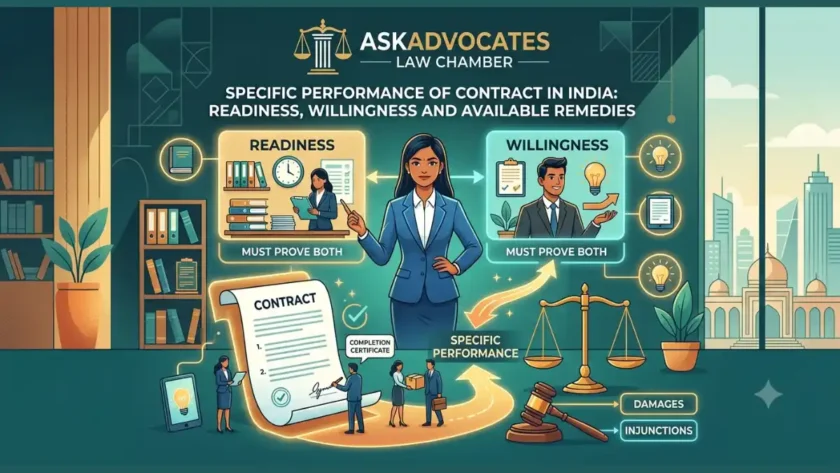
Temporary Injunction and Specific Performance
A party seeking specific performance may also request temporary injunctive protection.
However, the interim application does not automatically succeed merely because a specific-performance suit has been filed.
The Supreme Court has specifically emphasised that an applicant seeking temporary injunction in a specific-performance suit must establish the necessary interim principles and that conduct can be an important consideration.
Therefore, the applicant should demonstrate:
- A credible contractual right
- Supporting documents
- Compliance with relevant contractual obligations
- Conduct consistent with the claim
- Urgency
- Potential irreparable harm
- Balance of convenience
How to Prepare a Strong Temporary Injunction Application
Step 1: Identify the Protected Right
State exactly what right requires immediate protection.
Avoid vague expressions such as “my rights are being violated.”
Step 2: Identify the Threat
Explain precisely what the defendant has done or intends to do.
Use dates, documents and identifiable events wherever possible.
Step 3: Establish the Prima Facie Case
Connect the documents and facts to the asserted legal right.
Step 4: Establish Irreparable Injury
Explain why damages may not adequately compensate the anticipated harm.
Step 5: Establish Balance of Convenience
Explain why interim protection causes less prejudice than refusing it.
Step 6: Establish Urgency
Identify the event requiring immediate judicial intervention.
Step 7: Prepare Supporting Evidence
Attach relevant documents and preserve original records.
Step 8: Request Precise Relief
The prayer should clearly identify the conduct that must be restrained.
An overly broad prayer can create practical and legal difficulties.
Step 9: Address the Defendant’s Likely Defence
Anticipate objections concerning title, possession, delay, conduct, limitation, jurisdiction or alternative remedies.
Step 10: Maintain Consistency
The plaint, injunction application, affidavit and documents should present a coherent factual case.
What Can Cause a Temporary Injunction Application to Fail?
A weak application may fail because of several factors.
Delay
A party that waits for a long period before seeking urgent protection may face questions about the alleged urgency.
Delay does not automatically defeat an application, but it can affect the court’s assessment.
Suppression of Facts
Failure to disclose material information can undermine the applicant’s credibility.
Weak Prima Facie Case
If the applicant cannot establish an arguable legal right, interim protection becomes difficult.
Inadequate Evidence
Assertions unsupported by documents or reliable material may not justify an injunction.
Alternative Remedy
If damages or another effective remedy can adequately address the alleged harm, the case for interim protection may weaken.
Unclear Relief
The court must understand precisely what conduct the order should restrain.
Applicant’s Conduct
The applicant’s own conduct can materially affect discretionary relief.
A person seeking equity should approach the court with appropriate candour and fairness.
Can a Temporary Injunction Be Modified or Vacated?
Yes.
An interim order is not necessarily permanent.
The court may reconsider protection when:
- New evidence emerges
- Circumstances change
- Material facts were suppressed
- The order becomes unnecessary
- The opposite party establishes prejudice
- The applicant fails to comply with conditions
- The underlying legal position changes
The defendant can contest the continuation of the order through the applicable procedural mechanism.
The applicant should therefore continue satisfying the legal basis for interim protection rather than assuming that an initial order will remain indefinitely.
Can a Temporary Injunction Be Appealed?
Certain orders concerning temporary injunctions can be challenged through the appellate mechanisms provided by the CPC and applicable law.
The exact remedy depends on the nature of the order and the procedural framework governing the proceeding.
An appeal against an interlocutory injunction order is not ordinarily a complete rehearing of the entire civil dispute.
The Supreme Court has reiterated that appellate courts should exercise restraint when reviewing discretionary interim injunction orders. Interference is generally concerned with whether the discretion was exercised arbitrarily, capriciously, perversely or contrary to settled principles.
Therefore, the appellate strategy should focus on the legal and discretionary error in the impugned order.
Temporary Injunction: Court-Focused Checklist
| Issue | Question to Answer |
|---|---|
| Legal right | What right requires protection? |
| Threat | What action by the defendant creates urgency? |
| Prima facie case | What evidence establishes an arguable right? |
| Irreparable injury | Why are damages inadequate? |
| Balance of convenience | Which party faces greater prejudice? |
| Urgency | Why is immediate protection necessary? |
| Jurisdiction | Which court has authority? |
| Documents | What evidence supports the application? |
| Conduct | Has the applicant acted fairly and promptly? |
| Relief | What exact conduct should be restrained? |
| Alternative remedy | Is another remedy adequate? |
| Appeal | What procedural remedy exists against the order? |
Six Frequently Asked Questions
Can I Obtain a Temporary Injunction Without Filing a Civil Suit?
It depends on the applicable proceeding and statutory framework. Interim relief is generally connected with substantive proceedings, although specific laws may provide different mechanisms.
What Are the Three Tests for a Temporary Injunction?
The principal tests are a prima facie case, balance of convenience and irreparable injury. Courts also consider conduct, urgency, evidence and the circumstances of each case.
Can a Temporary Injunction Stop the Sale of Disputed Property?
Potentially. The applicant must establish a legal basis for protection and satisfy the requirements for interim relief. Evidence concerning the proposed transaction is important.
Can a Court Grant an Injunction Without Hearing the Defendant?
In appropriate urgent circumstances, an ex parte order may be granted. Procedural safeguards apply, and the opposite party will ordinarily receive an opportunity to contest the order.
How Long Does a Temporary Injunction Remain Effective?
Its duration depends on the order and subsequent proceedings. It may continue subject to further orders, be modified or be vacated when circumstances justify reconsideration.
Can an Injunction Order Be Challenged?
Yes, depending on the nature of the order and applicable procedural law. The available remedy must be assessed from the actual order and proceeding.
How to Apply for a Temporary Injunction in India
- Identify the legal right requiring immediate protection.
- Document the threatened conduct using dates, communications and other evidence.
- Select the correct substantive remedy and procedural forum.
- Establish a prima facie case through pleadings and supporting documents.
- Explain the irreparable injury that may occur without protection.
- Demonstrate balance of convenience in favour of interim relief.
- Explain urgency and why ordinary final relief may be insufficient.
- Prepare the injunction application and supporting affidavit consistently with the main pleadings.
- Request precise interim relief that directly addresses the threatened conduct.
- Prepare to answer the defendant’s objections concerning delay, conduct, jurisdiction, evidence and alternative remedies.
Conclusion
A temporary injunction is a discretionary civil remedy designed to prevent serious prejudice while a dispute remains pending. The applicant must establish more than a genuine grievance.
The court examines the prima facie case, balance of convenience and potential irreparable injury, together with the applicant’s conduct, evidence, urgency and the circumstances of the dispute.
Order XXXIX of the CPC provides the principal procedural framework for many civil injunction applications. However, the correct strategy depends on the underlying right and the applicable substantive law.
A carefully prepared application should identify the precise threat, establish the factual foundation and request proportionate relief. Parties should also consider jurisdiction, alternative remedies and the consequences of the proposed order before approaching the court.
Legal Information Disclaimer
This article provides general legal information about temporary injunctions in India. The appropriate remedy, forum, evidence and procedural strategy depend on the facts, applicable legislation and jurisdiction. Case-specific legal advice should be obtained before filing an injunction application.