A writ petition for government service disputes can help employees challenge unlawful administrative decisions. However, the High Court does not ordinarily reconsider every disagreement with a government department. Article 226 empowers High Courts to examine public authorities’ actions within constitutional limits. Therefore, employees must identify a recognised legal defect before seeking judicial intervention. Common disputes involve disciplinary penalties, suspension, dismissal, promotion, seniority, recruitment, transfer and pension benefits. Additionally, procedural unfairness, jurisdictional errors and violations of statutory rules may justify judicial review.
The correct forum depends on the employee’s service category and applicable legislation. Some employees must first approach a tribunal or departmental appellate authority. Nevertheless, recognised exceptions may permit High Court intervention despite an alternative remedy. AskAdvocates Law Chamber explains the legal principles, procedural requirements and potential remedies. This guide provides general information, not a substitute for advice on individual facts. Early legal assessment helps employees preserve evidence, identify deadlines and select an appropriate remedy.
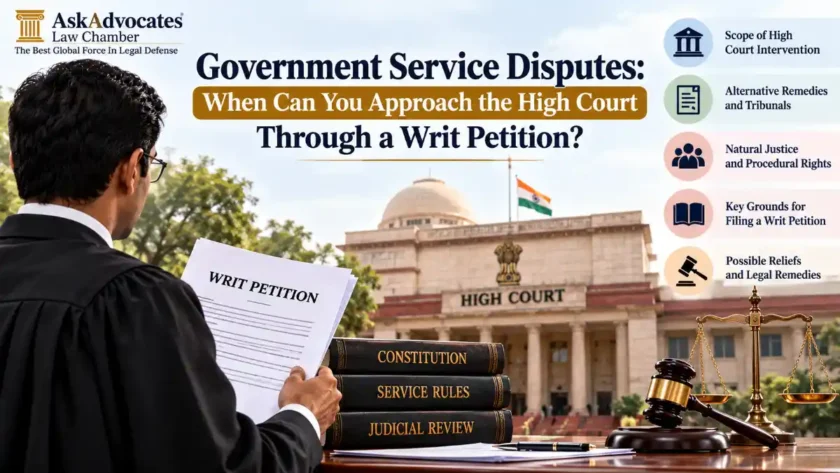
Government Service Disputes: When Can You Approach the High Court Through a Writ Petition?
When Can the High Court Intervene in Government Service Disputes?
Article 226 authorises High Courts to issue appropriate writs, directions and orders for enforcing rights. Its scope extends beyond fundamental rights to other legally enforceable rights within the provision’s framework. However, judicial review differs fundamentally from an ordinary appeal against an administrative decision. The Court generally examines jurisdiction, legality, procedural fairness and compliance with governing law. Therefore, a petitioner must identify the precise defect affecting the impugned decision. Examples include action by an incompetent authority, denial of a required hearing or disregard of mandatory rules.
A decision based on legally irrelevant considerations may also warrant scrutiny. Conversely, dissatisfaction with an official’s factual assessment does not automatically justify intervention. The petitioner must connect the alleged defect to applicable law and supporting records. Furthermore, the requested relief must address the defect without exceeding the Court’s proper role. A carefully framed service writ petition should therefore distinguish legal grounds from personal grievances. This distinction improves clarity and helps the Court assess maintainability and merits.
Alternative Remedies, Tribunals and Writ Petition Maintainability
Before filing a service writ petition, employees should identify every available statutory remedy. An internal appeal, revision or tribunal application may provide the prescribed route for challenging an adverse order. For covered service disputes, the Administrative Tribunals Act, 1985, may confer jurisdiction on the Central Administrative Tribunal. However, tribunal jurisdiction depends on the employee’s status, applicable notifications and statutory provisions. State service disputes require separate examination of relevant legislation and available forums.
The existence of an alternative remedy ordinarily weighs against immediate High Court intervention. Nevertheless, the rule does not operate as an absolute jurisdictional bar in every case. Recognised exceptions include certain natural-justice violations, jurisdictional defects and challenges to statutory validity. Fundamental-rights issues may also require careful assessment. A petitioner should explain the applicable exception rather than merely label an order illegal. The pleading should identify why the alternative remedy does not adequately address the particular defect. Accurate forum selection reduces avoidable objections and procedural delay.
Natural Justice, Jurisdictional Errors and Effective Legal Remedies
Natural justice remains an important consideration in disciplinary and other government service proceedings. Depending on the governing rules, an employee may require notice, access to relevant material and a meaningful opportunity to respond. A denial of these protections can undermine the legality of an administrative decision. However, a petition should explain the actual procedural failure and its legal significance. For example, identify the withheld document, refused hearing or rejected representation. Then explain how that failure affected the employee’s defence or statutory rights.
Jurisdictional challenges require a different analysis. The petitioner must identify the source of the authority’s power and the legal limitation allegedly breached. Courts may also examine statutory interpretation, relevant considerations and legally unsustainable findings. Nevertheless, judicial review does not automatically replace departmental appeals or factual inquiry. Interim relief requires a separate justification based on urgency and potential prejudice. Final relief should match the established defect. Depending on the circumstances, the Court may quash an order, direct reconsideration or grant another lawful remedy.
Identify the Impugned Government Service Order
A writ petition should identify the exact government decision or administrative action under challenge. The impugned order may concern dismissal, suspension, transfer, promotion, seniority, recruitment or retirement benefits. Alternatively, the dispute may arise from an inquiry report or departmental penalty. Obtain the complete order, including its reasons, operative directions and relevant annexures. Next, identify the official or authority responsible for issuing it. Examine whether the order cites the correct service rules and statutory provisions.
Compare the decision with earlier notices, representations and departmental correspondence. This exercise helps establish the decision-making sequence and identify the real dispute. A petition that challenges an undefined action may invite maintainability objections. Therefore, describe the decision precisely and attach the relevant record. Explain the legal consequence affecting the employee. If the challenge concerns an ongoing proceeding, identify the exceptional ground requiring immediate intervention. The petition should not merely repeat that the decision feels unfair. Instead, it must connect the impugned action to a recognised public-law defect.
Assess Alternative Remedies and Tribunal Jurisdiction
Forum selection requires an examination of the employee’s legal status and applicable statutory framework. Certain Central Government employees may fall within the Central Administrative Tribunal’s jurisdiction. Other covered organisations may also fall within the tribunal framework, depending on legislation and notifications. State Government employees may have different statutory remedies and administrative arrangements. Consequently, the petitioner should not assume that every government employee must approach the same forum.
Review the appointment order, service classification, relevant legislation and operative notifications. Then determine whether a departmental appeal, revision or tribunal application remains available. If an alternative remedy exists, explain why direct judicial review is nevertheless legally justified. A recognised exception must arise from the facts and applicable law. Merely alleging bias or unfairness without supporting particulars may prove insufficient. Also consider limitation and whether earlier representations affect the available remedy. The petition should address maintainability expressly rather than leave the issue unexplained. Proper forum analysis can prevent unnecessary litigation and help preserve the employee’s substantive rights.
Establish a Natural-Justice Violation
A natural-justice ground should identify the particular procedural safeguard that the authority denied. Relevant issues may include inadequate notice, withheld relied-upon documents or refusal of a required opportunity to respond. In disciplinary proceedings, disputed witness evidence may raise questions about a meaningful opportunity to defend. However, the precise procedural entitlement depends on the governing service rules and circumstances. The petitioner should identify the relevant rule, notice, request and response. Next, explain how the denial affected the employee’s ability to present a defence. For example, a missing document may have contained material contradicting the charge.
A refused hearing may have prevented the employee from addressing a decisive issue. Preserve written requests, acknowledgements, hearing records and relevant orders. Avoid relying solely on a broad assertion that the proceedings were unfair. The Court needs a clear account of what happened and why it matters legally. A specific, documented explanation is generally more useful than unsupported allegations. Counsel should also assess whether the alleged defect satisfies the applicable legal test for intervention.
Identify Jurisdictional and Statutory Errors
A jurisdictional error concerns the legal authority to take a particular action. The petitioner should identify the relevant statute, service rule or delegation order. Then explain how the authority exceeded, misused or lacked the required power. Examples may include action by an incompetent officer or failure to satisfy a mandatory statutory precondition. A decision may also involve an impermissible purpose or disregard of a binding legal requirement. However, an adverse outcome does not itself establish jurisdictional illegality.
The argument must connect the disputed action to the governing legal framework. Collect appointment orders, delegation notifications, service regulations and the impugned decision. Identify any provision limiting the authority’s power. Distinguish jurisdictional objections from ordinary disagreements about evidence. The distinction matters because courts apply different principles to different categories of challenge. Where an authority acted outside its legal powers, Article 226 may provide an appropriate remedy. Nevertheless, counsel must assess alternative remedies and relevant procedural requirements. The petition should state the precise legal defect and request relief suited to that defect.
Review Disciplinary Proceedings and Penalty Orders
Disciplinary disputes frequently involve charge memos, inquiry reports, suspension orders and final penalties. Employees should preserve each document and arrange the record chronologically. Examine whether the disciplinary authority followed the applicable rules and provided required opportunities. Check whether the inquiry findings have evidentiary support under the governing framework. Identify any material defence evidence that the authority ignored. Also examine whether the final order addresses relevant submissions and applies the correct penalty provisions.
A writ petition should not simply request another assessment of every disputed fact. Instead, identify a recognised legal defect affecting the decision. Examples may include jurisdictional error, serious procedural unfairness or legally unsustainable findings. Where the inquiry remains incomplete, courts generally exercise caution before intervening. Exceptional circumstances may nevertheless justify an earlier challenge. After a final penalty, consider the statutory appeal or tribunal route. Explain any reason for invoking Article 226 directly. The requested relief should address the defect rather than assume that every procedural error requires automatic reinstatement.
Examine Recruitment, Promotion and Seniority Disputes
Government service writ petitions may challenge recruitment results, promotion decisions, seniority lists and eligibility determinations. These disputes often depend on recruitment rules, service regulations and the criteria applicable on the relevant date. Obtain the advertisement, appointment conditions, applicable rules and impugned decision. Where promotion is disputed, collect seniority records, eligibility documents and relevant departmental orders. Then identify the specific rule or legal requirement allegedly breached.
A petitioner should distinguish an enforceable procedural or statutory right from an expectation of promotion. Courts generally do not substitute their preferred administrative assessment without a recognised legal basis. Additionally, disputes involving other employees may require their participation as necessary parties. Delay can complicate challenges to old selection lists or seniority arrangements. Therefore, record when the decision was made and when the employee learned of it. Consider any statutory appeal or tribunal remedy before filing. Finally, frame relief carefully because an order affecting one employee may influence others. Accurate pleadings should address both the legal defect and its practical consequences.
Challenge Suspension, Transfer and Service-Benefit Decisions
Suspension, transfer, recovery, pension and service-benefit disputes require close attention to the governing rules. First, obtain the operative order and any reasons supplied by the department. Next, identify the legal provision authorising the action. Examine whether the authority considered mandatory factors and followed the prescribed procedure. A transfer dispute usually requires more than showing personal inconvenience. A suspension challenge should address the applicable rules and any legally relevant procedural defects.
Recovery or pension disputes may involve statutory entitlements, calculation errors or unlawful deductions. Collect salary statements, service records, pension calculations and relevant departmental correspondence. Where an order has immediate consequences, explain the urgency and potential prejudice. However, interim relief remains discretionary and requires proper legal grounds. Do not assume that every adverse service decision will be stayed. A focused petition should identify the specific defect and request proportionate relief. Depending on the circumstances, the appropriate remedy may involve reconsideration, correction of records, release of benefits or quashing an unlawful order.
Understand Judicial Review of Evidence
The High Court generally does not conduct a full rehearing of disputed facts in service litigation. Instead, it examines whether the decision satisfies the applicable standards of legality and procedural fairness. In disciplinary cases, relevant questions may include whether the findings rest on legally acceptable material. A finding unsupported by evidence or affected by a serious legal defect may attract scrutiny. However, a disagreement about the weight assigned to competing documents does not automatically justify intervention.
The petition should identify the precise evidentiary problem and explain its legal consequence. For example, the authority may have ignored decisive material or relied on an impermissible consideration. Compare the finding with the inquiry record and relevant service rules. Avoid presenting every factual contradiction as a jurisdictional error. Courts distinguish reviewable illegality from ordinary factual disagreement. This distinction helps frame realistic grounds and appropriate relief. Where a statutory appeal allows broader review, the petitioner should consider whether that remedy is more suitable. Accurate legal classification strengthens the overall litigation strategy.
Assess Interim Protection and Final Relief
An employee may seek interim protection while the High Court considers the writ petition. The request should identify the immediate consequence requiring judicial attention. Examples include implementation of a disputed dismissal, recovery of money or denial of a service benefit. Explain the legal ground, urgency and potential prejudice with supporting documents. Courts may consider whether the requested order would disrupt lawful administration or affect other employees. Therefore, an interim prayer should remain proportionate to the demonstrated risk.
Final relief requires separate analysis. Depending on the case, the Court may quash an order, direct reconsideration or remit the matter for a fresh decision. It may also issue another direction permitted by law. Quashing an order does not always guarantee reinstatement or every consequential benefit. The result depends on the defect, governing rules and circumstances. Frame each prayer clearly and explain its legal basis. Avoid seeking relief unrelated to the established defect. A well-structured petition distinguishes immediate protection from the final remedy required to resolve the dispute.
Create a Chronology of the Service Dispute
A chronology helps the Court understand the sequence of administrative events. Record the relevant appointment, service action, notices, representations, hearings and final orders. Add the date of receipt for each important communication. Identify the document supporting every material event. This process can reveal inconsistencies between the employee’s account and the official record. It also helps counsel assess delay and limitation issues. Keep verified facts separate from recollection or inference. If a date remains uncertain, identify that uncertainty instead of inventing precision.
Include departmental appeals and tribunal proceedings where relevant. Then connect the chronology to the legal grounds in the petition. This structure avoids repetition and makes the factual narrative easier to follow. A concise timeline can also help identify missing records before filing. Update it whenever a new order or communication arrives. Proper chronology supports accurate drafting, realistic relief and an informed assessment of the dispute’s procedural history.
Prepare an Indexed Petition Record
A service writ petition should rely on a complete and organised documentary record. Include the impugned order, relevant service rules, earlier notices and material representations. Add appellate or tribunal orders where applicable. Prepare an index identifying each annexure by date and description. Explain the relevance of each important document in the petition. Avoid submitting large bundles without identifying their significance. Preserve original records and secure copies of electronic communications. Ensure that confidential information receives appropriate protection.
Check whether the proposed petition requires particular documents under applicable court rules. If a material document remains unavailable, explain the steps taken to obtain it. A clear record allows the Court to understand the administrative sequence without reconstructing it from scattered papers. It also helps counsel identify evidentiary gaps and potential objections. Before filing, cross-check every factual assertion against the annexures. Accurate pagination and consistent references improve readability and reduce avoidable filing errors.
Address Limitation and Procedural Delay
Delay can affect the availability and practicality of a service-law remedy. Identify the operative decision and record when the employee received it. Check the limitation period governing any departmental appeal or tribunal application. Constitutional writ jurisdiction also remains subject to principles concerning delay and laches. Repeated representations do not necessarily restart limitation for every purpose. Therefore, employees should not assume that continued correspondence preserves every remedy. If delay occurred, explain the circumstances accurately and provide supporting records.
Consider whether later orders created a distinct cause of action. Distinguish a continuing legal wrong from the continuing effects of an earlier decision. The applicable analysis depends on the facts and governing law. Obtain advice before relying on a limitation argument. A precise chronology can help counsel assess whether the petition remains viable. Where an alternative statutory remedy exists, verify its deadline separately. Timely action protects the employee’s options and reduces avoidable procedural disputes.
Frame Legal Grounds and Prayers Separately
A clear writ petition separates the factual narrative, legal grounds and requested relief. Begin with the impugned decision and relevant background. Then state each ground under an appropriate heading. Possible grounds include lack of jurisdiction, breach of natural justice, statutory misinterpretation and failure to consider mandatory material. Explain how the record supports each ground. Avoid repeating the same allegation in different sections without adding legal value. The prayer should identify the specific order or action challenged. It may seek quashing, reconsideration, release of benefits or another legally available direction. Interim relief should appear separately and address immediate consequences.
Ensure that the requested remedy follows logically from the alleged defect. A procedural failure may justify reconsideration rather than a final determination of every underlying issue. Likewise, a jurisdictional defect may require relief different from a factual dispute. Carefully framed grounds help the Court identify the questions requiring decision. This structure also improves the clarity of subsequent written submissions.
Anticipate Maintainability Objections
The government department may challenge a writ petition on several procedural grounds. These may include an available statutory remedy, delay, incorrect forum or absence of a sufficiently developed cause of action. A preliminary notice may also raise questions about whether judicial intervention is premature. The petitioner should assess these issues before filing. Identify the applicable statutory framework and explain why the selected forum can hear the dispute. If an alternative-remedy exception applies, support it with specific facts and legal principles. Do not assume that describing an order as arbitrary automatically establishes maintainability. Consider necessary parties, particularly where relief could affect other employees.
Check the relevant court rules and filing requirements. A petition should also distinguish the operative decision from earlier communications that merely preceded it. Addressing these issues at the outset can reduce avoidable objections. However, no drafting technique guarantees admission or success. The strength of the petition ultimately depends on jurisdiction, evidence, applicable law and the relief sought.
If a Departmental Appeal Remains Available
Identify the appellate authority and prescribed deadline before deciding to file directly in the High Court. Consider whether the appeal can address the disputed issue effectively. If a recognised exception supports immediate judicial review, explain it specifically. Preserve the appeal papers and relevant orders for legal assessment. Do not assume that filing a representation automatically extends limitation.
If the Tribunal May Have Jurisdiction
Check the employee’s category, governing legislation and applicable notifications. Determine whether the Central Administrative Tribunal or another legally established forum can hear the dispute. Confirm limitation and procedural requirements before filing. If direct writ jurisdiction is proposed, explain the legal basis and any recognised exception to the alternative-remedy principle.
If Natural Justice Was Denied
Identify the denied opportunity, the relevant rule and the evidence proving the procedural event. Explain how the failure affected the employee’s ability to answer the case. Attach relevant requests, notices and orders. A specific account of prejudice is more useful than a general allegation of unfair treatment.
If Immediate Interim Protection Is Necessary
State the immediate consequence and explain why waiting for final disposal may cause serious prejudice. Support the request with the impugned order and relevant records. Frame relief narrowly and address the applicable legal grounds. Interim protection remains discretionary and depends on the circumstances.
Legal Framework, Authorities and Practical Filing Roadmap
First, multiple provisions govern service disputes. Specifically, Article 226 grants writ jurisdiction. Next, High Courts enforce these powers. Meanwhile, Article 227 ensures supervisory control. Thus, High Courts oversee lower tribunals. Additionally, Article 311 safeguards civil servants. However, constitutional exceptions still apply. Furthermore, statutory rules guide administrative proceedings. Then, aggrieved employees file writ petitions. Subsequently, courts review departmental actions. Consequently, natural justice receives full protection. Therefore, illegal dismissal orders face cancellation. Moreover, public servants gain essential remedies. Ultimately, constitutional guarantees protect employee rights. In short, legal remedies ensure fairness.
The Administrative Tribunals Act, 1985, governs the statutory tribunal framework for covered service disputes. Applicable service rules and recruitment regulations may determine the employee’s substantive rights. The Code of Civil Procedure, 1908, does not automatically govern every aspect of constitutional writ proceedings. Likewise, the Bharatiya Nyaya Sanhita, 2023, Bharatiya Nagarik Suraksha Sanhita, 2023, and Bharatiya Sakshya Adhiniyam, 2023, principally address criminal law, criminal procedure and evidence. They do not automatically replace service-law procedures. Relevant authorities include L. Chandra Kumar v. Union of India, (1997) 3 SCC 261; Whirlpool Corporation v. Registrar of Trade Marks, (1998) 8 SCC 1; and State of U.P. v. Mohd. Nooh, AIR 1958 SC 86. Verify each judgment’s holding and applicability before relying on it.
Practical Steps Before Filing a Service Writ
Start by obtaining the impugned order and the complete administrative record. Confirm the employee’s service classification and identify the applicable statutory provisions. Next, determine whether an appeal, revision or tribunal remedy exists. Calculate relevant deadlines and preserve proof of receipt. Prepare a chronology linking each important event to a supporting document. Identify the public-law defect and distinguish it from ordinary factual disagreement. Then assess whether a recognised exception supports direct High Court intervention.
Collect the relevant service rules, orders, representations and procedural records. Identify any necessary parties who may be affected by the relief. Frame the grounds around jurisdiction, statutory compliance, natural justice and other applicable review principles. Finally, prepare separate prayers for interim and final relief. Review the petition for accuracy, consistency and adequate documentary support. Employees should seek case-specific legal advice before filing because service disputes often involve technical forum and limitation questions. A structured preparation process improves clarity but cannot guarantee a favourable result.
Frequently Asked Questions
1. Can a government employee directly file a writ petition?
Sometimes. The employee must examine the applicable service framework, tribunal jurisdiction and available remedies. Direct intervention may be appropriate when recognised legal exceptions apply.
2. When can the High Court intervene despite an alternative remedy?
Recognised exceptions may include natural-justice violations, jurisdictional defects, certain fundamental-rights issues and statutory-validity challenges. The facts must support the particular exception relied upon.
3. Can the High Court reconsider disciplinary evidence?
Judicial review is not ordinarily a factual rehearing. The Court examines legality, procedure, jurisdiction and other recognised grounds rather than routinely substituting its factual assessment.
4. Must every government employee approach the CAT?
No. Tribunal jurisdiction depends on the employee’s category, applicable legislation and notifications. Verify the statutory framework before choosing the forum.
5. Can a writ petition stop a dismissal or recovery order?
The Court may grant interim protection in appropriate cases. The employee must establish a credible legal ground, urgency and sufficient prejudice to justify the request.
6. What documents are required for a service writ petition?
Usually, the impugned order, service rules, relevant notices, representations, departmental decisions and supporting records. The exact documents depend on the dispute and requested relief.
Legal Disclaimer:
This article provides general legal information, not individual legal advice. Service rules, statutory remedies and jurisdiction vary. Verify current law and obtain professional advice before filing proceedings.
AskAdvocates Law Chamber — The Best Global Force in Legal Defense. For assistance with government service disputes, departmental proceedings, tribunal applications and writ petitions, arrange a legal consultation to assess the documents, jurisdiction and available remedies.
Related Legal Guides:
Government Employee Charge Memo: Response and Defence | Departmental Enquiry and Natural Justice