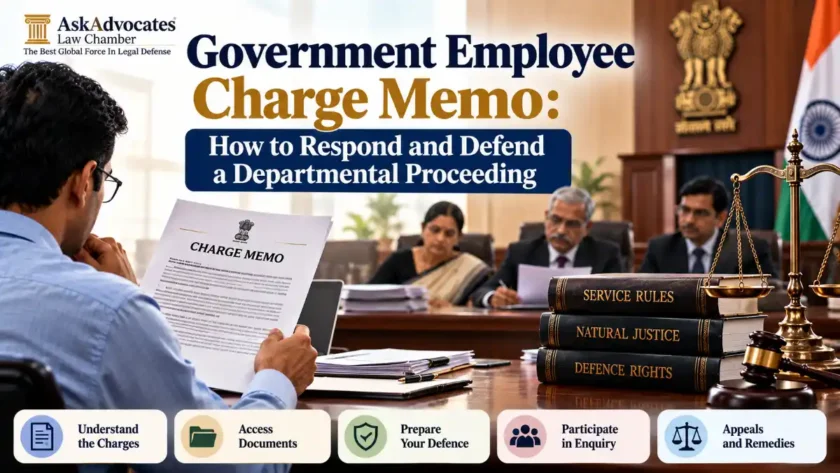
A government employee charge memo requires a timely, evidence-based response grounded in the applicable service rules. A poorly drafted reply can weaken the employee’s defence, while a structured response can expose factual gaps and procedural defects. AskAdvocates Law Chamber explains how employees can examine allegations, request relevant records, prepare written explanations and participate effectively in departmental proceedings. The correct approach depends on the employee’s service category, the authority issuing the charge memo and the disciplinary rules governing the case. Therefore, employees should assess the allegations before making admissions or submitting a general denial. This guide covers natural justice, disciplinary authority, documentary evidence, witness examination, inquiry reports, penalties and available legal remedies. It also explains when an administrative appeal, tribunal application or High Court petition may become relevant. Since every service dispute involves different facts and rules, employees should obtain case-specific legal advice before taking consequential steps. Early preparation helps preserve evidence, meet deadlines and protect procedural rights.
Understand the Government Employee Charge Memo
A charge memo formally communicates allegations of misconduct under an applicable disciplinary framework. It may identify alleged misconduct, relevant dates, violated duties and provisions of the governing service rules. Some proceedings also include a statement of imputations, a list of relied-upon documents and a list of departmental witnesses. Employees should examine each component because the charge memo alone may not contain the complete case against them. First, identify the issuing authority and confirm its competence under the applicable rules. Next, note the response deadline and every procedural direction in the notice. Then, compare each allegation with official records, correspondence and the employee’s assigned duties. Avoid destroying records, contacting witnesses improperly or making unsupported accusations against officials. Instead, preserve relevant evidence and prepare a chronological account of events. A government employee disciplinary case should be approached methodically, not emotionally. AskAdvocates Law Chamber can assist with charge memo analysis, drafting a written explanation and identifying appropriate procedural objections.
Identify the Applicable Service Rules and Disciplinary Authority
The correct defence begins by identifying the service framework governing the employee. Central Government employees may fall under the Central Civil Services (Classification, Control and Appeal) Rules, 1965, depending on their service category and applicable provisions. State Government employees may be governed by Tamil Nadu service and disciplinary rules or another state’s framework. Employees of public sector undertakings, universities, statutory bodies and local authorities may face separate regulations. Consequently, one rulebook does not govern every public servant. Examine the appointment order, service regulations, conduct rules and relevant delegation orders. Confirm who can initiate proceedings, appoint the inquiry officer and impose the proposed penalty. Also identify the designated appellate authority and any prescribed limitation period. Article 311 of the Constitution provides specific safeguards to qualifying civil servants, subject to its wording and recognised exceptions. However, constitutional protection does not automatically apply identically to every employee of every public body. Correct classification helps determine jurisdiction, procedure and available remedies before the employee submits a substantive reply.
Prepare a Charge-Wise Defence and Protect Natural Justice
A strong written explanation answers each article of charge separately and addresses the supporting material. Begin by identifying the precise allegation, relevant date, alleged duty and rule cited by the department. Then distinguish admitted facts from disputed allegations and explain the evidentiary basis for each denial. Where records support the employee, identify them clearly and request consideration during the inquiry. If the department withholds relevant documents, submit a written request explaining their importance to the defence. Retain proof of submission and any departmental response. Natural justice generally requires a meaningful opportunity to answer the case, subject to the governing procedure. Depending on the rules and circumstances, this may include document inspection, presentation of evidence and cross-examination of relevant witnesses. However, employees should not assume that every procedural request must automatically be granted. Explain the practical prejudice caused by a refusal. A precise, documented defence preserves important objections for later representations, appeals or judicial review.
Examine the Allegations Before Drafting the Reply
Read the charge memo alongside its statement of imputations, annexures and cited service provisions. Identify whether each charge specifies the conduct, relevant period and duty allegedly breached. A vague allegation may prevent an employee from understanding what must be answered. Conversely, a clearly drafted allegation may still lack reliable evidence. These are different objections and should receive different responses. Prepare a working table containing the charge, the department’s supporting material, the employee’s explanation and relevant defence evidence. Include dates, file references, witnesses and applicable rules where known. Check whether the allegation relies on assumptions rather than personal knowledge or contemporaneous records. Also identify any inconsistency between the charge memo and the underlying documents. Avoid exaggerating minor discrepancies or alleging bias without supporting facts. Instead, explain how each significant defect affects the ability to answer the charge. This disciplined method makes the reply more precise and assists the inquiry officer in identifying the real disputed issues.
Request Relied-Upon Documents and Preserve Evidence
Documentary evidence can determine whether a departmental allegation withstands scrutiny. Relevant records may include attendance registers, official correspondence, movement registers, duty rosters, approval notes, inspection reports and electronic communications. Employees should preserve materials lawfully available to them and avoid altering original records. If the department relies on documents that were not supplied, request access in writing. Identify each document and explain how it relates to a specific charge or defence issue. Where appropriate, request inspection, copies or another procedure permitted by the applicable rules. Keep the request, acknowledgement and response with the disciplinary file. If officials refuse access, record the refusal and explain the resulting disadvantage. Do not obtain confidential records through unauthorised access or remove official material unlawfully. Electronic evidence may require careful preservation of dates, metadata and original files. A clear document index helps connect each record to the relevant allegation. These steps can support the written explanation, inquiry participation and later challenge to procedural unfairness.
Use Cross-Examination and Defence Evidence Effectively
Where the inquiry relies on disputed witness testimony, cross-examination may expose weaknesses in the department’s case. The exact procedure depends on the applicable disciplinary rules and the issues under examination. Prepare questions around personal knowledge, chronology, documentary contradictions and the specific elements of each charge. Distinguish what a witness directly observed from what another person reported. Compare testimony with contemporaneous records and previous statements where the rules permit. Employees should avoid irrelevant questions, personal attacks and arguments that do not test the evidence. They may also need to identify defence witnesses or submit relevant documents through the prescribed process. Ask for procedural directions when a genuine dispute arises about evidence or participation. Keep a record of objections, rulings and material events during the inquiry. The purpose is to test the evidence fairly, not to imitate every feature of a criminal trial. A focused evidentiary strategy can clarify whether the department has established its allegations under the applicable service framework.
Respond to the Inquiry Report and Proposed Penalty
When the inquiry report becomes available, examine every finding against the charge, evidence and defence already recorded. Identify conclusions unsupported by evidence, material contradictions and relevant defence documents that the inquiry officer overlooked. Explain why each identified defect matters rather than merely repeating the original reply. Check the applicable rules to determine whether the employee must receive the report or an opportunity to make a representation. Under the CCS (CCA) framework, Rule 15 addresses action on the inquiry report, subject to the rule’s applicable text and circumstances. The final disciplinary order should also be assessed separately from the inquiry findings. A finding of misconduct does not automatically determine the lawful or proportionate penalty. Consider the governing penalty provisions, service record and relevant mitigating circumstances. If the rules provide an appeal, revision or review, identify the deadline immediately. A carefully prepared representation can preserve specific objections and establish a clearer record for the next available remedy.
Verify the Competence of the Disciplinary Authority
The authority’s legal competence should be checked against the applicable service rules and delegation framework. Identify the appointing authority, disciplinary authority and appellate authority for the employee’s particular post. Then examine whether the official who initiated or approved the proceeding possessed the necessary power. Relevant appointment orders, service regulations and delegation notifications may help answer this question. Do not assume that a senior official automatically possesses every disciplinary power. Equally, do not allege lack of jurisdiction without checking the governing provisions. A competence objection should identify the specific rule or delegation issue and explain its legal significance. If the defect becomes apparent only later, preserve the supporting records and raise it at the appropriate stage. Jurisdictional objections may differ from disputes about factual evidence or the fairness of a particular hearing. Proper classification of the employee and the authority’s powers helps identify whether the objection belongs in the departmental reply, an appeal or another legally available proceeding.
Distinguish Procedural Defects from Disputed Facts
A departmental defence may involve factual disagreement, procedural unfairness or both. A factual defence argues that the alleged conduct did not occur or that the available evidence does not establish it. A procedural objection may concern missing documents, inadequate notice, an incompetent authority or denial of a required opportunity. These grounds should not be confused because they require different supporting material. For factual disputes, identify records and witnesses that contradict the allegation. For procedural objections, record the relevant event, applicable rule and resulting prejudice. Some irregularities may not invalidate a proceeding unless they materially affect the defence or breach a mandatory requirement. Therefore, explain the connection between the defect and the employee’s ability to answer the charge. Maintain copies of requests, notices, orders and hearing records. Avoid relying on technical objections without explaining their practical significance. A well-organised submission allows the disciplinary authority or reviewing forum to assess each issue independently and apply the correct legal test.
Check the Inquiry Record and Findings
The inquiry record provides the foundation for assessing whether the proceedings followed the prescribed process. Collect available notices, attendance records, witness statements, exhibits, procedural orders and the inquiry report. Prepare a chronology showing when each important event occurred and which documents support it. Compare the findings with the evidence actually presented during the inquiry. Identify whether the report addresses the material defence or relies on assumptions without evidentiary support. Also examine whether the inquiry officer applied the correct charge and relevant service provision. Do not treat every disagreement with a finding as proof of illegality. Instead, identify a material evidentiary gap, an ignored relevant consideration or a procedural failure. This approach helps distinguish a genuine reviewable defect from a request to reassess every factual conclusion. The same record may become important during an appeal, tribunal application or judicial review. Preserve it carefully and organise the supporting material before preparing the next representation.
Assess Penalty, Proportionality and Mitigating Circumstances
Penalty assessment requires separate analysis after the disciplinary authority reaches a finding. Examine the penalties permitted by the applicable rules and the seriousness of the established misconduct. Relevant circumstances may include the employee’s service history, the nature of the duty, actual consequences and supported mitigating factors. Do not assume that a clean record automatically prevents disciplinary action. Instead, explain why the circumstances matter under the governing framework. Where the penalty appears excessive, identify the legal or factual basis for that contention. Compare treatment of other cases only when the comparison is reliable and legally relevant. The disciplinary authority must apply the governing rules rather than follow an unsupported demand for leniency. An appeal should separately challenge an unlawful finding, a procedural defect and an excessive penalty where each ground exists. Courts generally exercise restraint in substituting their views on punishment, although recognised legal grounds may justify intervention. A focused penalty representation is therefore more useful than a general plea for sympathy.
Understand When a Legal Challenge May Be Premature
Employees often ask whether they can approach a court immediately after receiving a charge memo. The answer depends on the governing rules, the nature of the defect and the relief sought. Courts may decline intervention when the disciplinary process remains incomplete and an adequate remedy exists. However, exceptional circumstances may justify earlier judicial scrutiny, including certain jurisdictional defects or serious procedural illegality. No employee should assume that every charge memo can be quashed at the threshold. Equally, the availability of a departmental process does not resolve every possible legal objection. Assess the actual document, statutory framework and stage of proceedings before choosing a forum. Record objections through the prescribed process where appropriate and avoid missing a response deadline while considering litigation. A lawyer can assess whether the better course involves an immediate challenge, participation under protest or a later appeal. Forum selection should follow a reasoned analysis rather than a general rule that applies to every employee.
Build a Chronology of Events
A reliable chronology helps the employee explain the disputed events without confusing dates or responsibilities. Record the alleged incident, relevant instructions, correspondence, inspections, departmental notices and each response. Add document references wherever available and identify any gap in the official sequence. This record can reveal contradictions between the charge memo and contemporaneous material. It can also help the employee calculate response deadlines and appeal periods. Keep the chronology factual and separate verified events from recollection or inference. Where dates remain uncertain, identify the uncertainty instead of inventing precision. Update the chronology whenever a new notice, order or inquiry event occurs. The final written defence should use this chronology to answer each charge in a clear sequence. A well-maintained timeline also helps legal counsel identify the strongest factual and procedural grounds without repeatedly reconstructing the entire history from scattered papers.
Maintain an Indexed Defence File
Organise the charge memo, annexures, service rules, written replies, document requests and departmental responses in one indexed file. Add inquiry notices, witness records, hearing directions, the inquiry report and the final order when received. Keep proof of delivery for every important submission. Store electronic records securely and preserve original files where possible. A separate index should explain which document supports or contradicts each disputed allegation. This prevents the common problem of submitting a large bundle without identifying its relevance. Maintain a duplicate copy in a secure location, subject to confidentiality and data-protection requirements. Avoid sharing sensitive departmental material with unauthorised persons or publishing allegations online. The indexed file will help prepare representations and appeals efficiently. It also allows a reviewing lawyer to identify missing records and procedural concerns quickly. Consistent document management is a practical safeguard throughout a lengthy departmental proceeding.
Observe Deadlines and Submission Requirements
Response deadlines can affect the employee’s options, so record every date immediately. Read the notice carefully and verify whether the governing rule specifies a particular period or submission method. If essential documents remain unavailable, consider requesting them promptly and explaining why additional time is necessary. A request does not automatically suspend the original deadline unless the applicable rules or authority provide otherwise. Therefore, do not assume that silence extends the time allowed for a reply. Keep acknowledgements, email receipts and dispatch records as proof of timely submission. For appeals, verify the limitation period, competent authority and any mandatory form or supporting documents. If a deadline has already passed, obtain advice about any available application for condonation or other lawful relief. Different service frameworks may prescribe different procedures. Accurate deadline management protects the employee from avoidable procedural disadvantages and helps ensure that substantive grounds receive proper consideration.
Prepare a Clear and Professional Written Explanation
The written explanation should be precise, respectful and supported by identifiable material. Address each charge separately and state whether the allegation is admitted, denied or requires clarification. Explain the factual basis for the employee’s position and cite relevant documents by date or reference number. Raise legal objections with reference to the applicable rule rather than using broad accusations. Avoid unnecessary personal remarks, speculative motives or admissions unrelated to the issue. Where information remains unavailable, identify it and explain the steps taken to obtain it. Request specific relief, such as document inspection or permission to present relevant defence evidence, where appropriate. Review the draft for consistency with earlier official correspondence. Ensure that every factual assertion has a reasonable basis and that the reply does not contradict the documentary record. A carefully prepared explanation gives the disciplinary authority a coherent account of the defence and preserves relevant issues for subsequent proceedings.
Record Objections During the Inquiry
Employees should raise material procedural objections when the relevant issue arises. Examples may include an unavailable relied-upon document, a disputed witness procedure or a request for reasonable accommodation permitted by the rules. State the concern clearly and identify the practical effect on the defence. Ask for the objection and decision to be recorded where the procedure permits. Preserve copies of written requests and any orders or communications responding to them. Avoid repeatedly raising irrelevant objections that distract from the actual allegations. If the inquiry proceeds despite a material concern, explain the resulting prejudice in the final representation. Timely objections can help establish that the employee sought a fair opportunity rather than remaining silent until an adverse result. However, the legal effect of an objection depends on the applicable rules and circumstances. Keep the record factual, complete and professional so that a reviewing authority can understand what happened and why the issue matters.
If the Department Refuses Documents
Identify the missing document, explain its relevance and request access through the prescribed channel. Retain the request and any refusal, and explain how the omission prevents an effective response. If the document is irrelevant or legally restricted, the authority may apply the governing rules and restrictions. Do not obtain it through unauthorised access. Seek advice before making a procedural challenge.
If the Employee Cannot Attend a Hearing
Notify the inquiry authority promptly and explain the genuine reason for non-attendance. Request an adjournment where justified and retain supporting records. Do not assume that absence stops the inquiry. Proceedings may continue ex parte when the applicable requirements are satisfied. Later challenges should explain the obstacle and its effect on the defence.
If the Inquiry Report Rejects the Defence
Compare every adverse finding with the evidence and the employee’s recorded submissions. Identify unsupported conclusions, contradictions and overlooked material. Explain each defect in the representation permitted by the applicable rules. Avoid repeating the original reply without analysing the report. Preserve the report, representation and final order for any later appeal or legal challenge.
If the Disciplinary Authority Imposes a Penalty
Obtain the final order and identify the penalty, reasons and applicable appeal route. Calculate the deadline from the governing provision and preserve proof of receipt. Prepare separate grounds concerning procedure, evidence and punishment where supported. Consider a departmental appeal or another competent remedy before approaching a court, subject to recognised exceptions.
Appeals, Tribunals, Courts and Legal Remedies
The available remedy depends on the employee’s category, governing rules, procedural stage and nature of the alleged defect. Departmental appeals or revisions may provide the prescribed route after a final disciplinary order. Certain Central Government service disputes may fall within the jurisdiction of the Central Administrative Tribunal under the Administrative Tribunals Act, 1985. State employees may have access to a designated tribunal where legislation establishes one. The relevant High Court may exercise judicial review under Article 226, subject to jurisdictional principles and applicable restrictions. The Supreme Court’s jurisdiction depends on the constitutional and procedural basis for the particular matter. Not every employee can bypass a prescribed remedy, and not every dispute belongs before the same forum. Civil Procedure Code provisions do not automatically govern departmental inquiries, which follow their own service rules. Similarly, criminal procedure and evidence statutes do not automatically replace disciplinary procedures. Legal counsel should identify the correct forum before preparing pleadings or selecting relief.
Relevant Laws and Judicial Principles
Article 311 of the Constitution provides specified protections to qualifying civil servants against dismissal, removal or reduction in rank, subject to constitutional conditions and exceptions. The CCS (CCA) Rules, 1965, may govern disciplinary proceedings involving covered Central Government employees. The Administrative Tribunals Act, 1985, establishes a statutory framework for designated service disputes. Other employees may be governed by state rules, service regulations or special enactments. Decisions such as State of Uttar Pradesh v. Saroj Kumar Sinha, (2010) 2 SCC 772, discuss procedural fairness in departmental inquiries. Managing Director, ECIL v. B. Karunakar, (1993) 4 SCC 727, addresses the inquiry report and the opportunity to respond in relevant circumstances. Each authority must be applied to its actual legal holding and the facts of the case. BNS, BNSS and BSA principally concern criminal law, criminal procedure and evidence; they do not automatically control departmental proceedings. Verify current statutory text, amendments and binding judgments before relying on any legal proposition.
When to Seek Specialist Legal Assistance
Specialist review is particularly useful when allegations may lead to dismissal, removal, compulsory retirement or another serious penalty. Legal assistance can also help where the authority’s competence is disputed, key documents remain unavailable or the inquiry raises complex evidentiary questions. Counsel can examine the service rules, prepare a charge-wise response and identify the relevant procedural objections. During the inquiry, representation may depend on the governing rules and permitted arrangements for defence assistance. After the report, counsel can prepare a focused representation addressing adverse findings and procedural prejudice. If a penalty follows, the next step may involve an appeal, revision, tribunal application or judicial review, depending on the employee’s circumstances. AskAdvocates Law Chamber can assess the documents and explain the available options without assuming that one remedy fits every case. Employees should bring the complete charge memo, annexures, service details, previous replies and related orders to the consultation. Early review helps identify deadlines and avoid preventable errors.
Frequently Asked Questions
1. What should I do after receiving a government employee charge memo?
Check the deadline and service rules, obtain the relied-upon material, analyse each allegation separately and prepare a documented reply. Seek legal advice promptly for serious charges.
2. Can I challenge a charge memo immediately?
Sometimes, but courts do not ordinarily intervene in every ongoing inquiry. The correct approach depends on jurisdiction, procedural illegality, natural justice and available alternative remedies.
3. Can I request documents mentioned in the charge memo?
Yes, where the applicable rules permit access. Identify missing records in writing, explain their relevance and preserve proof of the request and the department’s response.
4. Can I cross-examine departmental witnesses?
Cross-examination may be available where the procedure and disputed evidence justify it. Check the governing rules and prepare questions addressing knowledge, contradictions and relevant records.
5. What can I do if the inquiry report is adverse?
Analyse each finding, identify evidentiary gaps and procedural prejudice, and submit a focused representation where permitted. Then assess appeal or other remedies under the applicable rules.
6. Can the High Court interfere with a disciplinary penalty?
Yes, in appropriate cases involving recognised legal grounds. Judicial review is not a routine rehearing of facts, and the availability of an alternative remedy may matter.
Legal notice: This article provides general legal information and does not replace advice on an individual case. Service rules, amendments, deadlines and jurisdiction differ across employee categories. Obtain a document-specific legal assessment before taking action.
AskAdvocates Law Chamber — The Best Global Force in Legal Defense. For assistance with a government employee charge memo, departmental inquiry, written explanation, appeal or service-law dispute, arrange a consultation with the legal team.