
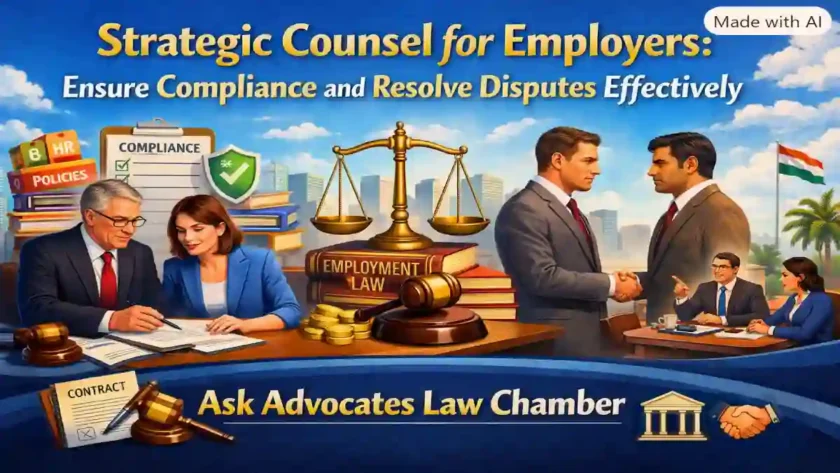
Strategic Counsel for Employers – Employers need structured legal systems covering recruitment, wages, workplace conduct, safety, records, and termination. India’s four Labour Codes now form the central framework for employment regulation. The Ministry of Labour lists the Code on Wages, Industrial Relations Code, Social Security Code, and OSH Code. Therefore, employers should review policies against applicable central and Tamil Nadu requirements. A compliance audit should examine contracts, attendance, wages, leave, benefits, disciplinary procedures, and statutory registers. Additionally, businesses should identify sector-specific obligations before expanding operations. Employers should document approvals and maintain evidence supporting every major employment decision. Consequently, strong documentation can reduce labour disputes and regulatory exposure. Ask Advocates Law Chamber assists employers with employment contracts, policy reviews, compliance audits, notices, and dispute prevention. Early legal advice also improves workplace governance and supports consistent decision-making.
Strategic Counsel for Employers: Ensure Compliance and Resolve Disputes Effectively – Ask Advocates Law Chamber

Review Employment Contracts and Policies
Employment contracts should clearly define duties, compensation, working hours, confidentiality, intellectual property, leave, and termination conditions. Employers should ensure contractual clauses remain consistent with applicable employment legislation. Additionally, policies should address workplace conduct, grievance handling, disciplinary procedures, and information security. Ambiguous clauses can create disputes involving salary, termination, misconduct, or employee benefits. Therefore, employers should review templates whenever laws, business models, or workforce structures change. The Industrial Relations Code, 2020 addresses important industrial relations matters, including standing orders and dispute mechanisms. Employers should also maintain separate procedures for misconduct investigations and disciplinary hearings. Proper notices and reasonable opportunities to respond strengthen procedural fairness. Consequently, documented processes can improve the employer’s position before labour authorities and courts. Legal counsel can draft employment agreements suited to managerial, technical, contractual, and senior executive roles. This proactive approach reduces inconsistent workplace decisions.
Strengthen Wage and Payroll Compliance
Payroll compliance requires accurate wages, deductions, overtime, bonuses, records, and statutory contributions. The Code on Wages, 2019 consolidates laws concerning wages, minimum wages, payment, and bonus matters. Employers should therefore review salary structures against applicable wage requirements and notified rules. Payroll teams must maintain reliable attendance and wage records supporting calculations. Additionally, employers should verify deductions and statutory remittances before processing monthly payroll. Errors can trigger employee claims, departmental inspections, interest, penalties, and recovery proceedings. The Labour Ministry currently publishes Labour Code rules, notifications, and employer compliance guidance. Consequently, businesses should monitor official notifications rather than rely upon outdated templates. Legal counsel can coordinate with payroll professionals during compliance reviews. A documented payroll process also supports stronger responses to wage-related notices. Employers should promptly investigate salary complaints and preserve payment evidence.
Manage Social Security Obligations
Employers must assess social-security obligations according to establishment characteristics and employee coverage. EPFO provides employer registration, electronic returns, contribution payments, and related compliance services. Employers should determine applicable provident-fund requirements before workforce expansion creates compliance gaps. EPFO currently describes coverage for notified establishments and establishments engaging twenty or more employees. However, employers should verify current statutory coverage before relying on numerical thresholds. ESIC obligations also require assessment according to applicable coverage and wage conditions. Therefore, businesses should maintain employee eligibility records and timely contribution evidence. Contract labour arrangements require additional review because principal employers may face compliance responsibilities. EPFO provides facilities for principal employers to connect contract-employer information. Legal counsel can audit social-security processes and address departmental queries. Timely correction usually reduces escalation and employee complaints.
Workplace Risk Management
Prevent Harassment and Misconduct Disputes
Workplace misconduct requires fair, documented, and legally compliant investigation procedures. Employers should maintain grievance mechanisms addressing harassment, discrimination, bullying, retaliation, and workplace misconduct. The POSH framework requires eligible employers to establish Internal Committees and follow prescribed procedures. Therefore, employers should maintain awareness programmes and appropriate complaint-handling systems. Complaints require confidentiality, impartiality, procedural fairness, and careful evidence management. Additionally, disciplinary policies should distinguish allegations from established misconduct. Employers should avoid premature conclusions that could compromise subsequent proceedings. Investigators should preserve emails, messages, attendance records, witness statements, and relevant documents. Consequently, evidence preservation can materially improve dispute resolution. Legal counsel can advise management and committees on notices, hearings, responses, and statutory procedures. Criminal allegations may additionally involve BNS and BNSS where applicable. The new criminal laws operate from July 1, 2024, subject to stated exceptions.
Handle Employee Grievances Early
Employee grievances can involve wages, termination, discrimination, harassment, leave, transfers, workload, or disciplinary action. Employers should create accessible channels for employees to raise concerns without retaliation. Early intervention can prevent ordinary workplace disagreements from becoming formal litigation. Therefore, management should acknowledge complaints and identify appropriate internal decision-makers. Each complaint should receive proportionate review based upon its seriousness and available evidence. Additionally, employers should record findings and communicate decisions clearly. Poor communication often increases distrust and encourages escalation. Legal counsel can review proposed responses before management issues sensitive communications. Consequently, employers can reduce admissions, inconsistent statements, and procedural errors. Serious complaints may require independent investigations or specialised statutory procedures. Businesses should also preserve documents likely to become relevant during future proceedings. A structured grievance process promotes employee confidence while protecting legitimate management authority.
Conduct Lawful Disciplinary Proceedings
Disciplinary action should follow applicable contracts, standing orders, policies, and statutory requirements. Employers should establish allegations clearly and provide appropriate opportunities for employee responses. Therefore, management should avoid punitive decisions before completing necessary investigations. Show-cause notices should identify material allegations without exaggeration or unsupported conclusions. Domestic enquiries should follow applicable procedural standards and maintain reliable records. Additionally, decision-makers should assess evidence objectively before imposing proportionate consequences. Termination decisions require particular care because procedural defects can create reinstatement or compensation claims. The Industrial Relations Code contains provisions concerning industrial disputes and related mechanisms. Legal counsel can assist with notices, enquiry strategy, evidence review, and final orders. Proper procedure also improves the employer’s position before labour courts and tribunals. Employers should preserve every material document supporting disciplinary decisions.
Prepare for Employment Litigation
Employment disputes may reach labour authorities, labour courts, industrial tribunals, civil courts, or constitutional courts. The correct forum depends upon employee status, statutory coverage, dispute character, and applicable law. Therefore, employers should conduct jurisdiction and maintainability reviews before filing or defending proceedings. Legal issues can include wrongful termination, unpaid wages, discrimination, industrial disputes, injunctions, and contractual breaches. Remedies may include settlement, reinstatement defence, compensation claims, injunctions, recovery proceedings, or statutory appeals. Additionally, employers should monitor limitation periods and procedural requirements carefully. Evidence should include contracts, payroll records, policies, notices, emails, attendance records, and enquiry materials. Legal counsel can formulate pleadings and coordinate evidence before the appropriate forum. Civil procedure may involve the CPC where applicable to the proceeding. Criminal allegations require separate analysis under BNS, BNSS, and BSA. The BSA governs evidence-related criminal proceedings under the new framework.
Resolve Disputes Through Strategic Legal Support
Select Appropriate Authorities and Forums
Employers should identify the correct authority before responding to a legal dispute. Labour departments may handle inspections, statutory complaints, registrations, and specified employment matters. Industrial tribunals and labour courts address qualifying industrial disputes under applicable legislation. Civil courts may handle contractual and commercial claims where jurisdiction permits. The Madras High Court can provide appropriate writ, appellate, supervisory, or other statutory relief. Additionally, criminal complaints may require interaction with the jurisdictional police station. Police authorities handle cognizable offences according to applicable criminal procedure. BNS defines offences, while BNSS regulates criminal procedure and BSA governs evidence. Employers should avoid treating every employee dispute as a criminal matter. Similarly, commercial disputes may require arbitration, mediation, or civil proceedings. Legal counsel can assess forum, jurisdiction, limitation, evidence, and available remedies before action.
Respond to Government Inspections and Notices
Government notices require timely assessment because careless responses can create additional liability. Employers should first verify the issuing authority, statutory provision, deadline, and requested documents. Therefore, businesses should preserve the original notice and prepare a response matrix. Labour authorities, EPFO, ESIC, tax authorities, and other regulators may seek records. EPFO maintains employer compliance facilities and provides enforcement-related information through its official portal. Employers should provide accurate information without unnecessary admissions or unsupported explanations. Additionally, legal counsel should review complex responses before submission. If an authority proposes recovery or penalty, applicable appeal and review remedies should receive immediate attention. Businesses should track acknowledgement numbers and preserve submitted documents. Consequently, an organised response reduces procedural mistakes and improves future defence. Ask Advocates Law Chamber can assist employers with notices, representations, hearings, inspections, and statutory proceedings.
Use Mediation and Settlement Strategically
Not every employment dispute requires prolonged litigation. Mediation and negotiated settlements can reduce legal costs, management disruption, and reputational risks. Employers should nevertheless assess statutory restrictions before agreeing to settlement terms. Therefore, settlement documents should clearly identify payments, releases, confidentiality, obligations, and dispute closure. Some statutory rights cannot simply disappear through private contractual wording. Additionally, employers should calculate potential litigation exposure before negotiating financial terms. Legal counsel can evaluate evidence strength, procedural risks, employee claims, and commercial consequences. A properly structured settlement can prevent repeated proceedings involving the same dispute. However, employers should avoid coercive settlement practices that create fresh legal risks. Courts and tribunals may examine settlement validity where statutory rights remain involved. Consequently, strategic negotiation should complement, not replace, legal compliance. Early mediation often provides a practical remedy where relationships remain commercially valuable.
Protect Evidence and Confidential Information
Employment disputes increasingly involve emails, messaging applications, access logs, payroll systems, and digital documents. Employers should establish evidence-preservation procedures when serious disputes arise. Therefore, relevant electronic records should receive protection from routine deletion or alteration. Businesses should also restrict unauthorised access to confidential employee and corporate information. Additionally, evidence collection should respect privacy, contractual obligations, and applicable data-protection requirements. BSA considerations become important where electronic evidence enters criminal proceedings. Legal counsel can advise on preservation notices, forensic collection, authentication, and disclosure strategy. Employers should maintain reliable records showing who created, stored, accessed, or produced documents. Strong evidence can materially improve negotiation and litigation outcomes. Conversely, missing records can weaken otherwise legitimate employment decisions. A written evidence protocol therefore provides valuable protection during regulatory investigations and court proceedings.
Build Long-Term Employer Legal Protection
Conduct Periodic Compliance Audits
Periodic employment-law audits help employers identify weaknesses before authorities or employees discover them. Audits should examine contracts, wages, leave, social security, workplace policies, registers, and disciplinary records. Additionally, businesses should review contractor arrangements and principal-employer responsibilities. EPFO provides dedicated employer services supporting registration, returns, payments, and related compliance activities. The Labour Ministry also publishes current Labour Code rules and compliance material. Therefore, audits should compare internal systems with current official requirements. Employers should classify findings according to urgency, financial exposure, and litigation risk. Legal counsel can prepare corrective-action plans and assign responsibility for each deficiency. Management should document completed corrective measures for future audits. Regular reviews also support mergers, acquisitions, investment due diligence, and corporate restructuring. Consequently, compliance auditing becomes an investment in business continuity rather than an administrative burden.
Train Managers and HR Teams
Managers often create legal exposure through poorly worded communications or inconsistent workplace decisions. Training should therefore cover contracts, grievances, discipline, harassment, wage issues, privacy, and termination. HR personnel should understand escalation procedures and document-management requirements. Additionally, managers should know when legal counsel must review sensitive employment decisions. Training can reduce impulsive dismissals, discriminatory conduct, retaliation claims, and confidentiality breaches. Employers should provide periodic refreshers when legislation or internal policies change. The Labour Ministry currently publishes updated Labour Code material and employer-focused guidance. Consequently, management training should incorporate official updates rather than outdated practices. Legal professionals can conduct workshops using realistic workplace scenarios. Written attendance records can demonstrate organisational commitment to compliance. Better-trained managers also resolve routine disagreements before formal complaints arise. This approach strengthens workplace culture while reducing avoidable litigation and regulatory exposure.
Obtain Tailored Employer Legal Advice
Every employer faces different legal risks based upon workforce size, industry, contracts, location, and business model. Therefore, generic compliance checklists cannot replace fact-specific legal assessment. Ask Advocates Law Chamber can assist with employment contracts, HR policies, disciplinary proceedings, workplace investigations, notices, and litigation strategy. Support may also cover labour authorities, industrial tribunals, labour courts, civil courts, and the Madras High Court. Additionally, employers can obtain assistance for police complaints involving workplace-related criminal allegations. Legal counsel can assess BNS, BNSS, and BSA implications where criminal proceedings arise. Businesses should seek advice before issuing high-risk termination orders or responding to serious allegations. Early intervention preserves evidence and improves strategic options. Consequently, preventive legal support can cost less than prolonged litigation. Employers should treat legal counsel as part of governance, risk management, and dispute-resolution planning.
Maintain a 24×7 Legal Response Plan
Serious employment disputes can emerge outside ordinary business hours. Employers therefore benefit from a clear escalation plan covering urgent notices, police contact, workplace incidents, and injunction risks. The plan should identify responsible managers, HR contacts, legal advisers, and document custodians. Additionally, emergency protocols should preserve evidence and prevent unauthorised communications. Employers should immediately identify deadlines because some legal remedies operate within strict limitation periods. Legal counsel can provide rapid assessment and recommend negotiation, representation, injunctions, complaints, or defensive proceedings. Police-related matters require prompt attention where allegations involve cognizable offences under applicable law. BNSS governs criminal procedure, while BNS defines relevant offences. Consequently, businesses should avoid informal responses that could prejudice later proceedings. A 24×7 legal response system provides continuity during critical incidents. Strategic preparation helps employers protect employees, management, evidence, reputation, and business operations.
Strengthen Corporate Dispute Governance
Employers should integrate employment compliance into wider corporate governance systems. Board-level oversight can identify recurring disputes, regulatory exposure, and significant workforce risks. Additionally, management should receive periodic reports concerning litigation, complaints, investigations, and statutory compliance. Businesses should establish escalation thresholds for high-value or reputationally sensitive disputes. Legal counsel can assist boards with risk assessments and remedial strategies. Industrial relations issues may require specialised advice concerning recognised unions and collective disputes. Contractual disputes may require arbitration or civil remedies depending upon the agreement. Criminal allegations may require coordinated representation before police and criminal courts. Therefore, governance systems should connect HR, finance, compliance, and legal teams. Consistent reporting can reveal patterns before they become systemic problems. Strong governance also supports investor confidence and regulatory readiness. Employers that invest in preventive legal systems generally achieve better dispute-management outcomes.
Frequently Asked Questions
What is employer compliance in India?
Employer compliance covers wages, contracts, social security, workplace safety, harassment prevention, records, disciplinary procedures, and applicable labour-law duties.
Which Labour Codes matter most to employers?
The four principal Labour Codes cover wages, industrial relations, social security, and occupational safety and working conditions.
Can employers challenge labour disputes?
Yes. Employers can use applicable statutory remedies before labour authorities, tribunals, courts, appellate forums, or through lawful settlement mechanisms.
When should an employer consult a lawyer?
Employers should seek advice before major disciplinary action, termination, regulatory responses, criminal complaints, litigation, or high-risk workplace investigations.
Do employers need EPFO compliance?
Applicable establishments must assess EPFO coverage and fulfil registration, contribution, filing, and record requirements.
Do BNS and BNSS affect employers?
Yes. Workplace conduct involving alleged offences can trigger BNS and BNSS considerations, while BSA governs evidence issues in criminal proceedings.
Read More
- Fairness and Justice in Employment: Expert Legal Guidance for Employees
- Your Rights in the Workplace: Trusted Labor Law Advocates by Your Side
- Legal Solutions with Heart: Resolving Family Disputes with Care and Expertise
- Your Family’s Advocate: Experienced Lawyers in Divorce, Custody, and Adoption
- Protecting What Matters Most: Dedicated Legal Support for Family Matters
- Ministry of Labour & Employment, Government of India