
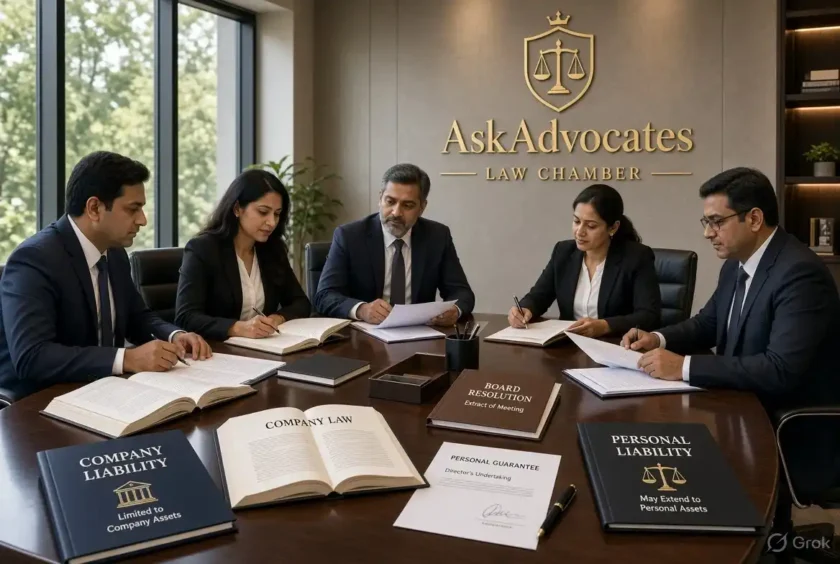
A company is a separate legal person. Its directors manage the company, but they do not ordinarily become personally liable for every debt, contract, default or wrongful act of the company merely because they hold office as directors.
This distinction is fundamental to Indian company law. At the same time, the protection of separate corporate personality is not absolute. A director can face personal civil liability, criminal prosecution, regulatory action, or liability under a specific statute where the legal requirements are satisfied.
Director Liability in India: When Can Directors Be Personally Sued or Prosecuted?
The practical question is therefore not simply whether a person is a director. The real questions are:
- What did the company do?
- What statutory provision creates liability?
- Was the director responsible for the relevant conduct?
- Did the director personally participate in the wrongful act?
- Did the director give a personal guarantee or indemnity?
- Was there fraud, misrepresentation, breach of fiduciary duty or misuse of the corporate structure?
- Was the director in charge of the company’s business when the alleged offence occurred?
These distinctions are particularly important in shareholder disputes, commercial recovery proceedings, cheque-bounce cases, tax proceedings, regulatory prosecutions and fraud allegations.
What Does Director Liability Mean in India?
Director liability means the circumstances in which a director can be held legally responsible for conduct connected with a company.
The starting point is separate corporate personality. The company’s assets and liabilities ordinarily belong to the company. A director does not become the debtor of every creditor merely by being a director. However, different legal mechanisms can create personal liability.
| Situation | Possible personal liability? | Main legal basis |
|---|---|---|
| Ordinary company debt | Generally no | Separate corporate personality |
| Personal guarantee by director | Yes | Guarantee / contract |
| Director’s own fraud | Yes | Civil / criminal law |
| Statutory offence with prescribed director liability | Yes | Specific statute |
| Cheque dishonour by company | Potentially | Section 141 NI Act |
| Misrepresentation inducing a transaction | Potentially | Tort / fraud principles |
| Breach of director’s statutory duties | Yes, depending on breach and remedy | Companies Act |
| Wrongful diversion of company assets | Potentially | Companies Act and other laws |
| Merely holding the office of director | No, by itself | No automatic liability |
The distinction between corporate liability and personal liability must be maintained throughout litigation.
Is a Director Personally Liable for Company Debts?
Ordinarily, no.
A private or public company incorporated under the Companies Act is a separate juristic person. A creditor who has a contractual claim against the company cannot automatically convert that claim into a personal recovery claim against each director.
The Delhi High Court has reiterated that directors ordinarily do not owe contractual duties to third parties merely because they are directors. Personal liability can arise where, among other circumstances, the director has personally guaranteed or indemnified an obligation or has independently committed a tort such as fraudulent misrepresentation.
Therefore, a plaint that merely states “The defendants are directors of the company and are therefore personally liable” may be legally inadequate unless additional facts establish a personal cause of action.
When Can a Director Become Personally Liable for a Company Debt?
Personal liability may arise where the director has independently undertaken liability. Common examples include:
- Personal guarantee
- Personal indemnity
- Separate contractual undertaking
- Fraudulent misrepresentation
- Personal receipt or diversion of money in circumstances creating an independent cause of action
- Statutory liability specifically imposed upon the director
- Personal participation in a wrongful act
- Conduct justifying lifting or piercing of the corporate veil in an appropriate case
The precise cause of action must be pleaded and proved.
Does Being a Managing Director Automatically Create Personal Liability?
Not for every company obligation.
A managing director generally occupies a more significant position in the management of the company than a non-executive director. That distinction can become important under statutes imposing vicarious criminal liability. But even in criminal proceedings, the applicable statutory conditions must be satisfied.
The Supreme Court has repeatedly emphasised that vicarious criminal liability cannot ordinarily be imposed merely by using the words “director”, “responsible officer” or “in charge of the company”. The complaint or prosecution must satisfy the requirements of the statute creating the vicarious liability.
Section 166 of the Companies Act: Duties of Directors
Section 166 of the Companies Act, 2013 codifies important duties of directors. A director is expected to act in accordance with the Articles of Association and in good faith to promote the company’s objectives for the benefit of its members as a whole. Directors must also exercise duties with appropriate care, skill and diligence, exercise independent judgment, avoid improper conflicts of interest, and not obtain undue gain or advantage.
A breach of statutory duties can expose a director to consequences under the Companies Act, although the exact remedy depends on the nature of the breach. Section 166 does not mean that every commercial failure becomes personal liability. A business decision that produces a loss is not automatically a breach of duty.
Courts generally distinguish between a genuine business decision, negligence or lack of due care, conflict of interest, self-dealing, diversion of corporate opportunity, misuse of company property, and fraudulent conduct.
Director Liability for Fraud
Fraud presents a substantially different situation. The Companies Act contains specific provisions dealing with fraud, including Section 447. Other statutory regimes may also create criminal or civil consequences for fraudulent conduct.
Where a director personally participates in fraudulent conduct, the director cannot ordinarily rely upon the company’s separate personality as a shield against liability for that personal wrongdoing. Examples include knowingly making false representations to obtain money, creating false corporate records, diverting company funds for personal benefit, concealing material facts from investors, manipulating corporate transactions for personal gain, or using the company structure as an instrument for fraud.
The evidence must establish the director’s personal role and the elements of the relevant cause of action or offence.
Can a Director Be Personally Sued by a Company Creditor?
Yes, but not merely because the person is a director. The creditor must identify an independent legal basis for proceeding against the director.
Personal guarantee
If the director signs a valid personal guarantee securing the company’s borrowing, the creditor may proceed against the guarantor according to the terms of the guarantee and applicable law.
Personal indemnity
A director may undertake an independent indemnity obligation.
Fraudulent representation
If the director personally makes a fraudulent representation that induces the creditor to part with money, an independent claim may arise.
Personal tort
A director may incur liability for a wrongful act personally committed against a third party where the legal elements of the tort are established.
Statutory liability
A specific statute may expressly impose liability upon persons responsible for the conduct of a company’s business. The pleading must identify the applicable legal foundation instead of treating directorship itself as the foundation.
Director Liability in Cheque-Bounce Cases
One of the most common areas in which directors face personal prosecution is dishonour of a cheque issued by a company. Section 138 of the Negotiable Instruments Act, 1881 creates the offence concerning dishonour of certain cheques. Section 141 addresses offences by companies and extends criminal liability in specified circumstances to persons who were in charge of and responsible for the conduct of the company’s business, as well as persons whose consent, connivance or negligence satisfies the statutory requirements.
This is vicarious criminal liability. It is therefore different from ordinary contractual liability.
Is Every Director Liable for a Company’s Dishonoured Cheque?
No. The Supreme Court has repeatedly held that merely being a director is insufficient.
In National Small Industries Corporation Ltd. v. Harmeet Singh Paintal, the Supreme Court explained that a complaint must contain the necessary factual basis showing how the accused director was in charge of and responsible for the conduct of the company’s business.
In K.S. Mehta v. Morgan Securities and Credits Pvt. Ltd. (2025 INSC 315), the Supreme Court reiterated that non-executive and independent directors cannot ordinarily be made liable under Section 138 read with Section 141 without specific allegations demonstrating the required involvement.
What Must a Cheque-Bounce Complaint Say About a Director?
The complaint should disclose the factual basis for invoking Section 141. The relevant question is not simply “Is this person a director?” It is: “What was this person’s role in the conduct of the company’s business at the relevant time?”
The Supreme Court’s jurisprudence distinguishes among a director who was actually in charge of and responsible for the business, a managing director or joint managing director, a director who signed the cheque, a non-executive director, an independent director, and a director with no demonstrated involvement in the relevant business. The legal consequences can differ substantially.
Can a Resigned Director Be Prosecuted?
Resignation does not automatically erase liability for conduct that occurred during the director’s tenure. Section 168 of the Companies Act expressly provides that a director who has resigned remains liable for offences that occurred during the director’s tenure. But this does not mean that every allegation made after resignation automatically creates liability.
The critical issue remains: When did the alleged offence or wrongful conduct occur, and what was the person’s role at that time?
A director facing proceedings should establish the date of appointment, date of resignation, effective date of resignation, date of the disputed transaction, date of the alleged offence, role held at the relevant time, board responsibilities, and documentary evidence showing actual involvement or non-involvement.
Independent and Non-Executive Directors
Independent and non-executive directors require particular attention. Their legal position cannot be equated automatically with executive management. A director who does not participate in day-to-day management may have a strong defence where the statute requires proof that the person was responsible for the relevant conduct.
However, the label “independent director” is not a universal immunity. If the facts and applicable statute establish a specific statutory basis for liability, or if the person personally participated in wrongful conduct, the analysis changes.
When Can the Corporate Veil Be Lifted?
The separate legal personality of a company is fundamental, but courts can in appropriate cases examine the persons behind a corporate structure. The expression “lifting the corporate veil” should not be used casually.
Examples may include fraud, sham transactions, evasion of legal obligations, misuse of corporate personality, improper diversion of assets, deliberate concealment, or statutory circumstances permitting such examination. The mere fact that one individual owns most of the shares, controls the board or manages the company does not by itself establish grounds for lifting the corporate veil.
Director Liability for Diversion of Company Assets
Diversion of company assets can create serious exposure. The legal analysis may involve fiduciary duties, conflict-of-interest rules, related-party transactions, accounting records, company approvals, statutory disclosures, fraud, breach of trust, oppression or mismanagement, and insolvency-related transactions.
The appropriate remedy will depend on the facts. In a shareholder dispute the remedy may involve proceedings before the NCLT. Firstly, In a fraud investigation, criminal proceedings may arise. Secondly, In a contractual dispute, civil remedies may be available. The same transaction can therefore generate multiple legal consequences.
Related-Party Transactions and Director Exposure
Sections 184 and 188 of the Companies Act are important when directors have interests in transactions involving the company. A director must make the required disclosures of interest and comply with applicable statutory requirements.
A transaction with an associated entity is not automatically unlawful. The relevant questions include whether the relationship was disclosed, whether the required approval was obtained, whether statutory procedures were followed, whether the transaction was commercially justified, whether the director obtained an improper benefit, whether the company was disadvantaged, and whether records were accurately maintained.
Civil Liability vs Criminal Liability
| Issue | Civil liability | Criminal liability |
|---|---|---|
| Nature | Compensation / recovery / enforcement | Punishment |
| Basis | Contract, tort, statute, guarantee | Penal statute |
| Director’s role | Personal cause of action usually required | Statutory conditions must be satisfied |
| Standard | Civil standard of proof | Proof beyond reasonable doubt |
| Vicarious liability | Depends on applicable law | Requires statutory basis |
| Personal guarantee | Can create liability | Usually contractual rather than criminal |
| Fraud | Can create civil consequences | May also constitute offence |
| Mere directorship | Normally insufficient | Normally insufficient |
What Evidence Matters in a Director-Liability Dispute?
Evidence should establish the director’s actual role. Important documents can include the Memorandum and Articles of Association, board resolutions, shareholders’ agreements, board minutes, MCA filings, DIR-12 filings, annual returns, financial statements, bank records, emails and corporate correspondence, contracts, personal guarantees, indemnities, cheque-signing records, delegation documents, internal approvals, related-party transaction records, statutory notices, resignation documents, and evidence concerning the disputed transaction.
The evidence should be organised chronologically. A director defending proceedings should normally prepare a timeline showing: appointment → role → relevant transaction → board involvement → statutory filing → resignation (if any) → alleged offence → proceedings.
Practical Test: Is the Director Personally Liable?
Before proceeding against a director, ask these eight questions:
- What is the legal cause of action?
- Is the company itself liable?
- What did the director personally do?
- Was the director responsible at the relevant time?
- Did the director personally guarantee or indemnify the obligation?
- Does a statute expressly create vicarious liability?
- Is there evidence of fraud or personal wrongdoing?
- Is the correct forum being used?
Ten-Step Legal Response for a Director Facing Personal Liability
- Obtain the complete complaint or notice — Do not respond solely from an oral description.
- Identify the legal provision — Determine exactly which statutory provision is being invoked.
- Establish the director’s tenure — Collect appointment and resignation records.
- Identify the director’s actual functions — Review board records, delegation documents and corporate filings.
- Separate company liability from personal liability — Ask whether an independent cause of action exists against the director.
- Review guarantees and indemnities — Check whether the director personally undertook liability.
- Examine the allegations for specificity — Particularly in criminal proceedings, identify whether the complaint explains the director’s role.
- Preserve documentary evidence — Do not destroy, alter or selectively delete corporate records.
- Determine the appropriate remedy — Possible remedies may include defence before the trial court, civil proceedings, statutory appeal, NCLT proceedings or a High Court challenge.
- Obtain case-specific legal advice — Director liability is highly fact-dependent.
Frequently Asked Questions
Can a director be personally sued for a company’s loan?
Ordinarily, a director is not personally liable merely because the company borrowed money. Personal liability may arise if the director executed a personal guarantee, indemnity or another legally enforceable undertaking.
Can all directors be arrested for a company offence?
No. Criminal liability cannot ordinarily be imposed merely because a person holds the office of director. The applicable statute and the person’s role must satisfy the requirements for prosecution.
Is a managing director automatically liable for every company offence?
No. A managing director’s position may have legal significance under particular statutes, but liability still depends upon the statutory framework and the facts of the alleged offence.
Can an independent director be prosecuted?
Potentially, but the prosecution must satisfy the applicable statutory requirements. The person’s actual role and the allegations concerning that role are important.
Is a director liable for a dishonoured company cheque?
Not automatically. Section 141 of the Negotiable Instruments Act creates specific conditions for extending criminal liability to company officers. Recent Supreme Court decisions continue to emphasise the need for the required factual basis.
Does resignation end all director liability?
No. Resignation does not erase liability for conduct or offences arising during the person’s tenure. Section 168 specifically addresses continuing liability for offences occurring during tenure.
Can a director be personally liable for fraud committed through the company?
Yes, where the director personally participated in conduct satisfying the applicable legal requirements for fraud or another actionable wrong.
Can a creditor sue both the company and its director?
Yes, where there is an independent legal basis for proceeding against the director. Simply adding a director as a defendant because of office is not sufficient.
Important Case Law
National Small Industries Corporation Ltd. v. Harmeet Singh Paintal — Established important principles governing vicarious liability of directors under Section 141 of the Negotiable Instruments Act.
K.S. Mehta v. Morgan Securities and Credits Pvt. Ltd. (2025 INSC 315) — Reiterated the distinction between persons actually responsible for the company’s business and directors who merely hold office, particularly non-executive and independent directors.
Aneeta Hada v. Godfather Travels & Tours (P) Ltd. — Foundational three-Judge Bench authority on Section 141 of the NI Act.
Pooja Ravinder Devidasani v. State of Maharashtra — Emphasised that a director’s designation alone does not establish the statutory requirements for vicarious criminal liability.
Tristar Consultants v. Customer Services India Pvt. Ltd. — Delhi High Court decision on the separate personality of a company and limited circumstances in which directors may incur personal liability for company contracts.
Relevant Statutes
| Statute | Relevance |
|---|---|
| Companies Act, 2013 | Corporate governance and director duties |
| Section 166 | Duties of directors |
| Section 168 | Resignation and continuing liability for offences during tenure |
| Section 184 | Disclosure of interest |
| Section 188 | Related-party transactions |
| Section 241–242 | Oppression and mismanagement |
| Section 447 | Fraud |
| Negotiable Instruments Act, 1881 | Cheque dishonour and statutory vicarious liability |
| Indian Contract Act, 1872 | Guarantees and contractual obligations |
| Insolvency and Bankruptcy Code, 2016 | Certain liabilities involving corporate debtors |
Civil Court, NCLT or Criminal Court?
| Dispute | Potential forum |
|---|---|
| Recovery against company | Civil / Commercial Court |
| Shareholder oppression / mismanagement | NCLT |
| Corporate governance dispute | NCLT or other competent forum |
| Cheque dishonour | Criminal court under NI Act |
| Challenge to criminal proceedings | High Court (where maintainable) |
| Insolvency proceedings | NCLT / NCLAT |
| Personal guarantee enforcement | Forum determined by the guarantee and applicable law |
Conclusion
Director liability in India is not automatic. The separate legal personality of a company remains the starting point. Personal liability arises only when a specific legal basis exists — personal guarantee, personal wrongdoing, fraud, or a statute that expressly creates vicarious liability and the facts satisfy its conditions.
Whether the claim is civil recovery, a cheque-bounce prosecution, a fraud allegation or a regulatory proceeding, the analysis must begin with the precise legal provision and the director’s actual role at the relevant time. Designation alone is never enough.
Legal Disclaimer
This article provides general legal information concerning director liability under Indian law. It does not constitute legal advice or create an advocate-client relationship. Specific advice should be obtained after reviewing the relevant documents, statutory provisions and facts of the case.