
Mental cruelty can provide grounds for contested divorce under applicable Indian matrimonial law. However, marital disagreements alone do not automatically establish cruelty. Courts examine the nature, frequency, seriousness, and overall impact of the alleged conduct. Therefore, a successful contested divorce petition requires precise pleadings, reliable evidence, and a legally sustainable litigation strategy. Ask Advocates Law Chamber provides legal guidance on matrimonial disputes, divorce proceedings, evidence collection, and court representation. This guide explains how spouses can approach mental cruelty allegations, identify relevant documents, prepare witness testimony, and understand available legal remedies. It also examines the roles of family courts, applicable personal laws, and related criminal proceedings. Ultimately, careful preparation helps litigants present their cases effectively while protecting their legal rights.
Navigating Mental Cruelty in Indian Contested Divorce: Pleadings, Evidence, and Trial Strategy
Understanding Mental Cruelty in Indian Matrimonial Law
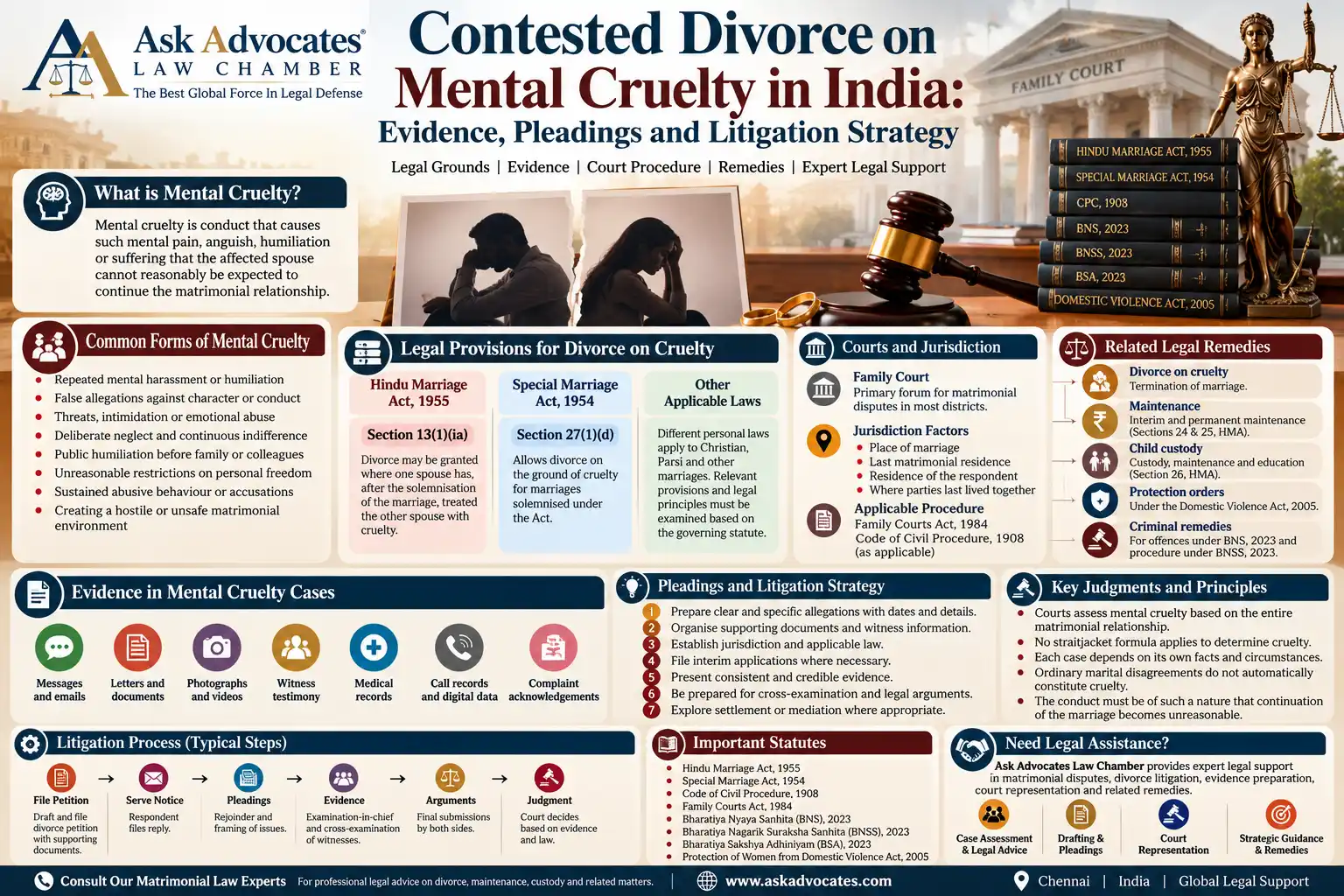
Mental cruelty concerns conduct that seriously affects the marital relationship and makes continued cohabitation unreasonable under applicable law. However, courts do not treat every disagreement, argument, or difference in temperament as cruelty. Instead, judges examine the circumstances surrounding the marriage and the conduct alleged against either spouse. Relevant considerations include repeated humiliation, sustained harassment, serious false accusations, threats, and conduct causing substantial emotional distress. Nevertheless, the legal threshold depends on the applicable statute and judicial interpretation. For example, a single serious incident may carry different significance from ordinary recurring disagreements. Consequently, litigants should evaluate the complete factual background before filing a contested divorce petition. A matrimonial lawyer can assess whether the available facts support a legally sustainable claim.
Statutory Grounds for Divorce Based on Mental Cruelty
Section 13(1)(ia) of the Hindu Marriage Act, 1955, permits either spouse to seek divorce on cruelty grounds. The provision applies to marriages governed by that legislation, subject to its requirements. Meanwhile, other marriages may fall under different statutory frameworks, including the Special Marriage Act, 1954. Section 27 of that Act contains grounds for matrimonial relief, including cruelty. Therefore, parties must identify the legislation governing their marriage before preparing pleadings. Christians, Parsis, Muslims, and other communities may require different legal analysis. The applicable personal law determines available grounds, procedures, and consequences. Accordingly, a matrimonial advocate should verify the governing statute before recommending litigation.
How Courts Assess Mental Cruelty
Courts consider the cumulative circumstances rather than applying a single universal test. Relevant factors include the parties’ relationship, conduct before and after separation, and the seriousness of alleged incidents. Furthermore, judges distinguish ordinary marital friction from conduct that undermines the essential foundation of marriage. Repeated threats, deliberate humiliation, or serious unfounded allegations may become relevant when supported by credible evidence. However, allegations alone do not establish the truth of an asserted incident. The petitioner must present facts capable of supporting the pleaded ground. Consequently, contemporaneous records, consistent testimony, and reliable witnesses may strengthen the evidentiary foundation.
Ordinary Disagreements Versus Legally Significant Conduct
Married couples may experience disagreements concerning finances, household responsibilities, relatives, employment, or parenting. Such disputes do not automatically constitute mental cruelty. However, sustained conduct involving intimidation, humiliation, or serious accusations may require judicial examination. Courts assess the surrounding circumstances and the effect of the conduct on the marital relationship. Therefore, pleadings should explain specific incidents instead of relying on broad descriptions. A statement that a spouse behaved badly provides limited factual detail. Conversely, identifying dates, words, witnesses, and consequences helps the court evaluate the allegation. The legal significance ultimately depends on the evidence and applicable principles.
Practical Examples of Potentially Relevant Conduct
Potentially relevant conduct may include persistent threats, repeated public humiliation, or serious accusations that lack a reasonable foundation. Deliberately making damaging allegations before relatives or professional colleagues may also require examination. Nevertheless, courts evaluate each allegation within its factual context. A party should not assume that every offensive statement independently establishes cruelty. Instead, the pleadings should explain the incident, its seriousness, and its effect on the marriage. Supporting documents may include communications, medical records, or witness accounts. These materials must remain authentic and lawfully obtained. A lawyer can assess their relevance before presenting them in court.
Selecting the Correct Court and Legal Procedure
The appropriate court depends on the governing matrimonial statute, jurisdictional facts, and applicable procedural rules. Family Courts established under the Family Courts Act, 1984, generally handle matrimonial proceedings within their notified jurisdiction. Where a Family Court does not exercise jurisdiction, another competent court may hear the matter. Jurisdiction may depend on residence, place of marriage, last matrimonial residence, and other statutory criteria. However, the precise requirements vary according to the governing legislation. Therefore, parties should confirm jurisdiction before filing their petitions. Filing before an unsuitable forum can cause delay and additional expense. A matrimonial lawyer can examine the relevant facts and identify the proper court.
Territorial and Subject-Matter Jurisdiction
Section 19 of the Hindu Marriage Act, 1955, specifies the courts competent to receive petitions under that legislation. Its application depends on the statutory jurisdictional criteria and the circumstances of the marriage. Similarly, proceedings under the Special Marriage Act require examination of that statute’s jurisdictional provisions. Family Court jurisdiction also depends on the applicable legislation and territorial notification. Accordingly, litigants should verify the current court structure and local filing requirements. Chennai matters may fall before the competent Family Court in Chennai, depending on jurisdictional facts. Cases elsewhere require examination of the relevant district and court arrangements. Correct forum selection supports efficient case management and avoids unnecessary procedural disputes.
Documents Required for Filing a Contested Divorce Petition
A well-prepared petition begins with documents establishing the marriage and supporting the pleaded allegations. The exact requirements depend on the governing statute, local rules, and the issues involved. Nevertheless, organised records help the advocate prepare a coherent chronology and assess evidentiary gaps.
Essential Marriage and Identity Documents
Applicants should collect documents that establish their identities and marital relationship. These may include the marriage certificate, wedding photographs, identity documents, and relevant registration records. Where appropriate, parties should also provide address evidence and information concerning previous proceedings. Additionally, documents relating to children may become relevant when custody or maintenance issues arise. Each document should be authentic and consistent with the pleaded facts. Missing records should be identified early rather than addressed through unsupported assertions. The advocate can determine which documents the court requires for the particular petition.
Documents Supporting Mental Cruelty Allegations
Relevant evidence may include messages, emails, letters, medical records, complaint acknowledgements, and witness details. However, each item must connect meaningfully with a pleaded incident or disputed issue. A large collection of unrelated screenshots may obscure rather than strengthen the case. Therefore, parties should organise evidence chronologically and preserve original files. They should also document the source and date of each item. Where authenticity becomes disputed, additional proof may be necessary. Legal counsel can assess admissibility and evidentiary value before relying on these materials.
Preparing Pleadings and Building the Evidence Record
Pleadings establish the factual foundation and legal grounds of a contested divorce petition. They should identify material incidents clearly, accurately, and consistently. General allegations without particulars can weaken the petition and complicate the respondent’s defence. Conversely, precise pleadings help the court identify the actual controversies. Each allegation should connect to a relevant legal ground and available supporting evidence. The petition should also address jurisdiction, statutory eligibility, and applicable procedural requirements. Therefore, preparation requires more than collecting documents or describing marital unhappiness. A structured legal assessment helps distinguish relevant facts from emotional conclusions.
Drafting Specific and Credible Allegations
A petition should describe the alleged conduct, relevant dates, locations, persons involved, and surrounding circumstances. Exact dates may not always be available, but the chronology should remain as precise as reasonably possible. Where an allegation concerns repeated conduct, the petition should identify representative incidents and their frequency. Furthermore, the petitioner should explain how the conduct affected the marital relationship. The pleading must not exaggerate incidents or introduce allegations without a reasonable factual basis. Inconsistencies between the petition and supporting documents may undermine credibility. Accordingly, advocates should compare the chronology against available communications and records before filing.
Organising the Chronology of Events
A chronology allows the advocate and court to understand how the alleged conduct developed over time. It should record significant incidents, communications, separations, complaints, and relevant attempts at reconciliation. Each entry should identify available corroboration and any uncertainty concerning the date. Moreover, the chronology can expose contradictions before the opposing party raises them. It can also help counsel identify missing evidence and potential witnesses. The chronology should remain a preparation tool rather than a substitute for formal pleadings. The final petition must comply with the applicable statutory and procedural requirements.
Witness Selection and Testimony Preparation
Potential witnesses may include relatives, neighbours, colleagues, or other persons with direct knowledge of relevant incidents. However, witnesses should testify only about matters they genuinely observed or heard. A witness who merely repeats another person’s account may have limited evidentiary value. Therefore, counsel should distinguish direct knowledge from hearsay and personal inference. Witness preparation should focus on accuracy, chronology, and understanding the court process. It must never involve coaching witnesses to provide false or manufactured testimony. Credibility depends on truthful evidence and consistency with the available record.
Cross-Examination and Credibility Assessment
Cross-examination tests the reliability, consistency, and foundation of a witness’s testimony. Counsel may examine contradictions between oral evidence, pleadings, communications, and earlier statements. However, a contradiction does not automatically establish that every allegation lacks merit. Courts assess its significance alongside the complete evidence. Accordingly, parties should preserve original records and avoid altering communications. Honest explanations for genuine inconsistencies may help the court understand the factual context. A coherent case requires consistency without suppressing relevant facts.
Electronic Evidence and Applicable Procedural Law
Electronic communications often feature prominently in contemporary matrimonial litigation. Messages, emails, photographs, call records, and social media posts may help establish relevant circumstances. Nevertheless, parties must consider authenticity, relevance, privacy, and admissibility. The Bharatiya Sakshya Adhiniyam, 2023, governs evidence in applicable proceedings, including provisions concerning electronic and digital records. Its requirements must be examined alongside relevant judicial decisions and procedural rules. The applicable legal framework depends on the proceeding and the relevant transition provisions. Therefore, counsel should verify the current law before relying on electronic material.
Preserving Digital Communications
Parties should preserve original devices, complete conversations, relevant metadata, and available backups where appropriate. Screenshots may provide context, but they may not resolve every authenticity dispute. Consequently, litigants should avoid editing, cropping, or selectively presenting material in misleading ways. They should also maintain a record explaining how each item was obtained. Unauthorised access to another person’s account can create separate legal risks. Instead, parties should obtain legal advice before collecting disputed digital evidence. Proper preservation helps protect evidentiary integrity and reduces avoidable objections.
Electronic Records and Admissibility
The Bharatiya Sakshya Adhiniyam, 2023, contains provisions governing electronic and digital records. The applicable requirements depend on the type of record, its source, and the manner of production. Section 63 addresses admissibility requirements for electronic records and associated certification matters. Counsel should verify the current statutory text and applicable judicial interpretation before filing such evidence. A printed screenshot should not automatically be treated as conclusive proof. The opposing party may dispute authenticity, completeness, authorship, or context. Therefore, evidentiary preparation should address these issues before trial.
Medical Records and Professional Evidence
Medical records may become relevant when a party alleges psychological distress, physical injury, or treatment following particular incidents. However, a diagnosis alone does not automatically prove that the other spouse committed cruelty. The court must assess the record alongside the pleaded facts and other evidence. Medical professionals may provide relevant evidence where legally appropriate. Parties should not pressure clinicians to make unsupported statements. Instead, counsel should identify the specific proposition that each medical record can legitimately establish.
Privacy and Lawful Evidence Collection
Matrimonial disputes frequently involve sensitive personal information. Parties should avoid publishing private messages, medical records, or intimate material unnecessarily. Unlawful surveillance, account intrusion, or threats to expose private information may create additional legal consequences. Therefore, evidence collection should respect applicable privacy and criminal laws. Counsel can assess whether a proposed collection method creates legal or ethical concerns. The court should receive relevant evidence through appropriate legal procedures.
Related Criminal Proceedings and Protective Remedies
Mental cruelty allegations may coexist with domestic violence complaints, criminal allegations, or other matrimonial proceedings. However, a contested divorce petition and a criminal prosecution serve different legal purposes. The divorce court determines matrimonial relief under the applicable statute. Criminal courts determine criminal liability under the relevant substantive and procedural law. Therefore, one proceeding does not automatically establish the outcome of another. Parties should assess each remedy independently and avoid contradictory factual positions. Coordinated legal advice can help manage parallel proceedings responsibly.
The Role of BNS, BNSS and Domestic Violence Law
The Bharatiya Nyaya Sanhita, 2023, governs applicable substantive criminal offences. The Bharatiya Nagarik Suraksha Sanhita, 2023, governs criminal procedure, subject to its provisions and applicable transition rules. The Protection of Women from Domestic Violence Act, 2005, provides civil remedies for qualifying domestic violence claims. Depending on the facts, remedies may include protection orders, residence orders, monetary relief, and compensation. However, eligibility and available relief require a case-specific assessment. Divorce proceedings do not automatically replace these remedies. Similarly, an allegation of mental cruelty does not itself establish a criminal offence.
Police Complaints and Criminal Proceedings
A person facing threats, violence, stalking, or other potentially criminal conduct may consider approaching the appropriate police station. Emergency circumstances require prompt contact with local emergency services. Complaints should describe verifiable facts and identify available supporting evidence. Depending on the alleged offence, police may register a case or take other action permitted by law. However, a matrimonial disagreement alone does not automatically justify criminal proceedings. Parties should avoid using criminal complaints to pressure an opposing spouse. A criminal lawyer can assess the facts and identify lawful options.
Choosing the Appropriate Legal Remedy
The correct remedy depends on the actual harm, legal relationship, evidence, and desired outcome. Divorce may address the legal termination of a marriage. Domestic violence proceedings may address protection, residence, or monetary relief where statutory requirements apply. Criminal proceedings address alleged offences and potential criminal liability. Maintenance proceedings may provide financial support under applicable legislation. Child custody proceedings focus on the child’s welfare and relevant legal standards. Therefore, legal strategy should identify each remedy’s purpose and avoid treating every dispute as interchangeable.
Managing Parallel Proceedings
Multiple proceedings can involve overlapping facts, documents, and witness accounts. Counsel should maintain consistent factual positions while respecting each proceeding’s distinct legal requirements. Orders from one forum may affect practical decisions in another, depending on the circumstances. However, parties should not assume that every proceeding automatically determines the others. A coordinated case file can help track pleadings, hearings, interim orders, and deadlines. This approach also reduces the risk of contradictory submissions.
Litigation Strategy, Settlement and Final Relief
A successful litigation strategy begins with realistic assessment rather than assumptions about the eventual outcome. Counsel should evaluate the legal ground, evidentiary strength, procedural risks, likely costs, and available alternatives. Settlement may be appropriate where both parties freely choose a lawful resolution. Nevertheless, parties should not accept coercion or abandon urgent protective remedies without careful consideration. Mediation or counselling may assist in suitable cases, subject to applicable law and safety considerations. The court retains its statutory responsibilities when deciding contested matrimonial claims. Therefore, preparation should address both trial readiness and lawful settlement possibilities.
Interim Relief and Related Applications
Depending on the dispute, parties may need interim orders concerning maintenance, child custody, residence, or protection. The governing statute and factual circumstances determine which applications are available. The Code of Civil Procedure, 1908, may apply to relevant procedural aspects, subject to statutory provisions and Family Court rules. However, CPC provisions should not be assumed to govern every matrimonial step identically. Counsel must verify the specific procedural framework before filing applications. Timely preparation can help prevent avoidable delays and incomplete submissions.
Court Hearings and Case Management
Parties should maintain an updated calendar of hearing dates, filing deadlines, and court directions. They should attend required hearings and provide documents requested by their advocate. Missing deadlines can create procedural difficulties or weaken the presentation of evidence. Furthermore, each hearing may address a different issue, including pleadings, interim relief, evidence, or arguments. Understanding the stage of proceedings helps parties prepare appropriately. The advocate should explain the next procedural step and any immediate obligation.
Costs, Duration and Practical Expectations
Contested divorce proceedings may involve substantial time, preparation, and legal expense. Duration depends on court workload, complexity, interim applications, evidence, and adjournments. Therefore, no responsible advocate should guarantee a specific completion date or result. Parties should discuss professional fees, expected stages, and foreseeable expenses at the outset. They should also preserve relevant documents and respond promptly to requests from counsel. Realistic expectations support informed decisions throughout litigation.
Preparing for Judgment and Post-Judgment Steps
Before final arguments, counsel should review the pleadings, admitted documents, witness testimony, and disputed issues. The final submissions should connect the evidence to the statutory ground and applicable legal principles. After judgment, the parties should obtain and review the court’s order. Depending on the outcome, legal options may include compliance, clarification, or an appeal where permitted. Applicable limitation periods require prompt verification. An advocate should assess the judgment before recommending further proceedings.
How Ask Advocates Law Chamber Can Assist
Ask Advocates Law Chamber can assist clients seeking legal advice on contested divorce and matrimonial disputes in India. Legal support may include reviewing the applicable statute, assessing mental cruelty allegations, preparing pleadings, organising documentary evidence, and advising on court procedure. Counsel can also evaluate related maintenance, custody, domestic violence, or criminal proceedings where appropriate. Each matter requires an individual assessment of the facts and available evidence. No advocate can responsibly guarantee a particular judicial outcome. Early legal advice may help clients understand their rights, obligations, risks, and procedural options.
Initial Consultation and Case Assessment
A useful consultation should establish the marriage details, applicable personal law, relevant incidents, existing proceedings, and immediate concerns. Clients should bring available marriage records, court documents, communications, and a chronology of important events. The advocate can then identify potential legal grounds and evidentiary gaps. Where urgent threats or safety concerns exist, those issues require immediate attention. Clients should also disclose unfavourable facts that may affect the case. Complete and accurate information supports better legal advice.
Taking the Next Legal Step
Before filing a contested divorce petition, obtain advice on jurisdiction, limitation issues where relevant, evidence, costs, and available remedies. Preserve original documents and avoid public statements that may complicate the dispute. Do not fabricate evidence, threaten the opposing spouse, or disregard existing court orders. Instead, maintain a clear record and follow lawful advice. A carefully prepared case gives the court a clearer basis for evaluating the dispute. The appropriate strategy will depend on the governing law and the individual facts.
Frequently Asked Questions
What qualifies as mental cruelty in an Indian divorce case?
Mental cruelty may involve serious conduct that makes continued marital life unreasonable. Courts assess the circumstances, evidence, and applicable personal law.
Which law governs divorce on mental cruelty grounds?
Section 13(1)(ia) of the Hindu Marriage Act, 1955, provides a cruelty ground. Other marriages may fall under different statutory provisions.
What evidence supports a mental cruelty petition?
Relevant evidence may include communications, witness testimony, medical records, and complaint documents. Each item must be authentic and legally relevant.
Can WhatsApp messages be used in divorce proceedings?
Potentially, yes. Their relevance, authenticity, and admissibility depend on the applicable evidence law and circumstances of production.
Can a spouse file criminal and divorce proceedings together?
Potentially, yes, where each proceeding has a valid legal basis. Their requirements and purposes remain distinct.
Which court handles contested divorce cases in Chennai?
The competent Family Court or other legally authorised court depends on the governing statute and jurisdictional facts. Obtain case-specific advice.
Conclusion
Contested divorce on mental cruelty grounds requires careful legal analysis, precise pleadings, and credible evidence. Indian courts examine the applicable statutory framework and the circumstances of each marriage. Consequently, parties should avoid exaggerated allegations, preserve authentic records, and prepare a coherent chronology. Electronic evidence requires particular attention to authenticity, privacy, and admissibility. Related criminal, domestic violence, maintenance, and custody proceedings require separate legal assessment. Early advice from a matrimonial advocate can help identify the appropriate forum and available remedies. Ask Advocates Law Chamber can provide case-specific guidance on divorce litigation, evidence preparation, and procedural strategy.