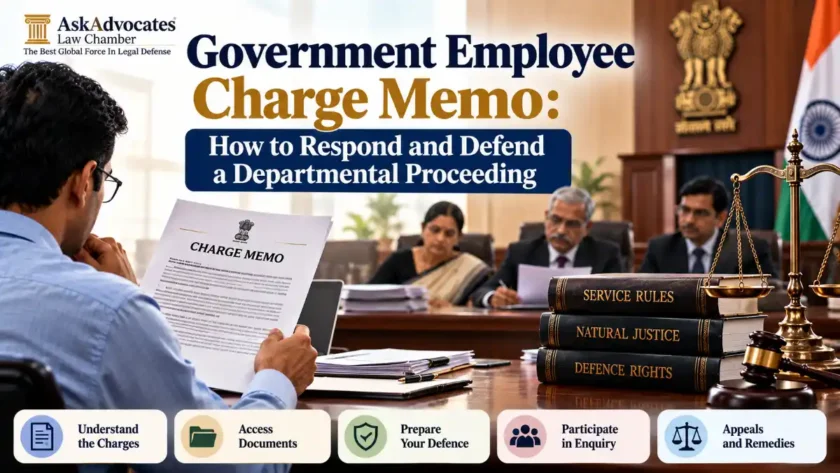

A departmental enquiry can affect a government employee’s career, salary, promotion, pension, and professional reputation. Depending on the applicable service rules, disciplinary proceedings may result in censure, withholding of increments, reduction in rank, compulsory retirement, removal, or dismissal. Therefore, receiving a charge memo requires a prompt, informed, and carefully documented response. Employees should understand the allegations, identify the governing service rules, request relevant documents, and prepare a charge-wise defence. Moreover, they should recognise that procedural fairness can significantly influence the outcome. Natural justice requires a fair opportunity to answer allegations, subject to the governing rules and circumstances. However, not every procedural irregularity automatically invalidates an enquiry. The legal effect depends on the nature of the defect, applicable rules, and resulting prejudice. Ask Advocates Law Chamber assists with service-law disputes, disciplinary proceedings, departmental appeals, and judicial remedies. This guide explains the enquiry process, employee defence rights, relevant legal principles, and available remedies across Indian government departments.
Protecting Employee Rights During Departmental Enquiries: Key Rules of Natural Justice
Understanding Departmental Enquiries and Applicable Service Rules
A departmental enquiry is an internal disciplinary process used to determine whether an employee committed alleged misconduct. Government departments, public authorities, and certain statutory institutions conduct these proceedings under applicable service regulations. Unlike a criminal trial, a departmental enquiry ordinarily determines service-related consequences rather than criminal guilt. Nevertheless, the same incident may lead to both departmental proceedings and a criminal prosecution. For example, allegations involving bribery, financial irregularities, unauthorised absence, insubordination, or misuse of official records may trigger separate processes. Importantly, a criminal case does not automatically suspend every departmental enquiry. Authorities and courts consider the allegations, evidence, applicable rules, and fairness concerns. Consequently, employees should obtain advice based on the actual charge memo rather than general assumptions. The enquiry procedure may include written explanations, document inspection, witness examination, cross-examination, defence evidence, and a reasoned decision. The exact stages depend on the applicable rules and whether the authority proposes a minor or major penalty.
Central Government, State Government, and Public-Sector Employees
Different employees may follow different disciplinary frameworks, even when they work within public administration. Central Government employees covered by the relevant framework may be governed by the Central Civil Services (Classification, Control and Appeal) Rules, 1965. Rule 14 addresses procedures for major penalties, while Rule 16 concerns specified minor-penalty proceedings. Rule 15 deals with action following an enquiry report, and Rule 19 provides special procedures in specified circumstances. However, these provisions should not be assumed to govern every public employee. State Government employees may instead follow applicable state service, conduct, and disciplinary rules. Members of All India Services may be governed by their specific regulations. Universities, public-sector undertakings, statutory bodies, cooperative institutions, and local authorities may also maintain separate rules. Therefore, the employee should first examine the appointment order, service regulations, conduct rules, and disciplinary provisions. Identifying the correct framework helps determine the competent authority, procedure, possible penalties, appeal route, and applicable deadlines.
Constitutional Protection and Article 311
Article 311 of the Constitution of India protects specified civil servants against dismissal or removal by an authority subordinate to the appointing authority. It also establishes procedural safeguards concerning dismissal, removal, and reduction in rank, subject to the constitutional text and recognised exceptions. These protections do not apply identically to every person employed by a public body. Accordingly, an employee’s status, appointment, applicable rules, and the nature of the proposed action require careful examination. Natural justice and administrative-law principles may provide additional grounds for challenging an unfair disciplinary process. However, a constitutional argument must rest on the employee’s actual legal position. A challenge should identify the precise protection allegedly violated and explain how the defect affected the proceeding. Where an exception to ordinary procedure is invoked, its legal requirements must also be examined. Employees should therefore obtain the charge memo, appointment documents, relevant service rules, and disciplinary orders before deciding whether Article 311 or another constitutional provision supports their case.
Common Allegations in Departmental Proceedings
Departmental proceedings may concern unauthorised absence, negligence, insubordination, misconduct, misuse of official authority, or breach of conduct rules. Financial allegations may involve procurement, public expenditure, audit objections, missing funds, accounting discrepancies, or suspected fraud. Other matters may concern confidential information, attendance records, procurement decisions, public complaints, workplace behaviour, or failure to follow administrative instructions. Police personnel, teachers, revenue officials, municipal employees, transport staff, healthcare personnel, and public-sector workers may face distinct allegations under their respective rules. Nevertheless, an allegation does not itself establish misconduct. The disciplinary authority must assess the evidence under the applicable legal framework. Employees should distinguish documented facts from assumptions, disputed interpretations, and conclusions unsupported by evidence. For instance, an audit objection may require examination of the underlying transaction, delegated authority, contemporaneous records, and the employee’s actual responsibilities. A well-prepared defence connects each allegation to the relevant evidence, applicable duty, and factual explanation. This approach also helps identify contradictions, missing documents, and potential procedural defects.
Identify the Disciplinary Authority
The first practical task is to identify the authority empowered to initiate proceedings and impose the proposed penalty. The answer depends on the employee’s cadre, appointment terms, governing rules, and delegation of powers. An employee should check whether the charge memo identifies the issuing authority and the legal basis for its action. The employee should also examine whether another authority must approve or initiate the proceeding. However, the mere involvement of a senior official does not automatically establish a jurisdictional defect. The applicable rules must support the objection. If a genuine concern arises, the employee should raise it clearly and promptly through the prescribed channel. Supporting documents may include the appointment order, delegation notification, service regulations, and previous official orders. Furthermore, the employee should preserve proof of the objection and any response received. A properly framed jurisdictional objection can preserve an important issue for later consideration. Nevertheless, employees should avoid delaying a substantive defence while pursuing an objection unless the applicable rules or legal advice justify that course.
Understand the Possible Penalties
Potential penalties vary according to the governing service rules and the seriousness of the established misconduct. They may include censure, withholding increments, reduction in pay or rank, recovery where legally authorised, compulsory retirement, removal, or dismissal. Some consequences may affect promotion prospects, service benefits, or pension entitlements. However, the authority must apply the relevant rules and consider the circumstances before imposing a penalty. Employees should distinguish the allegation, the finding on each charge, and the final penalty decision. These are separate stages and may involve different legal questions. A charge may fail because the evidence does not establish it, even when the department suspected misconduct. Alternatively, a charge may be proved, but the employee may still dispute the penalty’s legality or proportionality. Therefore, a defence should address both factual liability and relevant mitigating circumstances. Service history, assigned responsibilities, absence of personal gain, contemporaneous instructions, and the actual consequences may be relevant where the rules permit consideration. Every argument should remain accurate, documented, and connected to the proposed decision.
Preserve the Complete Service Record
Employees should preserve the charge memo, annexures, appointment documents, service rules, notices, representations, and delivery records. They should also retain inspection requests, departmental replies, hearing notices, witness statements, exhibits, and written submissions. Keep the inquiry report and final order once received. Organise these records chronologically and maintain copies in a secure location. Where electronic correspondence matters, preserve the original messages and available metadata rather than relying solely on screenshots. Never alter official records or obtain documents through unauthorised access. If a document is unavailable, record the request and the department’s response. A complete file helps the employee prepare a consistent defence and identify missed procedural steps. It also supports a later departmental appeal, tribunal application, or court proceeding where legally available. In addition, a timeline can reveal whether the authority complied with notice requirements and deadlines. This simple recordkeeping practice often improves the quality of legal advice because the lawyer can examine the actual sequence instead of relying on recollection alone.
Separate Facts from Assumptions
Before replying, employees should separate admitted facts, disputed facts, missing information, and conclusions that lack documentary support. For every charge, identify the alleged act, date, applicable duty, supporting evidence, and available explanation. Then note which documents or witnesses could clarify the dispute. Avoid broad denials that do not address the specific allegations. Equally, do not make admissions merely to end the process quickly. A written response should remain truthful, precise, and consistent with the available record. If the employee cannot answer a particular allegation without inspecting a document, the response should identify that document and request access. Explain why the material matters to the defence. Where time is insufficient, consider a reasoned request for an extension under the applicable procedure. However, do not assume that an extension will be granted automatically. The employee should comply with existing directions unless a lawful variation or stay applies. A structured analysis reduces confusion and makes it easier to identify substantive legal issues.
Natural Justice and the Employee’s Right to Defend
Natural justice supports fair decision-making in disciplinary proceedings. Its requirements depend on the applicable rules, the nature of the decision, and the circumstances. Common safeguards include clear notice of the allegations, a reasonable opportunity to respond, an impartial decision-maker, and fair consideration of relevant material. Where the procedure requires an oral enquiry, the employee should receive a meaningful opportunity to test departmental evidence and present a defence. Access to relied-upon documents may be essential to that opportunity. Similarly, an inquiry officer should not approach the case with a closed mind. The authority must evaluate the evidence rather than treat the charge memo as proof. However, natural justice does not mean that every procedural error automatically nullifies a disciplinary order. Courts may examine the governing rules, seriousness of the breach, and resulting prejudice. Employees should therefore identify the actual denial of fairness and explain its effect. A clear record of timely objections, document requests, and hearing participation can help establish the issue.
The Right to Receive a Clear Charge Memo
A charge memo should explain the alleged misconduct sufficiently for the employee to understand and answer the case. Under the applicable CCS (CCA) procedure for major penalties, the charge framework includes distinct articles of charge and a statement of imputations. Relevant lists of documents and witnesses also form part of the prescribed process. Other service rules may contain comparable or different requirements. A vague allegation such as “you acted improperly” may create a serious problem when it identifies no specific act, date, transaction, or breached duty. Nevertheless, the legal effect depends on the wording, context, applicable rules, and actual ability to defend the charge. Employees should examine each allegation separately and request clarification where necessary. If a material ambiguity prevents an effective response, they should raise a reasoned objection promptly. Explain precisely what information is missing and why it matters. Avoid relying on technical drafting objections alone when the substance of the allegation remains clear. The strongest challenge links the defect to a real difficulty in preparing the defence.
Access to Documents and Inspection of Records
Access to relevant evidence allows an employee to understand the department’s case and prepare an effective response. Documents may include attendance registers, audit reports, inspection records, financial statements, official correspondence, procurement files, and witness statements. Electronic evidence may include emails, system logs, messages, or transaction records, where relevant and lawfully obtained. Employees should compare the charge memo’s annexures with the documents actually supplied. If a relevant record is missing, submit a written request identifying it and explaining its connection to the charge. Request inspection or copies through the applicable procedure. Keep proof of submission and any reply. If the department refuses access, record the reason and consider whether the refusal materially impairs the defence. Some documents may attract lawful restrictions, confidentiality concerns, or other limits. Therefore, access is not necessarily unlimited. The question is whether the employee receives the material and opportunity required under the governing rules and principles of fairness. A timely, specific request is generally more useful than a broad demand for every departmental record.
Cross-Examination and Defence Evidence
Where the applicable procedure provides an oral enquiry, the employee may have an opportunity to question departmental witnesses. Cross-examination can test a witness’s personal knowledge, memory, consistency, and documentary basis. Questions should focus on disputed facts rather than personal attacks. For example, a witness who alleges unauthorised absence may need to explain the source of the attendance information and relevant records. A witness discussing a financial transaction may need to clarify approval powers, supporting documents, and the employee’s role. The employee may also seek to produce defence witnesses or documents where the rules permit. However, the right to cross-examine and the method of presenting evidence depend on the governing framework and circumstances. The employee should request necessary witnesses or records through the proper channel. If a request is refused, ask for the decision and reasons to be recorded. After evidence closes, organise the defence around the elements of each charge. Explain contradictions, missing links, and alternative factual interpretations supported by the record.
Impartiality of the Inquiry Officer
An inquiry officer should conduct the proceeding fairly and evaluate the evidence without bias. A genuine concern may arise where the officer has a disqualifying personal interest or has prejudged the disputed issues. However, disagreement with an adverse procedural ruling does not by itself prove bias. Employees should identify the specific facts supporting their concern and raise the issue through the appropriate procedure. A written representation should explain the connection between those facts and the officer’s impartiality. Avoid unsupported allegations or personal accusations. The employee should preserve relevant orders, correspondence, and hearing records. If the applicable rules provide a mechanism to seek a change of inquiry officer, the request should follow that mechanism. Whether reassignment or another remedy is justified depends on the evidence and law. Meanwhile, employees should continue complying with lawful directions unless the competent authority or court grants relief. A well-supported objection is more persuasive than a general claim that the enquiry is unfair. Legal advice can help distinguish an arguable bias issue from ordinary procedural disagreement.
Reasoned Findings and the Inquiry Report
An inquiry report should address the charges and evidence under the applicable procedure. The inquiry officer should assess relevant material rather than merely repeat the department’s allegations. Findings should show how the evidence supports or fails to support each charge. Employees should examine whether the report discusses important defence explanations, material contradictions, and relevant documents. A conclusion unsupported by evidence may raise a serious challenge. In State of U.P. v. Saroj Kumar Sinha, (2010) 2 SCC 772, the Supreme Court considered important principles governing departmental enquiries and the need for a proper evidentiary process. In Roop Singh Negi v. Punjab National Bank, (2009) 2 SCC 570, the Court addressed evidentiary assessment in disciplinary proceedings. These authorities should be read in context rather than treated as automatic grounds to invalidate every adverse finding. The employee should identify the precise defect in the report and explain its legal significance. If the rules permit representation against the report, address each disputed finding and cite the relevant record.
Representation Before the Final Order
Where the applicable rules provide an opportunity to respond to the inquiry report, the employee should use it carefully. Identify findings that lack evidentiary support, overlook relevant material, or misread the record. Explain any procedural objection already raised during the enquiry and refer to the supporting documents. If the disciplinary authority proposes to disagree with the inquiry officer’s findings, examine the applicable rules governing notice and representation. The precise requirement depends on the legal framework and circumstances. A representation should distinguish factual arguments from legal objections and mitigation. It should also address the employee’s actual responsibilities and any relevant service history. Avoid introducing unsupported allegations against witnesses or supervisors. Submit the response within the prescribed period and retain proof of delivery. If the notice provides insufficient time, request a reasonable extension promptly and explain the need. Do not assume that filing a representation automatically suspends the proceeding. The employee should monitor the matter until the authority issues its final decision.
Defending an Ex Parte Enquiry
An employee who fails to attend a scheduled hearing may face an enquiry in their absence, subject to the applicable rules. However, absence does not automatically prove every allegation. The department must still follow the required procedure and establish the charges through appropriate material. Employees who receive hearing notices should attend or seek an adjournment for a genuine, documented reason. If illness, late notice, or another serious obstacle prevents attendance, notify the inquiry officer promptly and retain proof. If an ex parte report has already issued, examine whether notices were properly served and whether the procedure complied with the governing rules. Any application to reopen the enquiry or challenge the order must follow the applicable legal route. Do not assume that the authority must grant a second opportunity. Explain the reasons for non-attendance, the supporting evidence, and the defence that could not previously be presented. Prompt action matters because appeal periods and other deadlines may continue to run.
Preparing a Written Defence and Participating Effectively
A written defence should answer the charge memo clearly, charge by charge. Begin by identifying the proceeding and the specific articles of charge. Then state which facts are admitted, denied, or require clarification. Explain the factual basis for each denial and refer to relevant records where available. If the employee needs documents to answer a charge, identify them and request access through the prescribed procedure. Avoid speculation, exaggerated claims, and inconsistent explanations. Where the charge concerns official decision-making, explain the employee’s assigned role, delegated authority, instructions received, and contemporaneous records. If another officer made the disputed decision, describe the documented division of responsibilities accurately. Employees should not conceal relevant facts or create documents after the event. During hearings, listen carefully, take notes where permitted, and raise objections respectfully. Submit documents and requests in the prescribed manner. After each hearing, record the date, directions, pending requests, and next deadline. These practices create a reliable record for the inquiry officer, disciplinary authority, and any later appellate forum.
Evidence, Electronic Records, and Documentation
Documentary evidence often plays a central role in departmental enquiries. Relevant records may include attendance registers, duty rosters, inspection reports, audit observations, purchase orders, payment records, official emails, and written instructions. Electronic records may require attention to authenticity, completeness, access, and the applicable evidentiary framework. Preserve records lawfully and avoid altering original files or metadata. If a document appears incomplete, identify the missing pages, attachments, or context. Where the department relies on a summary, consider whether the underlying record is necessary to test the allegation. A defence may also rely on duty allocations, approval notes, prior correspondence, or records showing that the employee acted under authorised instructions. However, a document’s existence does not automatically prove its interpretation. Explain what it establishes and how it relates to the charge. If a record conflicts with oral testimony, identify the specific inconsistency and request appropriate examination. Good documentary analysis connects each exhibit to a clear factual proposition. It also avoids irrelevant material that distracts from the issues the disciplinary authority must decide.
Representation Through a Defence Assistant or Lawyer
Whether an employee may engage a lawyer or another defence assistant depends on the applicable rules and circumstances. Some service rules regulate representation and may impose conditions on who can assist during an enquiry. Employees should therefore check the specific provisions before assuming unrestricted representation rights. Where the allegations involve complex financial records, technical evidence, or serious potential penalties, professional assistance may be particularly valuable. A service-law advocate can review the charge memo, identify procedural issues, prepare representations, organise evidence, and advise on available remedies. The advocate can also help distinguish a legally significant defect from an objection unlikely to affect the result. However, legal representation does not replace the employee’s duty to provide accurate facts and relevant records. The employee should disclose the complete history, including unfavourable documents, to obtain reliable advice. Do not submit a representation containing unverified case citations or inaccurate allegations. If the rules restrict representation, seek advice on the permitted alternatives. The objective is to present a clear, evidence-based defence within the procedure that legally governs the enquiry.
Mitigation and Proportionality of Penalty
Even when a charge is established, the employee may have grounds to challenge the proposed penalty. The relevant service rules and judicial principles determine the scope of the authority’s discretion. Potentially relevant circumstances include the nature of the misconduct, the employee’s role, the surrounding facts, and the consequences established by the evidence. Service history may also matter where the rules permit its consideration. Employees should support mitigation with genuine records rather than general statements. For example, an employee may explain that a disputed action followed a documented instruction or fell within a delegated responsibility. Such an explanation must match the contemporaneous record. A penalty challenge may also examine whether the authority considered relevant factors and followed the prescribed process. However, courts do not automatically substitute their preferred penalty whenever another outcome appears possible. The legal argument should identify the specific error, relevant rule, or applicable principle. An employee should address penalty-related submissions at the appropriate stage and preserve them for any appeal. The final strategy depends on the findings, proposed sanction, and available legal remedies.
Create a Charge-Wise Defence Matrix
A defence matrix helps organise complex allegations into manageable issues. Create a separate row for each article of charge and identify the conduct alleged, relevant date, and applicable duty. Next, list the documents and witnesses cited by the department. Record which materials are missing or require inspection. Then summarise the employee’s response and identify supporting evidence. Include any procedural objection, the date it was raised, and the department’s response. Finally, record the next deadline or action required. This matrix is a working tool, not a substitute for the formal written defence. It helps ensure that no charge receives an incomplete answer. It also enables the employee and adviser to identify repeated allegations, factual inconsistencies, and gaps in the evidence. Keep the matrix confidential where appropriate and store it securely. Update it after every hearing or document disclosure. Before submitting a final representation, compare it against the matrix and the actual record. This method improves consistency and reduces the risk of overlooking a material issue.
Appeals, Tribunals, Courts, and Available Legal Remedies
An employee who disputes a disciplinary decision should identify the remedy provided by the applicable service rules. Depending on the framework, options may include an appeal, revision, review, or a judicial challenge. The correct forum depends on the employee’s status, the authority involved, the nature of the order, and statutory requirements. Some eligible service disputes may fall within the jurisdiction of the Central Administrative Tribunal or a relevant State Administrative Tribunal. Other matters may proceed before a High Court under its constitutional jurisdiction, subject to maintainability and applicable principles. The Supreme Court may have a role where the Constitution or law permits the relevant proceeding. Employees should not assume that every forum is available in every case. They must also examine limitation periods, required internal remedies, jurisdictional rules, and the relief sought. A challenge may concern procedural unfairness, lack of jurisdiction, unsupported findings, failure to follow mandatory rules, or an unlawful penalty. The appropriate strategy depends on the actual record and the applicable legal framework.
Departmental Appeals, Revision, and Review
Many service frameworks provide an internal appeal against specified disciplinary orders. The relevant rules identify the appellate authority, eligible orders, procedure, and applicable time limit. Some frameworks also provide revision or review in defined circumstances. Employees should read the final order carefully and identify the correct remedy before filing. An effective appeal should challenge the findings and penalty through specific grounds supported by the record. Explain why the evidence does not establish a charge, why a procedural defect affected the defence, or why the authority failed to comply with a relevant rule. Attach the necessary documents and provide a concise chronology. Where the employee disputes the penalty, address the legal and factual basis for that challenge. Avoid merely repeating the original defence without engaging with the inquiry report and final order. The appeal should also request clearly identified relief. Submit it through the prescribed channel and retain proof of filing. Because deadlines differ, obtain prompt advice rather than relying on a general limitation period. An internal remedy may be important even when the employee later considers judicial review.
Central Administrative Tribunal and Other Forums
The Central Administrative Tribunal deals with service matters within the jurisdiction conferred by the Administrative Tribunals Act, 1985 and related law. Its jurisdiction does not automatically cover every employee or every public-sector dispute. Eligibility, statutory coverage, exclusions, procedural requirements, and available remedies must be checked. A State Administrative Tribunal may have jurisdiction where the relevant law establishes one and the dispute falls within its authority. In other cases, the High Court may be the appropriate judicial forum, subject to applicable law and procedural principles. Employees should identify the correct forum before filing because a jurisdictional mistake can cause delay and additional expense. The application should set out material facts, the challenged order, grounds of challenge, supporting documents, and relief requested. It should also address limitation and any relevant alternative remedy. A tribunal or court may examine legal defects, procedural fairness, jurisdiction, and evidentiary support within the applicable standard of review. However, the forum and scope of intervention depend on the particular proceeding. Obtain advice based on the actual employment category and disciplinary order.
Judicial Review Before the High Court
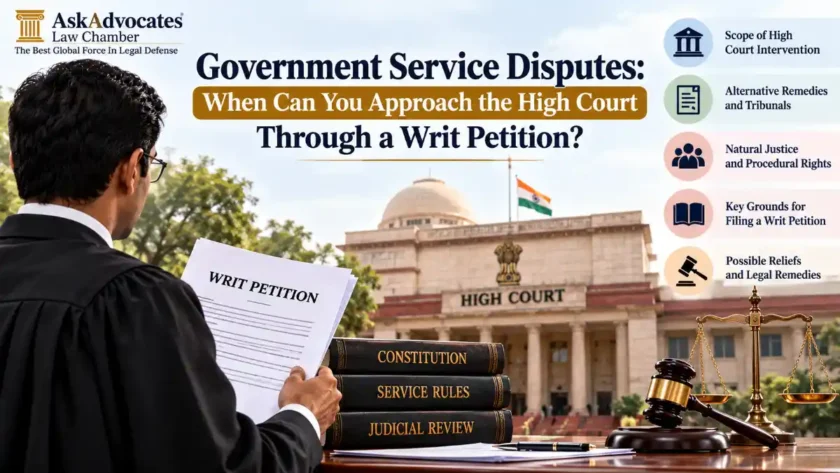
A High Court may review disciplinary action through its constitutional jurisdiction where the law permits. Judicial review generally focuses on legality, jurisdiction, procedural fairness, and other recognised grounds. It does not ordinarily operate as a complete rehearing of every factual dispute. A challenge may arise where the authority acted beyond its powers, breached a mandatory procedure, denied a fair opportunity, or reached findings unsupported by the material in a legally significant way. The precise standard depends on the case and governing principles. Employees should identify the impugned order and explain each legal defect with reference to the record. They should also consider whether an alternative statutory remedy must be pursued or whether an exception may apply. Interim relief is not automatic, even when a challenge raises serious issues. The employee should therefore avoid assuming that filing a petition will stay the disciplinary order. Before approaching the High Court, organise the complete proceedings, relevant service rules, appeal documents, and proof of dates. A focused legal analysis helps assess maintainability, potential relief, limitation, and litigation risks.
Evidence, Burden, and Findings of Misconduct
Departmental enquiries generally apply a standard of proof different from the criminal standard of proof beyond reasonable doubt. The applicable legal principles usually assess whether the charge is established on the evidence under the relevant disciplinary framework. However, a lower standard does not mean that an allegation proves itself. The inquiry officer must consider relevant evidence and reach findings supported by the record. In Union of India v. H.C. Goel, AIR 1964 SC 364, the Supreme Court considered the limits of judicial review where findings lack evidentiary support. In Kuldeep Singh v. Commissioner of Police, (1999) 2 SCC 10, the Court addressed findings in disciplinary proceedings and the role of judicial review. These decisions must be applied to their facts and later legal developments. An employee should identify the specific evidence relied upon for each charge and examine whether it supports the finding. Contradictions, unsupported assumptions, and ignored material may matter when legally significant. The argument should explain the defect clearly instead of simply asserting that the authority reached the wrong conclusion.
When Criminal Law and Departmental Proceedings Overlap
Some allegations may lead to both a departmental enquiry and criminal proceedings. For example, suspected bribery, forgery, misappropriation, or destruction of records may attract separate service and criminal-law consequences. The Bharatiya Nyaya Sanhita, 2023 addresses substantive criminal offences, while the Bharatiya Nagarik Suraksha Sanhita, 2023 governs criminal procedure. The Bharatiya Sakshya Adhiniyam, 2023 addresses evidentiary rules in proceedings within its scope. The Code of Civil Procedure, 1908 may be relevant to civil litigation where applicable, but it does not automatically govern internal disciplinary enquiries. Whether criminal and departmental matters should proceed simultaneously depends on the circumstances and applicable legal principles. Employees should not assume that an FIR, arrest, charge sheet, or pending criminal trial automatically stops departmental action. Equally, they should not assume that a departmental finding determines criminal guilt. Each process has its own purpose and procedure. Obtain advice that considers both proceedings, disclosure risks, service rules, and deadlines. Avoid making inconsistent statements across proceedings without understanding their legal consequences.
Police Complaints and Separate Criminal Remedies
A departmental enquiry is not ordinarily a process conducted by a local police station. Police involvement may arise separately when the alleged facts disclose a possible criminal offence or require a lawful investigation. Whether to approach the police depends on the facts, evidence, and applicable criminal law. Employees should not file an unsupported criminal complaint merely to gain leverage in a service dispute. Similarly, a disciplinary objection should not be confused with a request for criminal investigation. Where both processes exist, preserve relevant notices, complaints, court orders, and official communications. Seek advice on the appropriate forum and avoid disclosing protected information unlawfully. The correct police station or investigating authority depends on the location and nature of the alleged offence, jurisdictional rules, and current circumstances. This article does not identify a nearby police station because no specific incident location has been provided. If the issue concerns only a charge memo or disciplinary order, the first step is usually to examine the applicable service rules and available departmental remedies. Criminal-law advice may be necessary when a separate criminal case genuinely exists.
Select the Remedy Based on the Actual Defect
The remedy should match the defect the employee seeks to correct. A missing document may require a prompt inspection request and a recorded objection. A defective hearing may require a representation under the governing rules. An adverse final order may trigger an appeal, revision, review, tribunal application, or court challenge, depending on eligibility and law. A jurisdictional objection requires examination of the authority’s legal powers. An evidentiary challenge requires a careful review of the charge, exhibits, witness testimony, and findings. A penalty challenge may require analysis of the applicable rules and relevant circumstances. These issues should not be combined into vague claims of unfairness. Identify the order being challenged, the precise legal defect, the supporting record, and the relief sought. Then check the correct forum and deadline. Where more than one remedy appears possible, consider maintainability, costs, urgency, and the consequences of choosing each route. A service-law advocate can help assess the options, but the decision must remain grounded in the actual documents and governing law.
Ask Advocates Law Chamber provides legal assistance concerning departmental enquiries, charge memos, service rules, disciplinary appeals, and related litigation. Assistance may include reviewing the charge memo, analysing evidence, preparing written representations, identifying procedural defects, and assessing tribunal or court remedies. Every matter requires an individual review of the employee’s status, applicable regulations, allegations, and procedural history. No particular outcome can be guaranteed. Employees should seek advice promptly after receiving a charge memo or disciplinary order because delay can affect available remedies. Preserve the original documents and prepare a chronology before consultation. Share both favourable and unfavourable facts so the legal assessment remains accurate. The correct strategy may involve responding within the department, challenging a procedural defect, appealing a final order, or pursuing another legally available remedy. The appropriate choice depends on the facts and law. This article provides general legal information, not an opinion on any individual case. A lawyer should review the relevant documents before the employee takes a case-specific decision.
Frequently Asked Questions
1. Can a government employee challenge a departmental enquiry?
Yes. Depending on the facts and rules, an employee may challenge procedural unfairness, lack of authority, unsupported findings, or an unlawful penalty through available remedies.
2. Is a lawyer allowed during a departmental enquiry?
Representation depends on the applicable service rules and circumstances. Check the governing provisions before deciding whether a lawyer or another defence assistant may participate.
3. Can departmental and criminal proceedings run together?
Sometimes. A pending criminal case does not automatically stop departmental proceedings. The decision depends on the allegations, evidence, applicable rules, and relevant legal principles.
4. What should an employee do after receiving a charge memo?
Identify the applicable service rules, read every charge carefully, request relevant documents, preserve records, and submit a timely, evidence-based written defence.
5. Can an employee challenge an adverse disciplinary order?
Potential remedies include an appeal, revision, review, tribunal application, or court challenge. The correct route depends on jurisdiction, service rules, limitation, and the order.
6. Does every procedural mistake invalidate an enquiry?
No. The legal effect depends on the applicable rule, nature of the defect, and its impact on fairness or the employee’s ability to defend the case.
Legal disclaimer: This article provides general legal information for educational purposes. It does not replace advice based on the applicable service rules, charge memo, inquiry report, or final order. Verify all case citations and current legal provisions before relying on them in a specific matter.