
Practice Area: Cyber Law | Publication Day: Day 19 | Primary keyword: online financial fraud in India
Related Legal Guides
- Electronic evidence in cybercrime cases
- What to expect after an FIR in India
- How to challenge or quash an FIR under BNSS
Online Financial Fraud in India: Bank Lien, Cyber Complaint, FIR and Recovery Remedies addresses a defined search intent within Cyber Law. The article is deliberately narrower than the existing AskAdvocates material where overlap was identified. It explains the governing legal test, procedural sequence, evidence requirements and remedies while distinguishing general information from advice on a particular case.
Report the Fraud Immediately
Online financial fraud is time-sensitive. The victim should contact the bank or payment provider immediately, report the unauthorised transaction and preserve the transaction reference. The official cybercrime reporting mechanism should be used where appropriate. The first objective is to create an official record and maximise the opportunity for tracing or restraining funds. Do not wait until every document is collected before reporting.
Bank Lien and Transaction Restraint
A bank may receive information or instructions concerning accounts connected with suspected fraud. A lien or restriction can affect the victim, a recipient account or an innocent third party. The legal position depends on the source of the restriction and the investigation. Obtain the complaint number, transaction details and reason for any restriction. If a legitimate account is wrongly affected, the affected person may require a separate legal strategy from the fraud victim.
Cyber Complaint and Police Action
A cyber complaint and an FIR are not identical. The victim should provide a clear factual chronology: how contact occurred, what representation was made, what payment was authorised or induced, where the funds went and what happened afterwards. The applicable BNS, IT Act and BNSS provisions should be identified by investigators and counsel. The victim should avoid guessing offence sections and instead provide complete factual information.
Preserve the Money Trail
Download bank statements, UTRs, UPI records, beneficiary information, wallet details and communications. Prepare a transaction table showing date, amount, sender, beneficiary and reference number. This is more useful than a folder containing hundreds of unlabelled screenshots. Preserve the original electronic records and devices where relevant. The evidence should demonstrate the financial route and connect the transaction to the fraudulent conduct.
Electronic Evidence
The BSA 2023 governs electronic-record evidence for proceedings under the new criminal-law framework. Older cases on electronic evidence remain useful only subject to current statutory requirements and transition. Preserve original devices, source records and relevant metadata. A screenshot can be supporting evidence, but it may not establish the complete source or context. For important cases, forensic preservation may be necessary.
Recovery and Follow-Up
Filing a complaint does not automatically guarantee reimbursement. Recovery depends on tracing, restraint, investigation and the legal status of the funds. The victim should follow up with the bank and investigating agency, preserve every acknowledgement and seek appropriate legal relief if progress stalls. Where substantial funds or multiple accounts are involved, specialist legal assistance can help coordinate the banking and criminal aspects.
Evidence That Decides the Issue
Online financial fraud is unusually time-sensitive because money may move through several accounts within minutes. The first response should therefore be operational: contact the bank or payment intermediary, report the unauthorised or induced transaction, obtain the complaint/reference number and request appropriate transaction-level intervention. The victim should not wait for a polished police complaint before notifying the financial institution. A concise chronology showing the time of the fraud, payment channel, UTR or transaction reference, beneficiary details and amount helps investigators and banking personnel act on the correct transaction.
Forum and Remedy Strategy
A bank restriction on an account connected with suspected fraud does not automatically mean that the victim has recovered the money. A lien or debit restriction may protect funds while the investigation proceeds, but ownership, competing claims and the source of the funds can still require adjudication or court directions. The victim should therefore preserve the trail from the original debit to the beneficiary account and subsequent transfers. Where money has moved across multiple accounts, the complaint should identify each known transfer rather than merely naming the first recipient.
Common Failure Points
A cybercrime portal complaint and a police FIR perform different functions. The complaint provides an initial factual and transactional record; the FIR is the formal criminal case where the statutory requirements for registration are met. The victim should state how the fraud was initiated, what representation induced payment, what technical or account information is available, and what immediate financial harm occurred. Avoid exaggeration. Investigators need transaction identifiers and source evidence that can be verified through bank and service-provider records.
When Specialist Legal Review Is Advisable
Screenshots alone rarely explain the complete transaction. Preserve bank statements, UPI transaction pages, emails, call logs, SMS alerts, chat exports, account details, URLs, device information and the original communications where possible. The evidentiary record should show both the communication that induced the payment and the financial event that followed. Under the BSA framework, electronic records must be preserved and produced through the applicable statutory route. A victim who destroys the original conversation or changes devices without preserving data may create avoidable evidentiary difficulties.
Current-Law and Statutory Accuracy
For online financial fraud, bank intervention, cyber complaints and recovery, statutory accuracy requires the practitioner to identify the exact law, rule, notification and case-law proposition applicable on the date of the disputed event. Older terminology should be retained only when it describes a legacy proceeding or remains useful as a search term. Every material proposition should be traceable to the governing enactment, rule, judgment or official guidance.
Procedural and Forum Strategy
Forum selection in online financial fraud, bank intervention, cyber complaints and recovery depends on the stage of the dispute, the relief required and the statutory allocation of jurisdiction. A technically available forum may still be strategically unsuitable if it cannot grant the needed relief or if an appeal is already prescribed. The reader should identify the present procedural stage before selecting a forum.
Evidence Architecture for the Case
The evidence architecture for online financial fraud, bank intervention, cyber complaints and recovery should be built around the elements that must actually be proved. Organise primary documents first, then corroborating records and explanatory material. Each important proposition should have a document, witness or electronic record behind it. A chronology should expose contradictions and missing steps rather than merely repeat one party’s narrative.
Deadlines and Procedural Triggers
Timing is substantive in online financial fraud, bank intervention, cyber complaints and recovery. Notice periods, limitation, response deadlines, statutory waiting periods and appeal windows can change the available remedy. Record the date of each operative document, calculate the next deadline from the governing provision and preserve proof of filing or service. Where the law changed during the relevant period, show which version governed each event.
Practical Decision Matrix
The legal strategy should run on parallel tracks: immediate banking intervention, cyber/police reporting, preservation of electronic evidence, investigation follow-up and legal recovery measures where required. The correct forum depends on whether the issue concerns criminal investigation, bank conduct, a disputed lien, recovery from identified funds or a civil claim against a wrongdoer. The objective is not simply to obtain an FIR. It is to preserve evidence, trace funds, secure recoverable assets and ensure that the investigative record identifies the complete chain of transactions.
Advanced Practical Analysis
Source identification
Every electronic exhibit should have a source story. Identify whether it came from a phone, laptop, email account, cloud service, CCTV system, social-media platform or another database. Record the relevant account or device identifier and the method by which the record was obtained. A screenshot without source information may still have relevance, but its evidentiary weight can be challenged. The stronger practice is to preserve the source and explain how the displayed record corresponds to it.
Section 63 certificate workflow
The BSA’s Section 63 requirements should be built into evidence collection at the beginning, not added after trial objections arise. Identify the system producing the record, the relevant device or account, the manner of extraction and the person competent to provide the required certificate. The certificate should correspond to the actual record tendered. A generic certificate copied from another case can create avoidable credibility and admissibility problems.
WhatsApp evidence
A WhatsApp export should preserve the identity of participants, relevant conversation range, timestamps and attachments. The party should avoid selecting only favourable messages while omitting preceding or subsequent context that could change the meaning. Where a device is available, preserve it appropriately. If the evidence is central to a criminal case, technical examination may be warranted. The article should distinguish evidentiary relevance from the separate question of admissibility and proof.
Email evidence
Email evidence can contain valuable header information, attachments and transmission details that disappear when a message is copied into a word processor. Preserve the original message and mailbox context where possible. If the account is hosted by a service provider, the source and retrieval method should be documented. The court may need evidence connecting the account and record to the relevant person. A printed email is therefore not always the end of the evidentiary inquiry.
CCTV and system logs
CCTV evidence is highly time-sensitive because systems overwrite older footage. The investigator or litigant should identify the relevant camera, date and time window and promptly request preservation. Exported footage should be retained in its original format where possible, with the extraction method documented. System logs, access records and audit trails can also establish who accessed or changed a file. The chain of custody should reflect these steps.
Metadata and integrity
Metadata can assist with chronology, authorship and file history, but it should not be treated as infallible. A court may consider how the metadata was generated and whether the file was converted. Hash values and forensic images can support integrity where appropriate. The legal team should preserve the original file and avoid unnecessary editing. Any conversion used for courtroom presentation should be recorded so the relationship between the original and displayed copy remains clear.
Challenging opponent evidence
A challenge should identify a concrete defect: unknown source, incomplete conversation, unexplained editing, missing certificate, inconsistent timestamp, unreliable extraction or lack of connection to the accused or claimant. Broad assertions that “digital evidence can be manipulated” are weak without a specific factual basis. The same principle applies when defending evidence. The party should be able to explain how the record was obtained and why it corresponds to the fact alleged.
Court presentation
Digital evidence should be presented through a clear exhibit map. For each item, state the source, relevant date, fact proved, witness or certificate relied upon and location in the electronic record. This makes the judge’s task easier and reduces confusion when hundreds of messages or files are involved. The article should teach readers that admissibility, authenticity, relevance and evidentiary weight are separate questions that may arise at different stages.
Victim chronology
Prepare a chronology beginning with the first contact by the fraudster and ending with the latest known movement of funds. Record every call, message, promise, payment, beneficiary and bank response. This chronology can become the backbone of the police complaint, bank follow-up and any later court proceeding. It should distinguish what the victim personally observed from information later obtained from bank or police records.
Preserving the device
If the fraud involved remote access, malware, phishing or a compromised account, the device itself may contain relevant evidence. The victim should avoid unnecessary resets or application changes before preservation is considered. Password changes may be necessary for security, but the security response should be documented. A lawyer or forensic professional can help balance immediate account protection with evidence preservation.
Multi-jurisdiction problems
Online fraud can involve a victim in one State, a beneficiary account in another and service providers located elsewhere. The complaint should therefore provide transaction and digital identifiers that permit coordination across jurisdictions. If investigation is delayed because the case appears to fall outside one local jurisdiction, the victim should maintain the documentary trail and seek appropriate escalation rather than filing inconsistent complaints that create confusion.
Frequently Asked Questions
What should I do immediately after an online financial fraud?
Notify the bank or payment provider immediately, report the transaction through the appropriate cybercrime mechanism, preserve all transaction references and communications, and record every complaint number.
Can a bank freeze the fraudster’s account?
Appropriate restrictions may be imposed through banking, investigative or lawful directions, but the exact process depends on the transaction and authority involved. A freeze does not automatically equal recovery.
Is a cybercrime complaint the same as an FIR?
No. A cybercrime complaint is an initial report; an FIR is the formal criminal registration where the statutory requirements are satisfied.
What evidence is most important in financial cyber fraud?
UTRs, bank statements, beneficiary details, payment screenshots, emails, chats, call records, device data and the communications that induced the transfer are particularly important.
Can stolen money be recovered after it reaches another bank account?
Recovery can remain possible where funds are traced and legally restrained, but it depends on timing, tracing, availability of funds and the applicable legal process.
Should the victim hire a lawyer after reporting the fraud?
Legal assistance can be valuable where the amount is substantial, the money has moved through several accounts, a lien is disputed, investigation is delayed or recovery requires court proceedings.
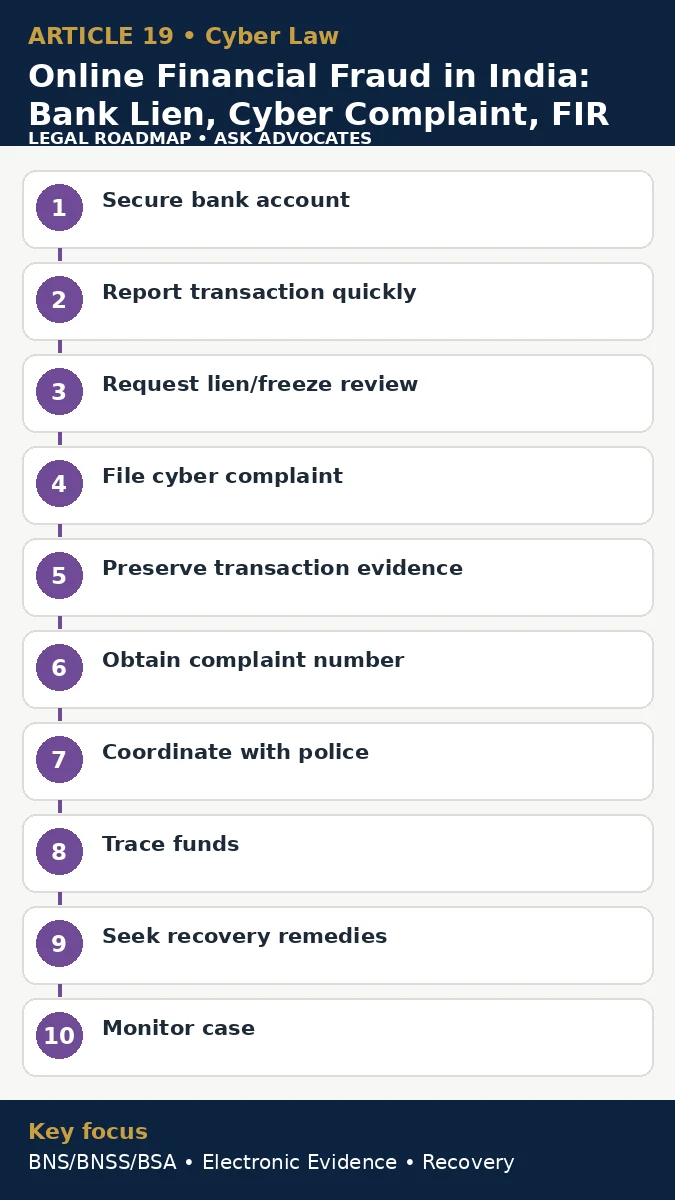
How To Proceed: 10-Step Roadmap
1. Report bank fraud immediately
Contact the bank or payment intermediary immediately and record the transaction reference, complaint number and time of reporting.
2. Use cybercrime reporting mechanism
File the appropriate cybercrime report with a precise description of the transaction and the suspected beneficiary.
3. Preserve transaction records
Prepare a chronological table of every payment, UTR, beneficiary account and subsequent known transfer.
4. Record complaint numbers
Preserve chats, emails, SMS, call logs, websites, social-media accounts and the original device or source data.
5. Provide beneficiary details
Request appropriate transaction restraint or investigation measures through the bank and investigating agency.
6. Follow up on freeze/lien
Provide the investigating officer with a structured evidence index instead of an unorganised bundle of screenshots.
7. Preserve electronic evidence
Identify whether the case requires an FIR, further police representation or a court-directed remedy.
8. Trace financial route
Follow the money trail and update the complaint when additional beneficiary accounts or transactions are identified.
9. Seek recovery/legal directions
Keep copies of every bank and police communication and note dates when follow-up is required.
10. Secure accounts and devices
Evaluate recovery, civil and criminal remedies separately after the transaction chain and available assets are established.
Key Statutes, Rules and Judicial Authorities
Statutes and Rules
Information Technology Act 2000
BNS 2023
BNSS 2023
BSA 2023
Judicial Authorities
Lalita Kumari v. Government of U.P., (2014) 2 SCC 1
Anvar P.V. v. P.K. Basheer, (2014) 10 SCC 473, subject to current BSA framework
Arjun Panditrao Khotkar v. Kailash Kushanrao Gorantyal, (2020) 7 SCC 1, subject to current law