
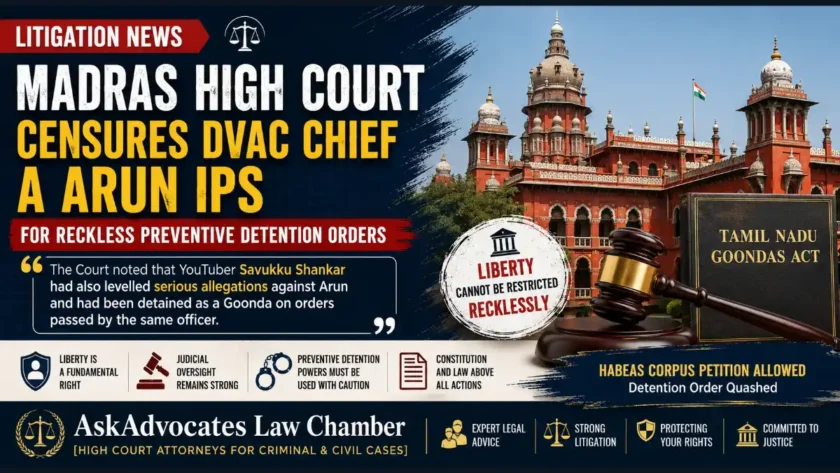
The Madras High Court recently delivered a significant judgment concerning preventive detention under the Tamil Nadu Goondas Act. The ruling has attracted attention from constitutional lawyers, criminal law practitioners, civil rights advocates, police authorities, and government departments throughout Tamil Nadu. The case arose from a detention order issued against a Chennai-based builder accused of cheating flat purchasers in a real estate project. While criminal proceedings were already underway, authorities invoked preventive detention provisions. The Court examined whether such extraordinary powers were exercised within the limits prescribed by law. Preventive detention affects personal liberty directly and therefore demands strict scrutiny. The Bench observed that constitutional safeguards cannot be ignored while exercising executive authority. The judgment is important because it highlights judicial oversight over detention orders and reinforces the constitutional principle that liberty remains one of the most valuable rights available to every citizen under Indian law.
Madras High Court Questions Preventive Detention Order and Reinforces Constitutional Liberty

Judicial Scrutiny of the Detention Order
A Division Bench comprising Justice GR Swaminathan and Justice V Lakshminarayanan closely examined the detention records. The Court observed that preventive detention cannot be used casually. Such powers are intended only for exceptional situations involving threats to public order. The Bench noted that ordinary criminal prosecution and preventive detention operate in different legal spheres. Criminal law punishes completed offences through investigation, trial, and conviction. Preventive detention seeks to prevent future activities that may affect public order. Therefore, authorities must demonstrate compelling reasons before invoking detention powers. The Court found substantial deficiencies in the detention order under challenge. Judicial review focused on procedural compliance, application of mind, statutory requirements, and constitutional safeguards. The Bench concluded that the detention order could not withstand legal scrutiny. Consequently, the Court quashed the order and reaffirmed the importance of constitutional protections available against arbitrary detention.
Background of the Real Estate Dispute
The detention proceedings originated from allegations involving a real estate development project in Chennai. Several flat purchasers alleged that they suffered financial losses due to actions attributed to the builder and his company. Criminal prosecution had already commenced concerning those allegations. However, authorities later issued a preventive detention order under the Tamil Nadu Goondas Act. The detainee’s daughter challenged the detention before the Madras High Court through a Habeas Corpus Petition. The Court carefully distinguished between criminal prosecution and preventive detention. It observed that criminal allegations may justify investigation and prosecution. However, preventive detention requires separate legal justification supported by specific materials. The Bench concluded that available facts did not justify such extraordinary action. This distinction formed a central aspect of the Court’s reasoning and highlights an important principle within preventive detention jurisprudence.
Difference Between Criminal Prosecution and Preventive Detention
Indian constitutional law consistently distinguishes preventive detention from criminal prosecution. Criminal proceedings focus on determining guilt through a judicial process. Preventive detention serves a different purpose and aims to prevent anticipated future conduct. Therefore, courts insist upon strict compliance with statutory safeguards before approving detention measures. Authorities possess numerous investigative and prosecutorial tools under existing criminal laws. Consequently, preventive detention should never become a substitute for ordinary criminal proceedings. The Court reiterated that executive authorities must justify detention independently of ongoing prosecutions. This principle protects constitutional liberty and prevents misuse of extraordinary powers. Lawyers frequently challenge detention orders whenever authorities fail to establish a clear preventive necessity. Such judicial scrutiny remains vital for preserving constitutional rights.
Court Expresses Concern Regarding Executive Accountability
The judgment contains strong observations concerning administrative accountability. The Court expressed concern regarding repeated detention orders issued by the same officer that were subsequently quashed. During proceedings, the officer personally appeared before the Bench and defended his actions. He stated that he merely discharged his official responsibilities. The Court, however, remained unconvinced by those explanations. Judicial scrutiny focused upon the officer’s extensive service experience and familiarity with detention law. The Bench observed that preventive detention directly affects personal liberty and therefore demands heightened caution. Authorities exercising such powers must act within legal boundaries and ensure compliance with constitutional requirements. The judgment reinforces the principle that public officials remain accountable whenever they exercise coercive authority affecting fundamental rights.
Constitutional Protection of Personal Liberty
Personal liberty occupies a central position within Indian constitutional jurisprudence. Articles 21 and 22 provide important safeguards against arbitrary detention. Courts consistently interpret these provisions in favour of protecting individual freedom. Consequently, preventive detention statutes receive strict judicial scrutiny. Authorities must follow procedural safeguards precisely. Any substantial deviation may render detention legally unsustainable. The Madras High Court reiterated that detention impacts not only physical freedom but also reputation, livelihood, and family life. Therefore, every detention order must satisfy constitutional and statutory requirements. Judicial intervention remains essential whenever executive action threatens individual liberty without adequate legal justification.
References to Earlier Controversies and Public Concerns
The Court also referred to earlier controversies involving preventive detention proceedings. It noted that YouTuber Savukku Shankar had levelled serious allegations against the concerned officer. The Court further observed that Savukku Shankar had been detained under the Goondas Act through an order passed by the same officer. That detention was subsequently revoked after the Advisory Board reportedly found insufficient grounds for continuation. The Bench also referred to proceedings involving journalist Varaaki, where observations had been made regarding police conduct. These references formed part of a broader examination of executive accountability. The Court’s observations suggest that detention powers must always remain subject to constitutional oversight and public scrutiny.
Role of Advisory Boards in Detention Cases
Advisory Boards perform an important role within preventive detention law. These bodies examine detention materials and determine whether sufficient cause exists for continued detention. Their review functions as an additional safeguard against arbitrary action. Consequently, findings of an Advisory Board can significantly influence detention proceedings. Courts often consider such findings while examining legal challenges. Effective advisory review strengthens transparency, accountability, and procedural fairness. Therefore, Advisory Boards remain an essential component of the preventive detention framework established under Indian law.
Impact of the Judgment on Future Detention Litigation
The ruling may influence future preventive detention litigation throughout Tamil Nadu. Lawyers handling Habeas Corpus Petitions are likely to rely upon the judgment in similar cases. Police authorities may also reassess internal procedures governing detention decisions. Courts frequently examine previous decisions while evaluating comparable disputes. Therefore, strong observations made by constitutional courts often possess significant persuasive value. The judgment reinforces the principle that detention powers must be exercised cautiously and only after proper application of mind. Consequently, future detention orders may face more rigorous scrutiny from both administrative authorities and constitutional courts.
Legal Implications for Police Administration and Government Departments
The decision carries substantial implications for police administration and government departments. Senior officers exercising statutory powers must ensure strict compliance with legal requirements. Administrative decisions affecting liberty demand careful evaluation of facts, materials, and statutory conditions. Furthermore, authorities must maintain detailed records demonstrating the basis for their decisions. The judgment highlights the importance of responsible governance and constitutional accountability. Public officials exercising extraordinary powers must remember that judicial review remains available whenever liberty interests are affected. Consequently, administrative diligence becomes essential at every stage of the detention process.
Interaction Between Preventive Detention and Modern Criminal Laws
India’s criminal justice system now operates under the Bharatiya Nyaya Sanhita, Bharatiya Nagarik Suraksha Sanhita, and Bharatiya Sakshya Adhiniyam. These statutes provide comprehensive mechanisms for investigation, prosecution, and adjudication. Consequently, authorities possess extensive powers to address criminal conduct through ordinary legal processes. Preventive detention therefore remains an exceptional measure rather than a routine enforcement tool. Courts frequently assess whether ordinary criminal law remedies could adequately address alleged misconduct. This approach ensures that preventive detention remains confined to genuinely exceptional circumstances.
Important Legal Frameworks Relevant to Similar Cases
The following legal frameworks frequently arise in detention-related litigation:
- Constitution of India.
- Tamil Nadu Goondas Act.
- Bharatiya Nyaya Sanhita, 2023.
- Bharatiya Nagarik Suraksha Sanhita, 2023.
- Bharatiya Sakshya Adhiniyam, 2023.
- Writ Jurisdiction under Articles 226 and 32.
These statutes collectively shape judicial examination of detention disputes and constitutional challenges.
Courts and Forums Relevant to Preventive Detention Cases
Several judicial and quasi-judicial forums may become relevant in preventive detention matters. The appropriate forum depends upon the nature of the dispute and procedural stage. Common forums include:
| Forum | Function |
|---|---|
| Madras High Court | Habeas Corpus and Writ Jurisdiction |
| Supreme Court of India | Constitutional Review |
| Advisory Boards | Detention Review |
| State Government Authorities | Administrative Consideration |
| Constitutional Benches | Interpretation of Fundamental Rights |
These institutions collectively safeguard constitutional liberties and ensure accountability within detention proceedings.
Legal Remedies Available Against Detention Orders
Individuals affected by preventive detention orders may pursue several remedies:
- Habeas Corpus Petition before the High Court.
- Constitutional challenge under Article 226.
- Special Leave Petition before the Supreme Court.
- Representation before the Advisory Board.
- Judicial review of executive action.
- Appropriate legal proceedings seeking constitutional relief.
Timely legal action often plays a crucial role in protecting individual liberty and challenging unlawful detention.
Conclusion
The Madras High Court’s decision represents an important development in preventive detention jurisprudence. The judgment emphasises that personal liberty remains a cornerstone of constitutional governance. It further reinforces the principle that extraordinary powers require extraordinary responsibility. Courts remain vigilant guardians of fundamental rights and continue to scrutinise executive action whenever constitutional protections appear threatened. The ruling serves as a reminder that preventive detention cannot replace ordinary criminal prosecution. Authorities must exercise such powers cautiously, lawfully, and only when statutory requirements are fully satisfied. As detention law continues to evolve, this decision is likely to remain an important reference point for lawyers, courts, government departments, and citizens concerned with constitutional accountability and liberty protection.
Frequently Asked Questions
Preventive detention aims to prevent anticipated conduct affecting public order. It differs from criminal prosecution, which addresses completed offences.
Yes. Affected persons may file a Habeas Corpus Petition before the High Court challenging the legality and validity of the detention order.
The Madras High Court frequently hears Habeas Corpus Petitions challenging preventive detention orders passed by authorities.
No. Authorities must establish independent grounds demonstrating the necessity for preventive detention under applicable laws.
An Advisory Board reviews detention materials and determines whether sufficient cause exists for continuation of detention.
The decision reinforces constitutional liberty, judicial oversight, executive accountability, and strict compliance with preventive detention laws.
Read More
- CONSTITUTIONAL LAW: Expert Advocates to protect your rights
- Goondas Act Lawyers in Chennai
- Right to Freedom
- False imprisonment
- The Best Law Firms and Reliable Legal Consultants
Editorial Note
This article is intended solely for legal awareness, litigation news reporting, and public information purposes. The contents are based on judicial proceedings reported in the matter of Varsha Sharma v. The Additional Chief Secretary to Government & Others (HCP No. 2066 of 2025) before the Madras High Court and related information available in the public domain as on the date of publication.
The observations, findings, and remarks referred to in this article are those recorded by the Hon’ble Madras High Court in the proceedings concerned. The case may be subject to further legal developments, review proceedings, appeals, clarifications, or subsequent judicial orders. Readers are advised to refer to the official court records and authenticated judgments for complete and authoritative information.
This publication does not constitute legal advice, legal opinion, professional representation, or a determination of guilt, innocence, misconduct, or liability of any individual, authority, department, or institution mentioned herein. Every person is entitled to the presumption of innocence and due process of law unless otherwise determined by a competent court.
For legal consultation regarding preventive detention, Habeas Corpus Petitions, constitutional remedies, criminal litigation, police action, real estate fraud disputes, civil litigation, writ proceedings, or matters arising under the Constitution of India, the Bharatiya Nyaya Sanhita, 2023, the Bharatiya Nagarik Suraksha Sanhita, 2023, the Bharatiya Sakshya Adhiniyam, 2023, and other applicable laws, readers should obtain independent legal advice based on the specific facts of their case.
LawyerChennai.com is an independent legal information platform and is not connected with any government department, investigating agency, police authority, court, tribunal, statutory body, advocate, law firm, litigant, or party referred to in this article.