
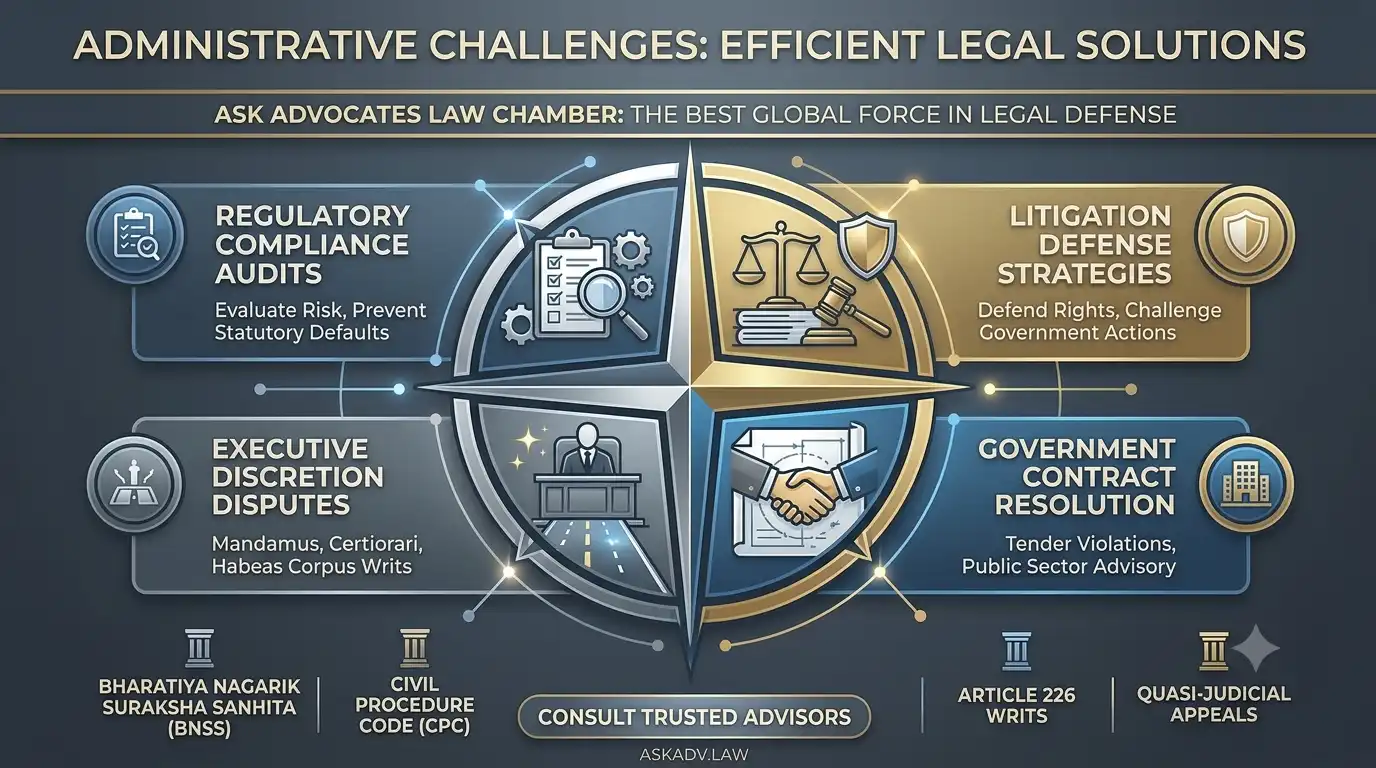
Modern corporate operations must navigate dense regulatory networks governed by municipal, state, and central authorities. Unanticipated administrative actions—such as delayed licenses or unexpected compliance notices—can severely interrupt business continuity.
Consequently, companies require proactive legal intervention to prevent minor compliance issues from escalating into full litigation. Ask Advocates Law Chamber offers immediate counsel to evaluate regulatory risk and maintain full statutory alignment. Additionally, our defense advocates intervene during preliminary audit inquiries to prevent administrative overreach.
Strategic Legal Support for Complex Administrative Disputes
We safeguard client interests using established statutory remedies across various enforcement bodies. Ultimately, our structured compliance frameworks keep your business compliant, secure, and commercially competitive.
│ ADMINISTRATIVE LEGAL PROTECTION FRAMEWORK │
└─────────────────────────────────────────────────────────────────────────┘
│
┌───────────────────────────┴───────────────────────────┐
▼ ▼
┌─────────────────────────────────┐ ┌─────────────────────────────────┐
│ PREVENTIVE COMPLIANCE │ │ LITIGATION DEFENSE │
├─────────────────────────────────┤ ├─────────────────────────────────┤
│ • Regulatory Audits │ │ • Constitutional Writs │
│ • License Filings │ │ • BNSS & BNS Criminal Defense │
│ • Statutory Risk Mapping │ │ • Quasi-Judicial Appeals │
└─────────────────────────────────┘ └─────────────────────────────────┘
Mastering Public Sector Regulatory Compliance Strategies
Navigating public sector compliance requires a clear understanding of administrative procedures and executive authority limits. Regulatory agencies often exercise broad discretionary powers, leading to arbitrary decisions or delayed approvals.
Therefore, our legal team conducts comprehensive audits to identify compliance gaps before authorities raise formal objections. We regularly interface with key regulatory bodies to secure approvals and resolve licensing conflicts efficiently.
- Regulatory Risk Mapping: Identifying potential statutory defaults across operational departments before enforcement actions occur.
- Executive Representation: Engaging directly with regulatory officers to present compliance evidence effectively.
- Policy Alignment: Updating corporate governance policies to reflect changes in regulatory standards.
Consequently, our strategies minimize administrative exposure while maintaining constructive relationships with regulatory authorities.
Modernizing Criminal and Administrative Defense Frameworks
Recent statutory reforms have transformed the legal defense landscape across multiple jurisdictions. The introduction of the Bharatiya Nagarik Suraksha Sanhita (BNSS), the Bharatiya Nyaya Sanhita (BNS), and the Bharatiya Sakshya Adhiniyam (BSA) establishes updated procedural and evidentiary standards.
Furthermore, Section 173 of the BNSS mandates Zero FIR registration regardless of territorial limits, reshaping preliminary investigations. Section 57 of the BSA establishes electronic records as primary evidence, changing digital compliance requirements.
Our legal defense team uses these updated procedural provisions to protect clients during corporate investigations. Additionally, we combine Bharatiya Nagarik Suraksha Sanhita provisions with civil protections to build robust defense frameworks.
| LEGISLATION | FORMER CODE REPLACED | KEY ADMINISTRATIVE IMPACT |
|---|---|---|
| Bharatiya Nagarik Suraksha Sanhita (BNSS) | Code of Criminal Procedure (CrPC, 1973) | Mandatory zero FIRs (Sec 173) and timed trial schedules |
| Bharatiya Nyaya Sanhita (BNS) | Indian Penal Code (IPC, 1860) | Re-defined economic offenses and white-collar liability |
| Bharatiya Sakshya Adhiniyam (BSA) | Indian Evidence Act (IEA, 1872) | Primary status for electronic records and data trails |
Constitutional Remedies for Executive Discretion Disputes
When administrative agencies exceed their statutory authority, constitutional remedies provide effective protection against unlawful actions. Article 226 empowers High Courts to issue extraordinary writs against arbitrary state decisions.
Similarly, Article 32 allows citizens and corporations to seek immediate recourse from the Supreme Court for fundamental rights violations. Ask Advocates Law Chamber files writ petitions to challenge illegal notices and regulatory overreach.
| WRIT TYPES | LEGAL PURPOSE | TARGET GOVERNMENT FORUM |
|---|---|---|
| Writ of Mandamus | Compels a public official to perform an omitted statutory duty. | High Courts, Central Administrative Tribunal. |
| Writ of Certiorari | Quashes unlawful quasi-judicial orders that violate natural justice. | High Courts, Supreme Court of India. |
| Writ of Prohibition | Prevents lower tribunals from exceeding their lawful jurisdiction. | High Courts, Appellate Regulatory Tribunals. |
| Writ of Quo Warranto | Challenges an individual’s legal authority to hold public office. | High Courts, Constitutional Benches. |
These constitutional instruments ensure regulatory authorities remain within their legal boundaries.
Navigating Enforcement Actions Across Investigating Agencies
Corporate entities frequently face simultaneous investigations from specialized government departments. The Directorate of Revenue Intelligence (DRI) handles complex customs and international trade compliance matters.
Meanwhile, the Enforcement Directorate (ED) examines financial structures under anti-money laundering regulations. The Central Bureau of Investigation (CBI) inspects allegations involving public sector corruption and corporate fraud.
- Immediate Notice Assessment: Evaluating statutory notices to formulate precise legal responses.
- Evidentiary Representation: Submitting validated records under Section 57 of the Bharatiya Sakshya Adhiniyam.
- Interim Protective Relief: Securing stays against coercive executive actions in appropriate judicial forums.
Our advocates guide clients through every phase of these enforcement proceedings.
Strategic Injunctions Under the Civil Procedure Code
Civil Procedure Code (CPC) injunctions provide crucial interim relief when administrative decisions threaten business operations. Order 39 Rules 1 and 2 of the CPC allow courts to issue temporary injunctions during pending disputes.
These remedies preserve the status quo and prevent administrative actions from creating irreparable harm. Furthermore, our litigation advocates secure emergency stay orders against unlawful tender disqualifications and contract cancellations.
- Prima Facie Case Establishment: Demonstrating clear legal rights and statutory violations by administrative authorities.
- Balance of Convenience: Proving that stopping the administrative action causes less harm than allowing it.
- Irreparable Loss Proof: Showing that monetary compensation cannot fix the damage caused by the order.
Therefore, civil injunctions serve as essential tools against aggressive administrative decisions.
Quasi-Judicial Appeals and Administrative Tribunals
Specialized tribunals handle regulatory disputes outside traditional court systems. The Central Administrative Tribunal (CAT) resolves employment, service, and organizational disputes involving government authorities.
Similarly, the National Company Law Tribunal (NCLT) handles corporate management disputes and insolvency proceedings. Furthermore, the Central Vigilance Commission (CVC) monitors ethics and integrity standards across public sector undertakings.
Consequently, we present structured arguments before these quasi-judicial bodies to reverse adverse administrative rulings. Our detailed understanding of tribunal procedures helps secure consistent outcomes for clients.
Local Jurisdiction Defense at Police Station Levels
Regulatory disputes can sometimes escalate into formal police complaints at local jurisdiction police stations. Under Section 173 of the BNSS, police officers hold expanded powers during initial inquiries.
Our legal defense team provides immediate support during police interviews and document requests. Furthermore, we ensure investigating officers strictly follow procedural rules outlined in the BNSS.
│ LOCAL POLICE INTERACTION PROTOCOL │
└─────────────────────────────────────────────────────────────────────────┘
│
┌─────────────────────────────┼─────────────────────────────┐
▼ ▼ ▼
┌───────────────┐ ┌───────────────┐ ┌───────────────┐
│ STATUTORY │ │ EVIDENTIARY │ │ BAIL │
│ NOTICE REVIEW │ ──────────► │ COMPLIANCE │ ──────────► │ APPLICATION │
│ (Sec 35 BNSS) │ │ (Sec 57 BSA) │ │ (Sec 480 BNSS)│
└───────────────┘ └───────────────┘ └───────────────┘
Therefore, early legal representation prevents routine administrative matters from turning into serious criminal actions.
Safeguarding Government Contracts and Public Tenders
Public sector contracts are governed by administrative law principles that require fairness, transparency, and equal opportunity. Government departments cannot arbitrarily cancel bids or blocklist contractors without due process.
Ask Advocates Law Chamber challenges illegal tender cancellations and blocklisting orders before High Courts. Additionally, we ensure public authorities follow established natural justice principles during bid evaluations.
- Notice Analysis: Verifying whether government departments provided fair hearing opportunities prior to adverse actions.
- Arbitrary Clause Challenges: Invalidating tender requirements designed to favor specific vendors.
- Damages Actions: Filing claims for compensation when arbitrary contract cancellations cause financial losses.
Consequently, our interventions protect client investments in major public sector projects.
Environmental Compliance and NGT Appellate Support
Environmental enforcement agencies can halt operations immediately using statutory stop-work notices. The National Green Tribunal (NGT) reviews regulatory decisions made by Pollution Control Boards and environmental ministries.
Furthermore, non-compliance can trigger financial penalties and personal liability for corporate officers. Ask Advocates Law Chamber represents industrial clients before the NGT to resolve complex environmental compliance orders.
We work with technical experts to demonstrate regulatory compliance and secure operational approvals. Thus, our defense framework keeps operations moving while meeting environmental requirements.
Customs and Tax Dispute Resolution Mechanisms
Tax and customs enforcement authorities exercise broad investigative and confiscation powers during compliance audits. The Directorate General of GST Intelligence (DGGI) and customs officials frequently issue high-value demand notices.
However, these demand notices often rely on incorrect statutory interpretations or improper evidentiary assessments. Our advocates prepare comprehensive replies to show-cause notices issued by tax enforcement agencies.
- Audit Defense: Organizing evidentiary records to refute penalty demands during preliminary investigations.
- Appellate Appeals: Challenging erroneous tax assessments before Customs, Excise, and Service Tax Appellate Tribunals.
- Seizure Protections: Securing the release of frozen assets through statutory appeals and constitutional writs.
Consequently, we protect corporate capital from improper administrative seizures.
Defense Against Ultra Vires Executive Actions
Administrative actions are legally void when they exceed the powers granted by parliament. Executive rules or orders that violate parent statutes are considered ultra vires.
Ask Advocates Law Chamber routinely challenges invalid regulations using judicial review proceedings. Moreover, we review official notifications to ensure administrative bodies do not exceed their statutory limits.
| LEGAL GROUNDS | STATUTORY TEST | JUDICIAL REMEDY |
|---|---|---|
| Substantive Ultra Vires | Exceeds statutory limits set by parent statute | Order quashed via Writ of Certiorari |
| Procedural Ultra Vires | Fails mandatory process or notice requirements | Injunction staying enforcement action |
| Principles of Natural Justice Violation | Denies fair hearing or shows executive bias | Judicial strike down of administrative order |
Consequently, our litigation strategy holds government agencies accountable to statutory standards.
Cross-Border Regulatory Enforcement Defense
International corporations operating across multiple legal jurisdictions face complex compliance requirements from foreign agencies. Cross-border investigations require careful alignment with both domestic laws and international treaties.
Furthermore, data transfer restrictions and extradition treaties add layers of complexity to these proceedings. Ask Advocates Law Chamber coordinates multi-jurisdictional legal strategies for global enterprises facing international regulatory scrutiny.
We ensure foreign evidence collection requests comply strictly with Section 57 of the BSA. Ultimately, our international defense framework protects global leaders from conflicting cross-border regulatory demands.
Preserving Principles of Natural Justice
Administrative authorities must follow principles of natural justice when issuing decisions that impact rights. The core rule, audi alteram partem, requires giving affected parties a fair opportunity to respond.
Additionally, decision-makers must remain free from bias throughout administrative and quasi-judicial proceedings. Ask Advocates Law Chamber challenges administrative decisions that fail to meet these essential fairness standards.
- Notice Verification: Ensuring administrative notices contain detailed factual grounds and adequate response times.
- Evidence Access: Securing full access to documents used by government agencies during proceedings.
- Bias Disqualification: Recusing biased administrative officers from presiding over quasi-judicial hearings.
Thus, enforcing these fairness principles protects corporate clients from arbitrary executive actions.
Mitigating Corporate Officers’ Personal Liability
Regulatory enforcement actions increasingly target corporate directors and executives with personal civil and criminal liability. Statutory provisions under the BNS and special acts can hold officers responsible for corporate non-compliance.
Therefore, establishing clear corporate governance protocols is essential to protect executives from personal exposure. Ask Advocates Law Chamber designs officer protection frameworks to insulate directors during regulatory inquiries.
│ DIRECTOR PROTECTION WORKFLOW │
└─────────────────────────────────────────────────────────────────────────┘
│
┌─────────────────────────────┼─────────────────────────────┐
▼ ▼ ▼
┌───────────────┐ ┌───────────────┐ ┌───────────────┐
│ STATUTORY │ │ DELEGATION │ │ ANTICIPATORY │
│ COMPLIANCE │ ──────────► │ RESOLUTION │ ──────────► │ BAIL FILING │
│ AUDIT │ │ RECORDING │ │ (Sec 482 BNSS)│
└───────────────┘ └───────────────┘ └───────────────┘
Furthermore, we secure emergency bail protection under the BNSS when executives face regulatory charges.
Emergency Judicial Stay Petitions
When administrative agencies issue immediate closure or penalty notices, fast judicial action is essential. Filing emergency stay petitions prevents immediate losses while courts review administrative decisions.
High Courts can suspend unlawful administrative orders during initial writ petition hearings. Furthermore, our Advocates prepare emergency filings quickly to protect client operations during regulatory actions.
White-Collar Defense in Administrative Proceedings
Administrative inquiries by agency officials can lead to formal white-collar prosecutions under the BNS. Parallel proceedings require a carefully coordinated strategy across civil tribunals and criminal courts.
Our defense team ensures statements made during regulatory audits do not compromise positions in court. Additionally, we manage document production under the Bharatiya Sakshya Adhiniyam to protect corporate interests.
Labor and Municipal Compliance Defense
Commercial facilities face frequent inspections from labor departments and municipal planning authorities. Sudden stop-work orders or licensing cancellations can disrupt day-to-day business operations completely.
Ask Advocates Law Chamber resolves municipal compliance disputes before administrative appellate authorities. We secure interim operating permissions while resolving underlying zoning or employment compliance matters.
Consequently, our local compliance frameworks keep corporate facilities operational and compliant.
Statutory Appeals Against License Revocations
Operating licenses form the backbone of commercial activities across industrial, financial, and service sectors. When administrative bodies revoke critical operating permits, businesses face immediate financial disruption.
Our advocates file statutory appeals before designated appellate authorities to contest arbitrary license cancellations. We demonstrate full compliance using empirical evidence and expert technical testimony.
- Filing Appellate Appeals: Submitting detailed legal appeals within strict statutory deadlines.
- Securing Interim Relief: Obtaining stay orders on license revocations during appeal proceedings.
- Restoring Licenses: Securing final orders to reinstate business operational permits.
Ultimately, preserving operating licenses protects corporate assets and long-term enterprise value.
Strategic Legal Support for Corporate Growth
Ask Advocates Law Chamber provides comprehensive legal defense against administrative, regulatory, and statutory challenges. Our global practice combines deep constitutional expertise with thorough knowledge of modern procedural laws.
We protect corporate operations using Bharatiya Nagarik Suraksha Sanhita provisions, Civil Procedure Code injunctions, and Article 226 writs. Furthermore, our advocates represent clients before investigating agencies, regulatory tribunals, and High Courts nationwide.
Partner with Ask Advocates Law Chamber to secure reliable legal solutions for your administrative challenges.
Frequently Asked Questions
Companies can file urgent writ petitions under Article 226 in High Courts or seek CPC Order 39 injunctions to stay arbitrary closure notices while challenging agency overreach.
BNSS regulates procedural searches and electronic summonses, while BSA Section 57 mandates strict authentication for digital records, directly shaping corporate compliance defense.
Yes, companies can challenge tender disqualifications through Article 226 writ petitions by demonstrating violations of natural justice, arbitrary bid rules, or improper evaluation procedures.
A writ of mandamus compels public officials to perform mandatory statutory duties, whereas certiorari quashes unlawful quasi-judicial orders passed without proper legal authority.
We establish officer compliance protocols, represent directors during statutory audits under BNSS, and secure anticipatory relief under BNSS Section 482 to prevent personal liability.
Disputes are contested before Central Administrative Tribunals, specialized bodies like NCLT, NGT, or CESTAT, local police stations, and High Courts via constitutional writs.