
Civil litigation in India allows individuals, businesses, families and organisations to enforce private legal rights. A civil dispute can involve property, contracts, money, possession, injunctions, damages, declarations or other legal claims.
Filing a civil case is not simply about approaching a court and presenting a grievance. The claimant must identify the correct legal remedy, competent forum, jurisdiction, limitation period and supporting evidence.
A poorly selected remedy can weaken an otherwise genuine claim. Similarly, filing before the wrong court can create avoidable procedural complications.
Therefore, effective civil litigation begins with legal analysis before drafting the plaint. This guide explains how to evaluate a civil dispute, select the appropriate remedy, determine jurisdiction, assess limitation and organise evidence before commencing litigation in India.
“What legal right has been affected, and what remedy can legally protect that right?”
Civil Litigation in India: Remedies, Jurisdiction, Limitation & Evidence
What Is Civil Litigation in India?
Civil litigation refers to judicial proceedings concerning civil rights, obligations, property interests, contractual rights, possession, compensation and other non-criminal disputes. Unlike criminal proceedings, the principal objective of civil litigation is generally to enforce or protect a legal right or obtain an appropriate civil remedy.
The remedy depends on the underlying cause of action and the relief legally available. Civil cases may arise between individuals, companies, partnerships, societies, trusts, landlords, tenants, purchasers, sellers, borrowers, lenders or other legal entities.
Government authorities may also become parties to civil proceedings when the applicable law permits a civil remedy. However, some disputes fall within special statutory forums instead of ordinary civil courts.
Common Civil Disputes in India
Civil litigation can arise from many factual situations. Common examples include:
- Property ownership and title disputes
- Partition and inheritance disputes
- Breach of contract
- Recovery of money
- Specific performance
- Possession disputes
- Permanent or temporary injunctions
- Landlord-tenant disputes
- Damages and compensation claims
- Declaration of legal rights
- Cancellation of documents
- Disputes concerning agreements
- Partnership disputes
- Commercial disputes
- Defamation claims with civil remedies
- Recovery proceedings
- Disputes involving trusts or estates
The correct legal classification matters because different claims may require different pleadings, evidence, limitation periods and forums.
When Should You Consider Civil Litigation?
Civil litigation becomes relevant when negotiation or other lawful remedies cannot adequately protect a legal right. However, litigation should not automatically be the first response to every dispute.
Before filing, consider whether the dispute can be resolved through:
- Negotiation
- Mediation
- Arbitration, where an enforceable arbitration agreement exists
- Statutory grievance mechanisms
- A legal notice
- Settlement
- Administrative remedies
- Consumer remedies
- Tribunal proceedings
- A civil suit
The appropriate option depends on the governing law, contractual terms, factual circumstances and available remedies.
Choosing the Correct Civil Remedy
The remedy determines much of the litigation strategy. A claimant should identify the precise outcome required before selecting the form of proceeding.
For example, a person who merely wants a declaration of title may require a different pleading from someone who also needs possession. A party facing an immediate threat to property may require interim injunctive relief while the substantive dispute remains pending.
Declaration of Rights
A declaratory suit seeks a judicial declaration concerning an existing legal character or right. The declaration must correspond to a legally recognisable right and must satisfy the requirements of the applicable substantive law.
A declaration may become relevant in disputes involving ownership, status, contractual rights, legal relationships or validity of certain instruments. However, a declaration may not always be sufficient by itself.
Where consequential relief is legally available and necessary, the pleadings must address that relief appropriately. The claimant should therefore identify the complete practical objective rather than selecting a declaration simply because ownership or entitlement is disputed.
Recovery of Money
A recovery suit may arise when a person claims that another party owes money under a contract, loan, transaction, invoice, settlement or other legally enforceable obligation.
The claimant should establish:
- Legal basis of the debt
- Amount claimed
- Date on which the obligation became due
- Contractual or statutory interest, if applicable
- Supporting documents
- Acknowledgments or admissions
- Payments already received
- Applicable limitation
- Competent court or forum
A demand for payment should not be confused with proof of liability. The claimant must establish the underlying transaction and legally enforceable obligation.
Injunction
An injunction seeks to restrain or compel conduct. Temporary injunctions may protect the subject matter while the main dispute proceeds.
For example, an injunction may become relevant where a party faces an immediate threat of dispossession, alienation, interference with possession or another actionable harm.
Courts generally examine the legal and factual requirements applicable to interim relief. The claimant should therefore present evidence showing the relevant right, urgency and consequences of refusing protection.
A temporary injunction does not necessarily decide the final rights of the parties. It operates within the procedural framework governing interim relief.
Specific Performance
Specific performance may become relevant when a party seeks enforcement of a contractual obligation rather than merely monetary compensation.
The court examines the contract, statutory requirements and conduct of the parties. Evidence concerning performance, contractual obligations, readiness, willingness and surrounding circumstances can become important.
A claimant should therefore analyse the contract before commencing litigation. The pleadings should clearly identify the agreement, breach, contractual obligations, performance position and relief sought.
Possession
Possession disputes may require careful analysis of title, lawful possession, prior possession, contractual rights, statutory protections and the conduct of the parties.
The appropriate remedy can differ depending on whether the claimant has title, possession, both or neither. A possession claim should therefore not be drafted using generic language.
The lawyer must first determine the legal basis of the claimant’s entitlement.
How Do You Choose the Correct Court?
Jurisdiction is one of the most important preliminary questions in civil litigation.
The Code of Civil Procedure, 1908 establishes the general framework for civil jurisdiction. Section 9 recognises the jurisdiction of civil courts to try suits of a civil nature unless cognisance is expressly or impliedly barred.
Sections 15 to 20 address important aspects concerning the place where suits may be instituted. However, the CPC is not the only source of jurisdiction.
Special legislation can create tribunals, statutory authorities or specialised forums with exclusive or additional jurisdiction.
Subject-Matter Jurisdiction
Subject-matter jurisdiction concerns whether the forum has legal authority to decide the particular type of dispute.
Certain statutory disputes may belong before specialised tribunals rather than ordinary civil courts. Similarly, arbitration agreements can affect the appropriate dispute-resolution mechanism.
Therefore, the existence of a civil dispute does not automatically mean that an ordinary civil court is the correct forum.
Territorial Jurisdiction
Territorial jurisdiction concerns the geographical area within which the court can exercise authority.
Depending on the dispute, relevant factors may include:
- Location of immovable property
- Defendant’s residence
- Defendant’s place of business
- Location where the cause of action arose
- Contractual provisions
- Statutory provisions
For immovable-property disputes, the location of the property can become particularly important. For other disputes, the place where the cause of action wholly or partly arose may become relevant.
Pecuniary Jurisdiction
Pecuniary jurisdiction concerns the monetary limits assigned to different courts.
The applicable pecuniary limits can depend on the relevant State legislation, court structure and nature of the proceeding.
Therefore, the lawyer should verify the current jurisdictional limits before filing. A plaint filed before a court lacking the required pecuniary jurisdiction can create avoidable procedural complications.
Special Forums and Tribunals
Some disputes are governed by special legislation. Depending on the subject, the appropriate forum may include:
- Commercial Court
- Consumer Commission
- Debt Recovery Tribunal
- National Company Law Tribunal
- Real Estate Regulatory Authority
- Administrative Tribunal
- Labour Court
- Industrial Tribunal
- Tax authorities or appellate forums
- Arbitration tribunal
- Statutory appellate authority
The existence of a specialised forum can materially change litigation strategy.
Why Limitation Must Be Examined Before Filing
Limitation is not a technical issue that should be considered after drafting the case. It should be examined at the beginning.
The Limitation Act, 1963 prescribes different limitation periods for different classes of suits and proceedings. The applicable period depends on the nature of the claim and the relevant statutory provision.
The starting point can also differ depending on the cause of action and applicable legal rules.
Questions to Ask About Limitation
Before filing, determine:
- What legal right has been violated?
- When did the cause of action arise?
- When did the claimant first acquire the right to sue?
- Which article of the Limitation Act applies?
- Was there a valid acknowledgment?
- Was there part-payment where legally relevant?
- Was there a continuing cause of action?
- Does another statute prescribe a different period?
- Is exclusion or extension legally available?
- Has the limitation period already expired?
A general statement such as “the case is within three years” can be dangerously inaccurate.
The answer must come from the facts and applicable law. The Supreme Court itself provides a limitation calculator for certain case categories, reflecting the practical importance of limitation analysis.
Limitation Is Different From Delay
Delay and limitation are not always interchangeable concepts. Limitation concerns the statutory period within which a proceeding must ordinarily be instituted.
Delay may also arise during an existing proceeding, appeal or procedural step. Different statutes can contain different mechanisms for condonation, exclusion, extension or computation.
Therefore, the lawyer should identify the exact statutory provision rather than applying a general limitation formula.
Evidence Determines the Strength of a Civil Case
A legally valid claim still requires evidence capable of proving the necessary facts. The evidence required depends on the cause of action and relief sought.
Documentary Evidence
Civil disputes frequently depend heavily on documents. Relevant documents may include:
- Agreements
- Sale deeds
- Invoices
- Receipts
- Bank statements
- Correspondence
- Notices
- Acknowledgments
- Photographs
- Government records
- Property records
- Tax records
- Company records
- Emails
- Digital communications
- Expert reports
Original documents should be preserved carefully. Where digital material is relevant, its authenticity, source, integrity and admissibility should be considered from the beginning.
Oral Evidence
Witness evidence may establish facts that documents cannot fully explain. Potential witnesses should be identified early.
Consider:
- Personal knowledge — what each witness personally knows
- Relevant event — whether the witness can testify about the relevant event
- Relationship with a party — whether the witness has a relationship with a party
- Contradictory statements — whether contradictory statements exist
- Documentary support — whether documentary evidence supports the testimony
A large witness list does not necessarily produce a stronger case. Relevant evidence is generally more valuable than excessive evidence.
Electronic Evidence
Modern civil disputes increasingly involve:
- WhatsApp conversations
- Emails
- SMS messages
- Electronic invoices
- CCTV footage
- Photographs
- Location records
- Online transactions
- Digital contracts
- Website records
Electronic evidence should be preserved in its original context. Do not rely only on screenshots when the underlying source can be preserved.
The applicable evidentiary requirements should be assessed under the current evidence law governing the proceeding.
What Should You Do Before Filing a Civil Suit?
A structured pre-litigation assessment can prevent many avoidable problems.
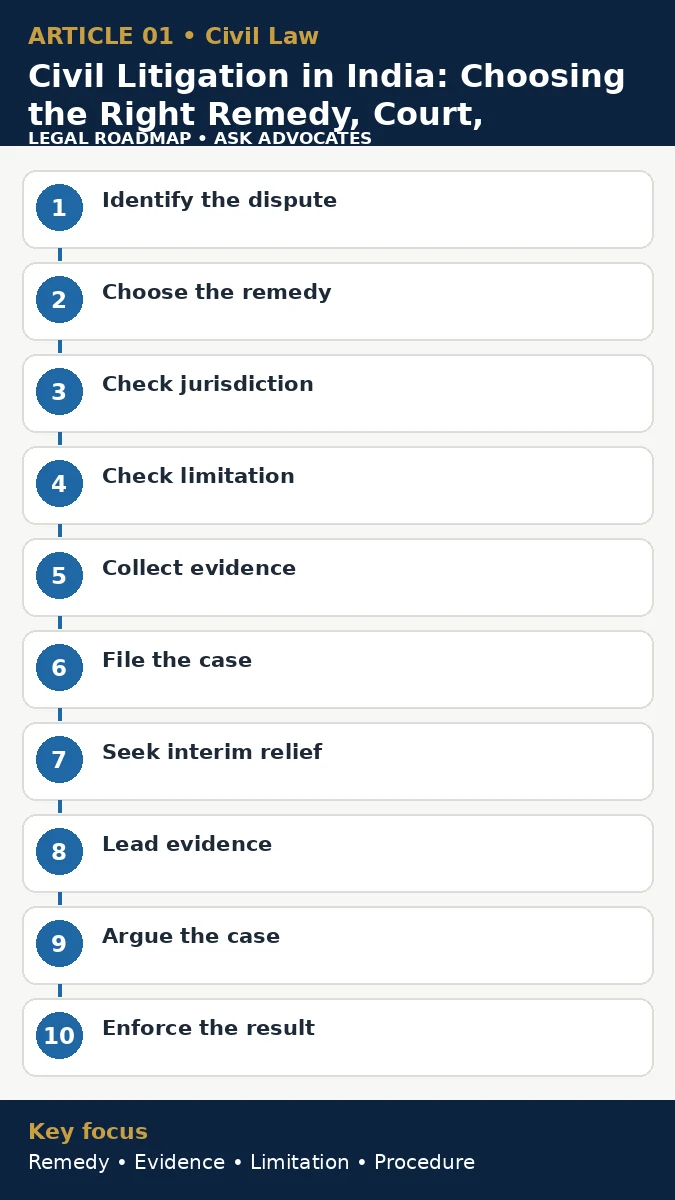
Step 1: Identify the Legal Right
Write down exactly what right has allegedly been violated. Avoid describing the dispute only emotionally.
Identify the legal relationship between the parties.
Step 2: Identify the Cause of Action
Determine the facts that legally give rise to the proceeding. The cause of action should connect the facts to the legal right and requested remedy.
Step 3: Identify the Correct Remedy
Decide whether the matter requires:
- Declaration
- Injunction
- Possession
- Recovery
- Damages
- Specific performance
- Cancellation
- Partition
- Another remedy
Multiple remedies may sometimes be appropriate.
Step 4: Check Jurisdiction
Determine:
- Subject-matter jurisdiction
- Territorial jurisdiction
- Pecuniary jurisdiction
- Statutory jurisdiction
- Contractual dispute-resolution clauses
Step 5: Check Limitation
Calculate limitation from the legally relevant date. Do not rely solely on the date of the latest communication.
Step 6: Preserve Evidence
Collect documents and preserve electronic material. Avoid altering, deleting or selectively editing relevant evidence.
Step 7: Identify Opposing Parties
Identify every person or entity whose presence is legally necessary. Improper joinder or non-joinder can create serious procedural problems.
Step 8: Consider Alternative Resolution
Assess whether negotiation, mediation or arbitration can provide an effective solution.
Litigation should be selected after considering the available legal routes.
Step 9: Prepare the Pleadings
The plaint should clearly state:
- Parties
- Jurisdiction
- Material facts
- Cause of action
- Limitation
- Valuation where applicable
- Court fee
- Reliefs
- Supporting documents
Step 10: Develop a Litigation Strategy
Finally, determine the likely defence and evidence required to answer it.
A civil case should be planned from both sides of the dispute.
What Happens After Filing a Civil Suit?
The procedural sequence depends on the type of proceeding and court.
A typical civil suit may involve:
- Institution of the plaint
- Scrutiny by the registry
- Numbering or registration
- Issue and service of summons
- Appearance by the defendant
- Written statement
- Replication or other pleadings where applicable
- Framing of issues
- Discovery or production of documents where applicable
- Examination of witnesses
- Cross-examination
- Arguments
- Judgment
- Decree
- Execution where necessary
Interlocutory applications can arise at different stages. For example, parties may seek interim injunctions, amendment of pleadings, appointment of commissioners or other procedural relief.
The exact sequence can differ substantially between ordinary civil suits, commercial disputes and proceedings under special legislation.
Common Mistakes in Civil Litigation
Filing Before Identifying the Remedy
A claimant may know that something unlawful occurred but remain unclear about the remedy. The court cannot necessarily grant every form of relief merely because the underlying grievance appears genuine.
Ignoring Limitation
Waiting until documents are collected or negotiations conclude can sometimes create serious limitation problems. Limitation should be analysed immediately.
Choosing the Court Based on Convenience
The nearest court is not necessarily the competent court. Jurisdiction depends on law, not convenience alone.
Relying on Unverified Documents
Documents supplied by a party should be checked against reliable sources wherever possible. This is particularly important in property disputes.
Overloading the Pleading
A plaint should contain legally material facts. Irrelevant allegations can obscure the actual cause of action and create unnecessary disputes.
Ignoring the Defence
A case should not be prepared only from the claimant’s perspective. The likely defence should be identified before filing.
Failing to Preserve Digital Evidence
Electronic material can disappear, become inaccessible or lose evidentiary context. Relevant digital evidence should therefore be preserved early.
Civil Litigation and Alternative Dispute Resolution
Civil disputes do not always require a full trial. Depending on the circumstances, parties may consider:
- Negotiation
- Mediation
- Arbitration
- Lok Adalat mechanisms
- Statutory settlement procedures
- Court-assisted settlement
Arbitration depends on an applicable arbitration agreement and the statutory framework.
Mediation can be useful where the parties want to preserve a continuing commercial, family or business relationship.
The appropriate mechanism depends on the dispute and the enforceability of the proposed settlement.
When Should You Consult a Civil Litigation Lawyer?
Legal advice becomes particularly important when:
- Property ownership is disputed
- A limitation period may be approaching
- A legal notice has been received
- A contract has been breached
- Possession is threatened
- Substantial money is involved
- An injunction is urgently required
- A government authority is involved
- Multiple forums appear possible
- Arbitration is mentioned in a contract
- The opposing party has already filed proceedings
- Important documents are missing
- Electronic evidence is central to the dispute
Early legal assessment can identify problems before they become procedural obstacles.
A lawyer should review the facts, documents, forum, limitation and available remedies before recommending litigation.
Civil Litigation Decision Checklist
| Question | Why it matters |
|---|---|
| What legal right is affected? | Establishes the foundation of the claim |
| What caused the dispute? | Identifies the cause of action |
| What remedy is required? | Determines the litigation objective |
| Which law applies? | Identifies substantive and procedural requirements |
| Which court or forum has jurisdiction? | Prevents filing in the wrong forum |
| Is the claim within limitation? | Protects the right to institute proceedings |
| What documents exist? | Establishes documentary proof |
| What witnesses are available? | Supports disputed factual matters |
| Is urgent interim relief required? | Protects rights before final adjudication |
| Is mediation or arbitration available? | May provide an alternative route |
| Who must be joined? | Prevents procedural defects |
| What defence is likely? | Improves litigation preparation |
Six Questions to Ask Before Filing a Civil Case
Is a Civil Suit Always the Correct Remedy?
No. A special statute may provide another forum or remedy. Arbitration, consumer proceedings, tribunal proceedings or statutory appeals may sometimes be more appropriate.
How Do I Know Which Civil Court Has Jurisdiction?
Jurisdiction depends on the subject matter, territorial connection, pecuniary limits and applicable statutory provisions. The facts must be analysed before filing.
How Is Limitation Calculated?
The applicable limitation period depends on the nature of the claim and governing provision. The relevant starting date and any legally recognised exclusion must also be examined.
What Evidence Is Needed for a Civil Case?
Evidence depends on the claim. Documents, contracts, property records, financial records, communications, witness testimony and electronic evidence may become relevant.
Can I Obtain an Injunction Before the Case Is Finally Decided?
Potentially, if the legal and factual requirements for interim relief are satisfied. The court considers the circumstances and applicable principles before granting such protection.
Should I Send a Legal Notice Before Filing a Civil Suit?
A legal notice can sometimes help clarify the dispute or support settlement. However, its necessity depends on the applicable law, contract and nature of the proceeding.
How to Assess a Civil Dispute Before Filing
- Identify the right: Determine the legal right affected by the dispute.
- Record the facts: Prepare a chronological factual history.
- Collect documents: Preserve contracts, notices, records and electronic evidence.
- Select the remedy: Identify the relief that can legally solve the problem.
- Check jurisdiction: Determine the correct court, tribunal or statutory forum.
- Check limitation: Calculate the applicable statutory limitation period.
- Assess urgency: Determine whether interim protection is required.
- Evaluate settlement: Consider negotiation, mediation or arbitration where appropriate.
- Prepare pleadings: Draft material facts, legal grounds and reliefs accurately.
- Plan the defence: Anticipate the principal arguments and evidence of the opposing party.
Conclusion
Civil litigation in India should begin with legal analysis rather than immediate filing. The strength of a civil case depends on the relationship between the legal right, cause of action, remedy, jurisdiction, limitation and evidence.
A claimant may possess a genuine grievance but still face difficulty if the wrong remedy or forum is selected. Similarly, strong documents cannot always cure a limitation problem or jurisdictional defect.
Therefore, parties should assess the complete dispute before commencing proceedings. The appropriate strategy may involve a civil suit, interim injunction, statutory proceeding, arbitration, mediation or another remedy.
Early review by a civil litigation lawyer can help identify the legally appropriate route, preserve evidence and reduce avoidable procedural risks.
Legal Information Disclaimer
This article provides general legal information concerning civil litigation in India. The appropriate remedy, forum, limitation period and procedure depend on the facts, applicable statute and jurisdiction.
Readers should obtain case-specific legal advice before commencing or defending proceedings.
Suggested Internal Links
- Civil Litigation Attorneys — View Civil Litigation Attorneys
- Before You File a Case: Questions an Advocate Should Ask — Read Before You File a Case
- Property Legal Verification — View Property Legal Verification
- Property Title Verification — View Property Title Verification
- Legal Support — View Legal Support
- Empowering Citizens Through Constitutional Law: Advocacy, Equality, Fairness
Estimated reading time: 15 minutes